The short answer
1. The EdTech enquiry reality
EdTech enquiry patterns differ from degree-college admissions in three important ways.
The volume is spikier
CAT coaching enquiries peak in October and November around registration deadlines and mock test cycles. GATE enquiries peak in September-October and again after results. UPSC enquiries follow the annual notification cycle. Online learning platforms running paid acquisition see spikes tied to campaign launches, exam seasons, and term starts.
The buyer research cycle is shorter
A student considering a CAT coaching batch does not deliberate for months the way a prospective MBA student does. They compare three or four options, attend one or two trial classes, and decide within a week or two. The window to engage is narrow.
The qualification question is different
Not "which program is right for my career" but "which course is right for my goal, in my time budget, at my current preparation level." A student asking about CAT 2027 prep has a specific exam, a fixed date, and a known gap between where they are and where they need to be. The chatbot has to ask about that gap, not about long-term career plans.
For a mid-sized Indian coaching institute preparing CAT or GATE batches, that typically looks like 400 to 800 enquiries a week during peak season, with 70 percent arriving outside business hours. For an online learning platform running paid acquisition on YouTube, Instagram, and Google, that is 1,500 to 3,000 enquiries a month across campaigns, with batch-wise pressure to convert within 7 to 10 days.
Three places leak
Repeat questions about course content, batch timings, and fee structures drain enrollment-team time.
Trial-class bookings get lost in follow-up email threads and never actually happen.
Undecided students drift to competitors with faster response and clearer trial-class flows.
2. What an AI chatbot does for EdTech
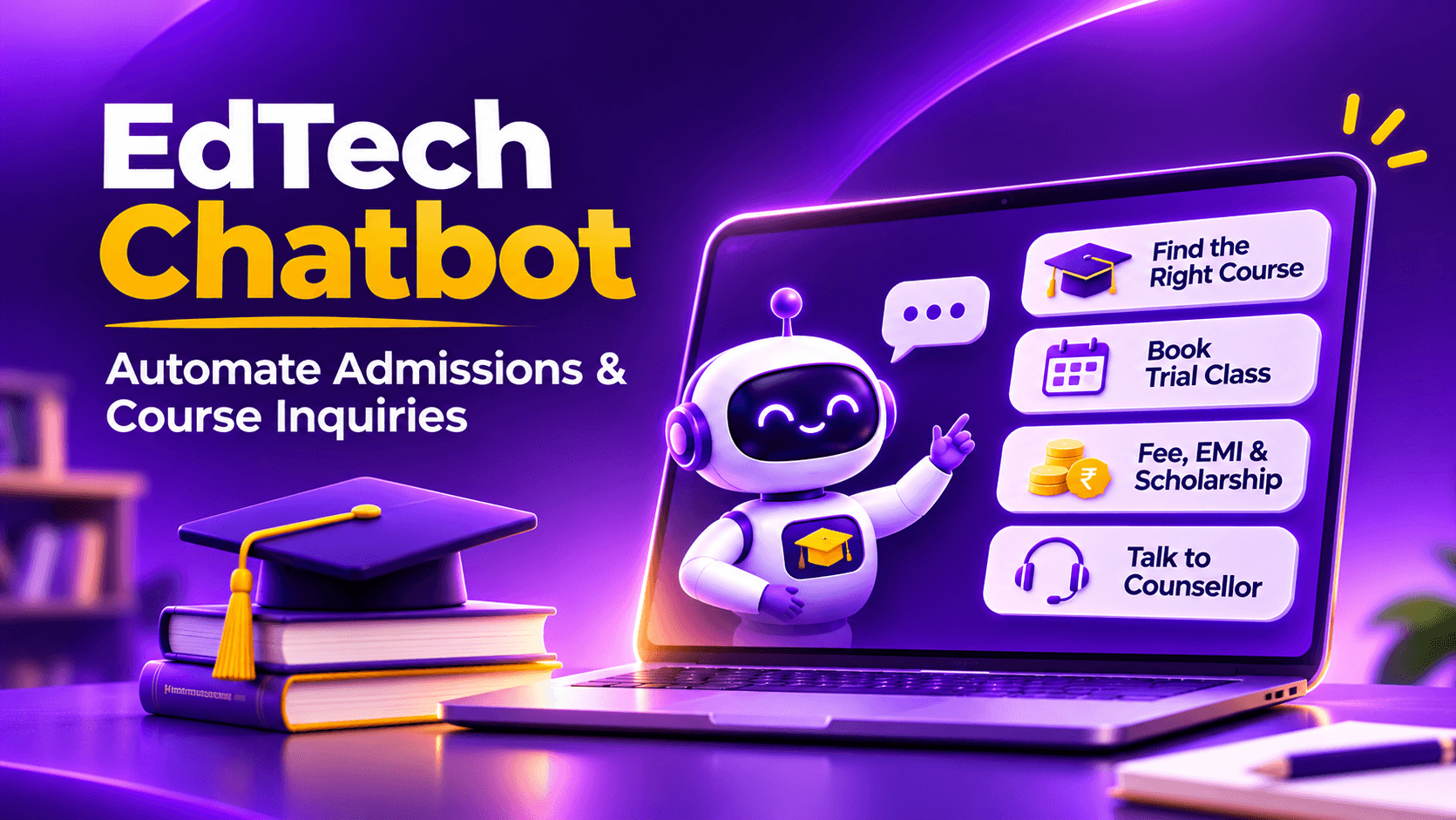
Four jobs, each tied to a specific point in the student decision window. The same pattern underpins our AI sales chatbot, adapted here for course-based education.
Course-fit qualification
The chatbot asks the student their exam (CAT 2027, GATE 2027, UPSC 2026 Prelims, NEET 2027), current preparation stage (just started, mid-way, revision phase), and available study hours per week. Against the institute's course catalogue, it maps the answers to the right offering: full course, crash course, test series, or weekend batch for working professionals.
"Based on where you are in your preparation and the time you have, our 6-month weekend batch starting 15 January fits you best. Would you like to see the schedule?"
Trial-class booking
For most EdTech products, the trial class is the primary conversion step. The chatbot shows available trial slots across upcoming days, asks the student's preference (weekday evening, weekend morning), books directly against the calendar, and sends SMS or email reminders. No "we will get back to you with the schedule" delay.
Fee, EMI, and scholarship explanation
Students, and often their parents, want to know the fee upfront. The chatbot shows the fee structure for the matched course, calculates any applicable scholarships (merit, early-bird, referral), and explains the EMI options.
"The full course fee is Rs 55,000. Based on your 12th percentage, you qualify for the merit scholarship of Rs 8,000. Net fee: Rs 47,000. EMI available at Rs 7,900 for 6 months through our partner banks."
Multi-touch follow-up through the decision window
An EdTech decision happens over a week or two, not a day. The chatbot runs a Day 1, Day 3, Day 7 follow-up sequence in the student's language. Day 1: trial-class reminder. Day 3: alumni outcomes and placement data for the course. Day 7: last-call before the batch starts, with any final offers.
3. The EdTech conversion economics
Take a CAT coaching institute running paid acquisition during peak season.
| Measure | Before the chatbot | After the chatbot |
|---|---|---|
| Monthly paid acquisition spend | Rs 3,00,000 | Rs 3,00,000 (same) |
| Monthly enquiries | 2,000 (peak season average) | 2,000 (same) |
| Trial-class conversion rate | 15 percent = 300 trial bookings | 28 percent = 560 trial bookings |
| Enrollment conversion from trial | 25 percent = 75 enrollments | 32 percent = 179 enrollments |
| Cost per enrollment | Rs 4,000 | Rs 1,676 |
Why the numbers move
Trial bookings rise because the chatbot books directly against the calendar, so enquiries actually become bookings. Enrollment from trial rises because students arrive at the trial class already qualified, so the trial itself converts better.
The chatbot moves cost per enrollment from Rs 4,000 to Rs 1,676, on the same ad spend. More importantly, enrollment volume more than doubles. The enrollment team is not working the same leads at a lower unit cost; they have substantially more students to work with.
Actual figures vary by exam, batch size, and the strength of the trial-class content itself. The direction is consistent.
4. A day in the life of an EdTech chatbot
Three real-world scenarios show the pattern.
Scenario 1: CAT aspirant browsing at 10 PM on a weekday
A student finishes their college day and starts browsing coaching options for CAT 2027 at 10 PM. The chatbot greets, asks about their current preparation stage ("just starting"), their 12th percentage (82), and their available study hours per week (15 to 20). It matches them to the full-course 12-month batch starting January, shows the fee with the merit scholarship applied, books a trial class for Saturday 10 AM, and confirms via SMS. The enrollment team opens the lead Monday morning to a student who has already attended a trial class.
Scenario 2: Working professional comparing weekend batches
A software engineer in Bengaluru wants to prepare for GATE 2027 while working. The chatbot asks about their current role, their target branch (CS), and their available study time (10 to 15 hours per week, mostly weekends). It matches them to the weekend-only 10-month batch starting November and the online test series.
"Our weekend batch runs Saturday-Sunday 7 to 10 PM. We also offer the online test series for mock practice. Together the package is Rs 42,000 with the early-bird 10 percent off." The student books a trial Saturday class.
Scenario 3: Parent asking on behalf of a NEET aspirant
A parent lands on a NEET coaching page and starts the conversation. The chatbot picks up the parent's framing (asking about their child), handles the language switch (parent typing in Hindi), captures the student's current class (12th appearing), target NEET year (2027), and preferred batch (classroom in Pune). It books a counselling session where both parent and student can attend. The enrollment counsellor sees the full context on Monday with the Hindi preference flagged.
5. Setting up an EdTech chatbot: five things to configure
1. Course catalogue with prerequisites
Every course, with its target exam, duration, mode (classroom or online), batch start dates, prerequisites, and current availability. The chatbot uses this to match students to courses.
2. Trial-class slots and booking rules
Available trial slots, maximum bookings per slot, buffer time before a class, and cancellation policy. The chatbot books directly against this calendar.
3. Scholarship and discount rules
Merit-based scholarships (by 12th percentage, by mock test score), early-bird discounts, referral discounts, and any promotional offers. The chatbot auto-calculates applicable discounts.
4. Fee, EMI, and payment plan configuration
Base fees per course, EMI options (3, 6, 12 months) through partner banks, and any payment plan structures. The chatbot presents fees with discounts applied.
5. CRM and follow-up sequence configuration
Which CRM leads land in, what fields are populated, and what the Day 1, Day 3, Day 7 follow-up sequence contains in each supported language.
For MagicFlow AI, the team configures all five during the managed 48-hour launch so the EdTech team does not run an internal integration project. For the software side of education, see our guide to the B2B SaaS chatbot, and for the full vertical overview, the AI chatbot for education page.
6. Multi-language enquiries
Tier-2 and tier-3 EdTech enquiries often arrive in regional languages, especially when a parent is involved. The chatbot auto-detects the student's or parent's language and responds in Hindi, English, and all major regional Indian languages. For more on why this matters, read our guide to multi-language chatbots in India.
7. What to do next
If your Indian EdTech business is seeing peak-season enquiry spikes you cannot answer in time, trial-class bookings that fall through, or batch-conversion cost per enrollment that is climbing, an AI chatbot can take the first conversation and get the student into a trial class.
Start a 30-day free trial of MagicFlow AI and connect it to your course pages. The managed 48-hour launch loads your course catalogue, configures the trial-class booking against your calendar, sets up the fee and scholarship rules, and wires up the follow-up sequence in the languages your students arrive in. Prefer to talk it through first? Talk to an expert.
Common questions from this article.

Founder, MagicFlow AI | MagicWorks IT Solutions Pvt. Ltd.
Swapnil has been building AI-first digital marketing products and running MagicWorks IT Solutions Pvt. Ltd. since 2012. MagicFlow AI is his latest venture: an intelligent conversational AI platform designed for businesses and agencies that need more than a chatbot and less than a full autonomous agent stack.