The language decision that decides your conversion rate
For Indian SMEs, the decision to offer or not offer conversations in Hindi and regional languages is not a feature choice. It is a conversion choice.
Consider a distance-education prospect in Nagpur exploring an MBA programme. She lands on your website from a Meta ad. Her English is functional, but her comfort language is Marathi, and her instinct is to type her question in Hindi. If the chatbot replies in English, she has to translate her thoughts twice, once to phrase the question and again to understand the answer. Every translation is friction. Every friction step is a chance for her to leave.
Now consider the same prospect meeting a Hindi-speaking chatbot. Her question flows out in Hindi. The answer comes back in Hindi. She stays in the conversation. She books the counselling call.
That is the conversion difference language makes. It is not marginal. For Indian SMEs whose paid traffic increasingly comes from tier-2 and tier-3 cities, it is often the single biggest lever on lead capture.
What 'supports Hindi' actually needs to mean
Many chatbot platforms claim Hindi support. Very few deliver it usefully. Before selecting a platform, check what 'supports Hindi' actually means in practice.
Genuine Hindi support means five things working together.
| Requirement | What it means in practice |
|---|---|
| Auto-detection | The chatbot recognises when a visitor types in Hindi, whether in Devanagari script or Roman transliteration, and switches without being asked. |
| Fluent response | The reply is not a machine-translated English sentence with awkward syntax. It reads like something a Hindi-speaking colleague would write. |
| Consistency across the conversation | If the visitor asks a question in Hindi, the chatbot does not revert to English on the next reply. |
| Handles code-switching | Indian conversations often mix Hindi and English within a single sentence. The chatbot should follow the flow, not force a language choice. |
| Correct capture in the right script | When the visitor's name or company is in Devanagari or Roman Hindi, the CRM receives it exactly as typed, not garbled or auto-translated. |
Regional Indian languages: what a serious chatbot handles
Hindi is the starting point. It is not the whole map.
Indian SME websites often draw traffic from multiple language regions at once. A construction training institute in Pune sees enquiries in Marathi and Hindi. A tuition centre in Bengaluru gets Kannada and English. A wellness clinic in Kochi handles Malayalam and English. A saree exporter in Surat receives Gujarati alongside Hindi.
The scale of this is not marginal. Indian language internet users overtook English users several years ago and now form the clear majority of India's online population. Google's own research indicates that around nine in ten new internet users in India come online in an Indian language, not in English. For SMEs serving these audiences, an English-only chatbot is not a small language gap. It is a majority-audience gap.
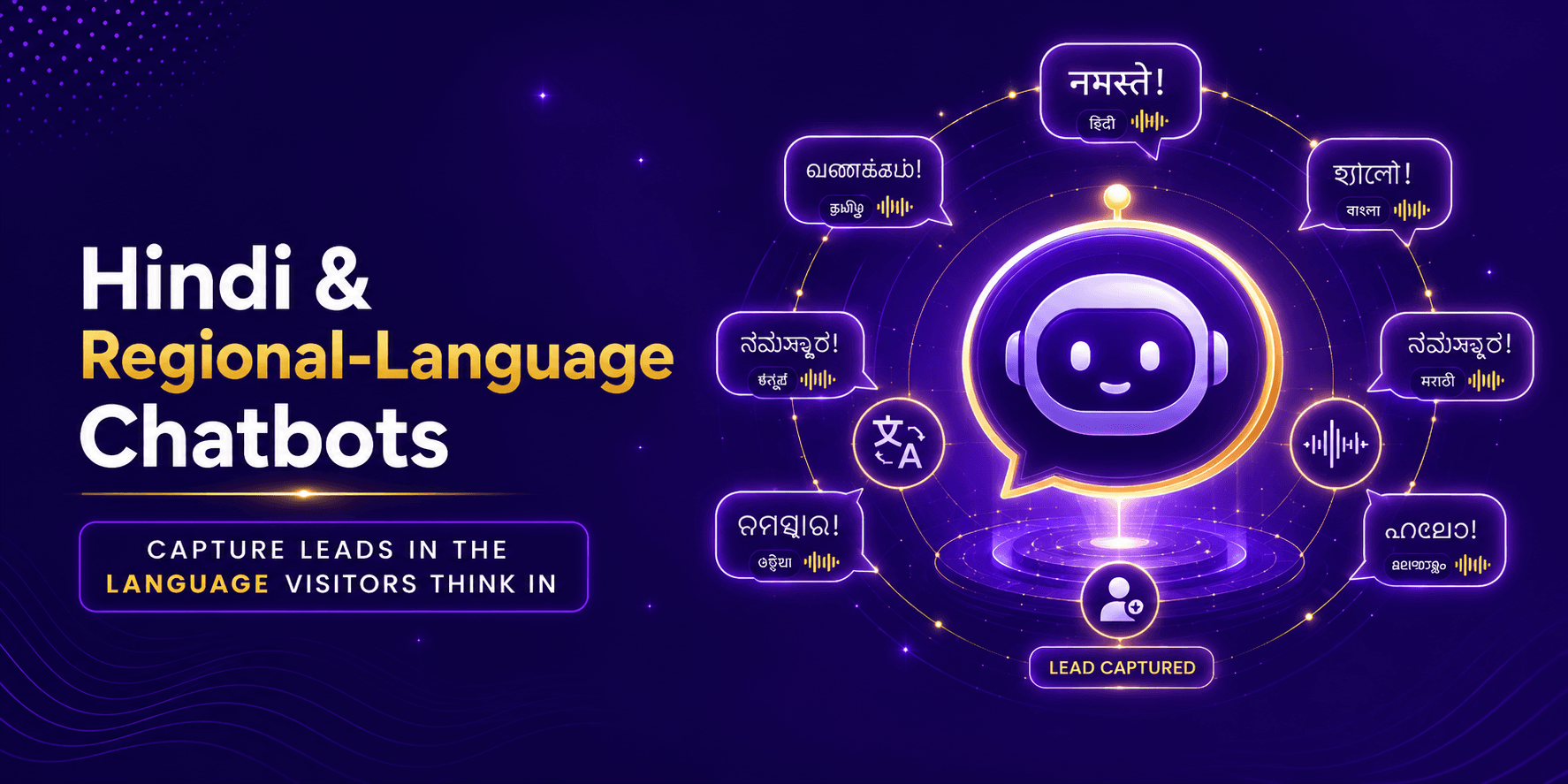
A chatbot for India should handle all major regional Indian languages, including Marathi, Tamil, Telugu, Bengali, Gujarati, Punjabi, Kannada and Malayalam, alongside Hindi and English. The visitor should never see a language wall. The chatbot detects, adapts, and responds in whichever language the conversation opens in.
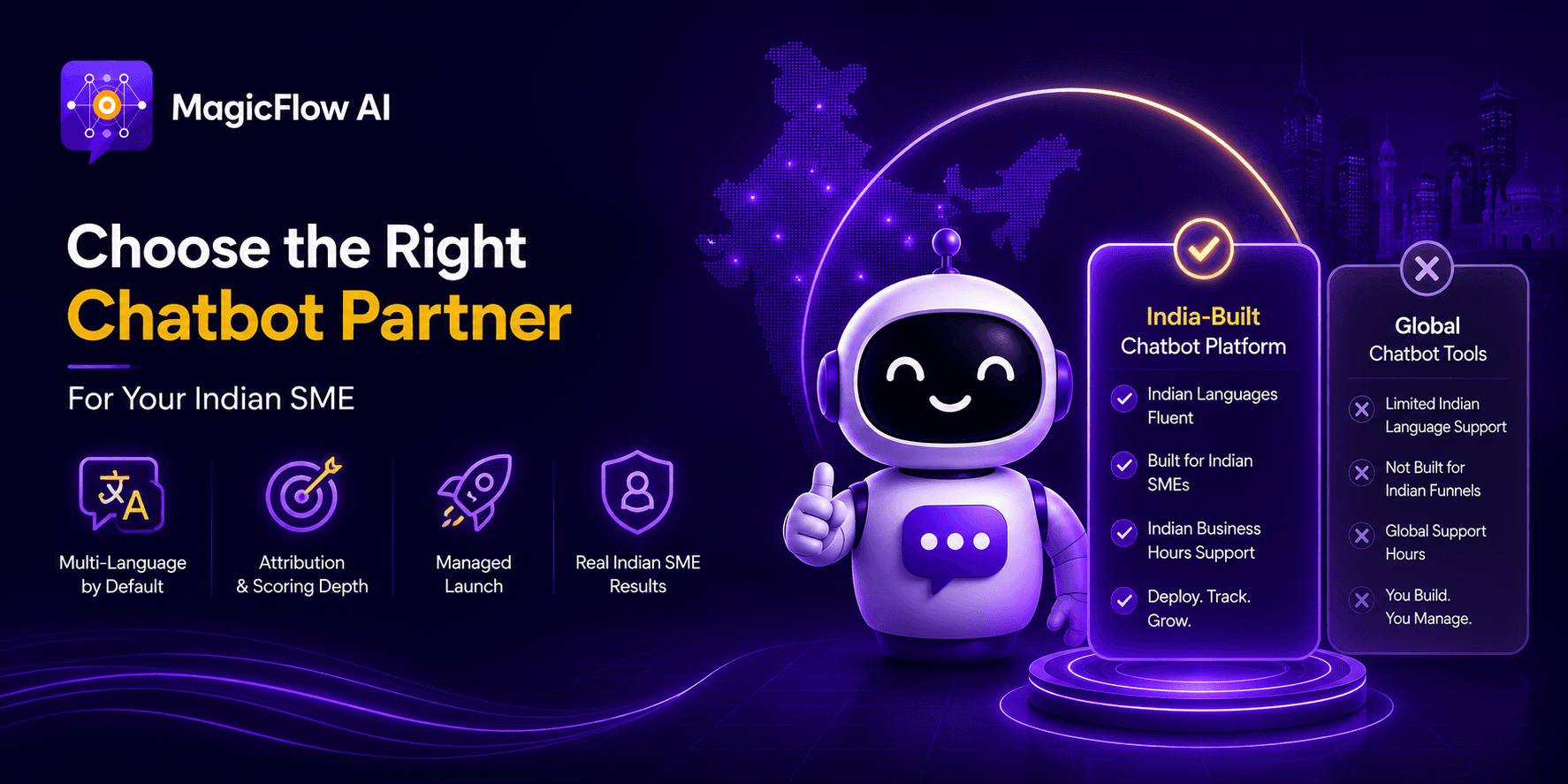
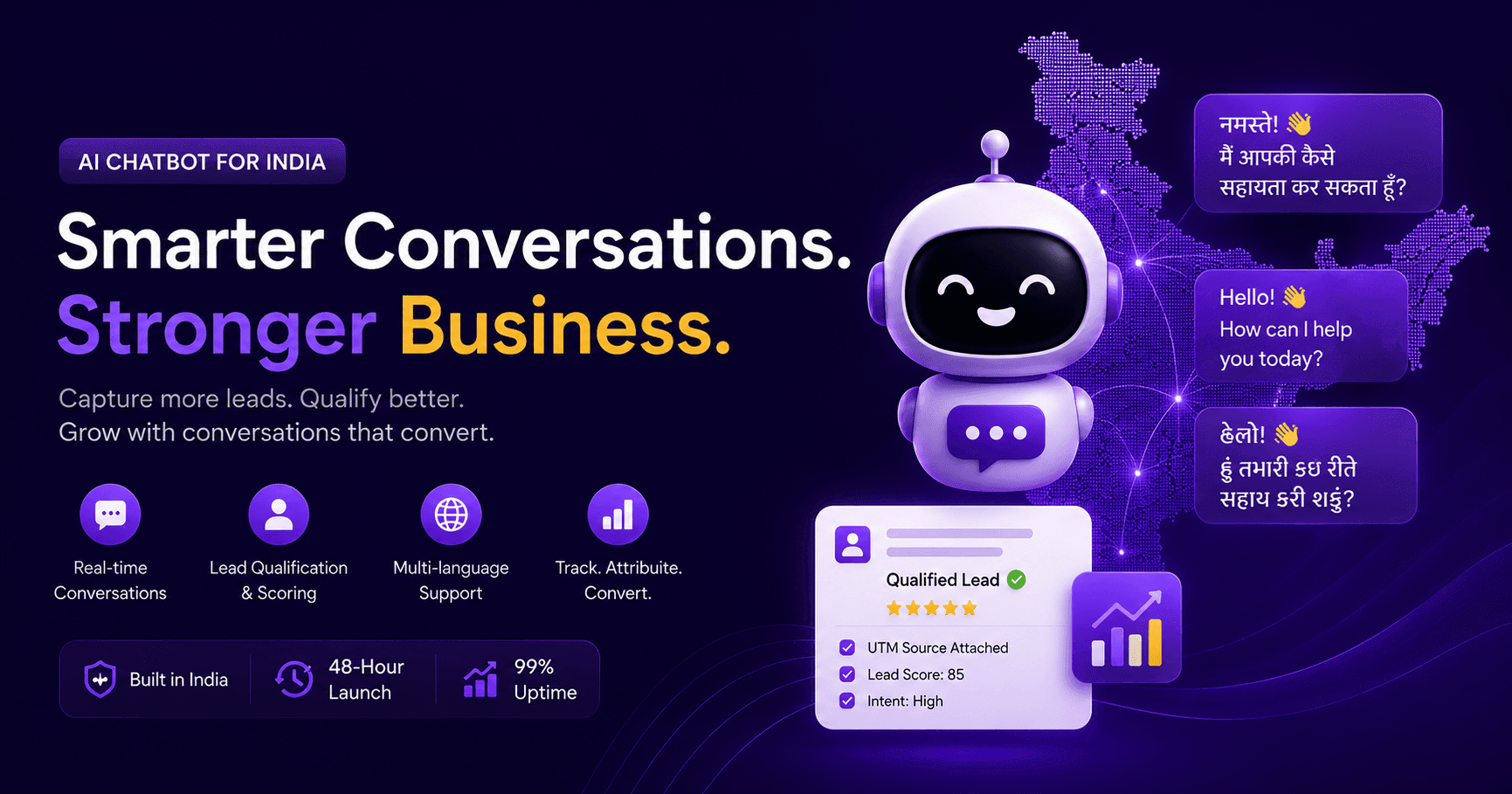
MagicFlow AI is built for exactly this. Multi-language conversation is the default posture across every plan, not a paid upgrade.
Why English-only chatbots leak leads in India
English-only chatbots on Indian SME websites lose leads in patterns that are easy to see once you look for them.
The bounce-and-abandon pattern
A visitor starts typing in Hindi. The chatbot replies in English. The visitor closes the widget within two exchanges. In the analytics this reads as a low-engagement session. In reality it was a language mismatch.
The half-completed conversation pattern
The visitor pushes through in broken English, gets confused by a nuanced answer, and leaves without giving contact details. The intent was there. The language barrier ate it.
The wrong-audience-capture pattern
English-only chatbots over-index on English-comfortable metro leads and under-capture the tier-2 and tier-3 city traffic that Indian SMEs increasingly depend on. That skews the pipeline in ways the sales team eventually notices, usually as unexpected regional gaps in the lead mix.
None of these show up as errors in a dashboard. They show up as leads that never happened.
What good multi-language conversation looks like
Good multi-language conversation in a chatbot is not translation. It is fluent, contextual conversation across languages, with three qualities working together.
| Quality | What it looks like |
|---|---|
| Instant language switch | The chatbot detects the visitor's language from their first message and matches it. No dropdown to select. No 'please choose your language' prompt. |
| Preserved context | The conversation state, meaning what has been asked and what has been captured, stays intact even if the visitor switches language mid-conversation. |
| Consistent brand tone | A brand that speaks warmly in English should sound equally warm in Hindi, not stiff or overly formal because the language changed. |
Under the hood: how language detection actually works
The result is a widget that feels native to any Indian visitor, regardless of which region they are typing from.
The chatbot identifies language from the visitor's first message using natural language processing, not from an IP guess or a browser locale. When someone types 'namaste, mera naam Rahul hai', the model recognises Hindi in Roman script, retains that context for the rest of the conversation, and responds in Hindi. If the next message switches to English, the model follows without losing the state built up so far. If the visitor mixes Hindi and English within one sentence, which is common in Indian conversations, the model reads both and replies in whichever language reads naturally for the response. No 'please select your language' prompt ever appears.
How to evaluate multi-language capability in a chatbot
When comparing platforms, test the language capability directly rather than trusting the sales sheet. Five practical checks.
| Check | What to look for |
|---|---|
| Start a conversation in Hindi | Does the chatbot respond in fluent Hindi, or in translated English? |
| Switch mid-conversation | Ask the next question in English. Does the chatbot follow smoothly? |
| Try a regional language | Send a message in Marathi, Tamil, Bengali or Gujarati. Does the chatbot handle it, or fall back to English? |
| Check the CRM output | After the test, look at how the lead arrived in the CRM. Is the Hindi text preserved correctly? Is the language of the conversation stamped on the record? |
| Ask about the language commitment | A serious platform will describe multi-language coverage clearly without asking you to buy a language add-on module. |
What Indian SMEs with multi-language traffic are seeing
Indian SME customers using MagicFlow AI's multi-language capability report the same shape of outcome: conversations that would have ended silently in an English-only widget instead become qualified leads. Two examples from the customer base.
| Customer | Outcome |
|---|---|
| Dnyanal Educon | Operates across 14 locations in Maharashtra with a mix of Marathi, Hindi and English speakers. Multi-language capture is part of the reason they achieved 34 percent faster appointment qualification across those locations. |
| Distance MBA College | Draws prospects from across India, most of whom are more comfortable in Hindi than in English. Multi-language conversation contributed to 41 percent more qualified counselling calls in the first 30 days, at zero additional ad spend. |
For Indian SMEs, the language layer is not an add-on to the chatbot decision. It is a large part of the decision.
What to do next
If your Indian SME website draws traffic from more than one language region, an English-only chatbot is quietly losing you leads every day. The fastest way to see the difference is to run a chatbot that handles Hindi and regional Indian languages against the same traffic, and compare the qualified lead count after 30 days.
Common questions from this article.

Founder, MagicFlow AI | MagicWorks IT Solutions Pvt. Ltd.
Swapnil has been building AI-first digital marketing products and running MagicWorks IT Solutions Pvt. Ltd. since 2012. MagicFlow AI is his latest venture: an intelligent conversational AI platform designed for businesses and agencies that need more than a chatbot and less than a full autonomous agent stack.