1. The admissions enquiry problem Indian colleges face
Peak admissions season for an Indian college runs June through August. During those three months, a mid-sized institution can receive between 300 and 800 admissions enquiries. In off-season, that drops to 50 to 100 per month.
Every enquiry needs three to five touches before it becomes an application: an eligibility check, program details, fee explanation, scholarship information, and application follow-up.
The catch: most enquiries do not arrive during office hours. Roughly 60 percent of admissions enquiries land on weekends, in the evening, or on days when the admissions team is offline. A student researching your college on a Sunday afternoon has already applied to three competitors by Monday morning if you have not responded.
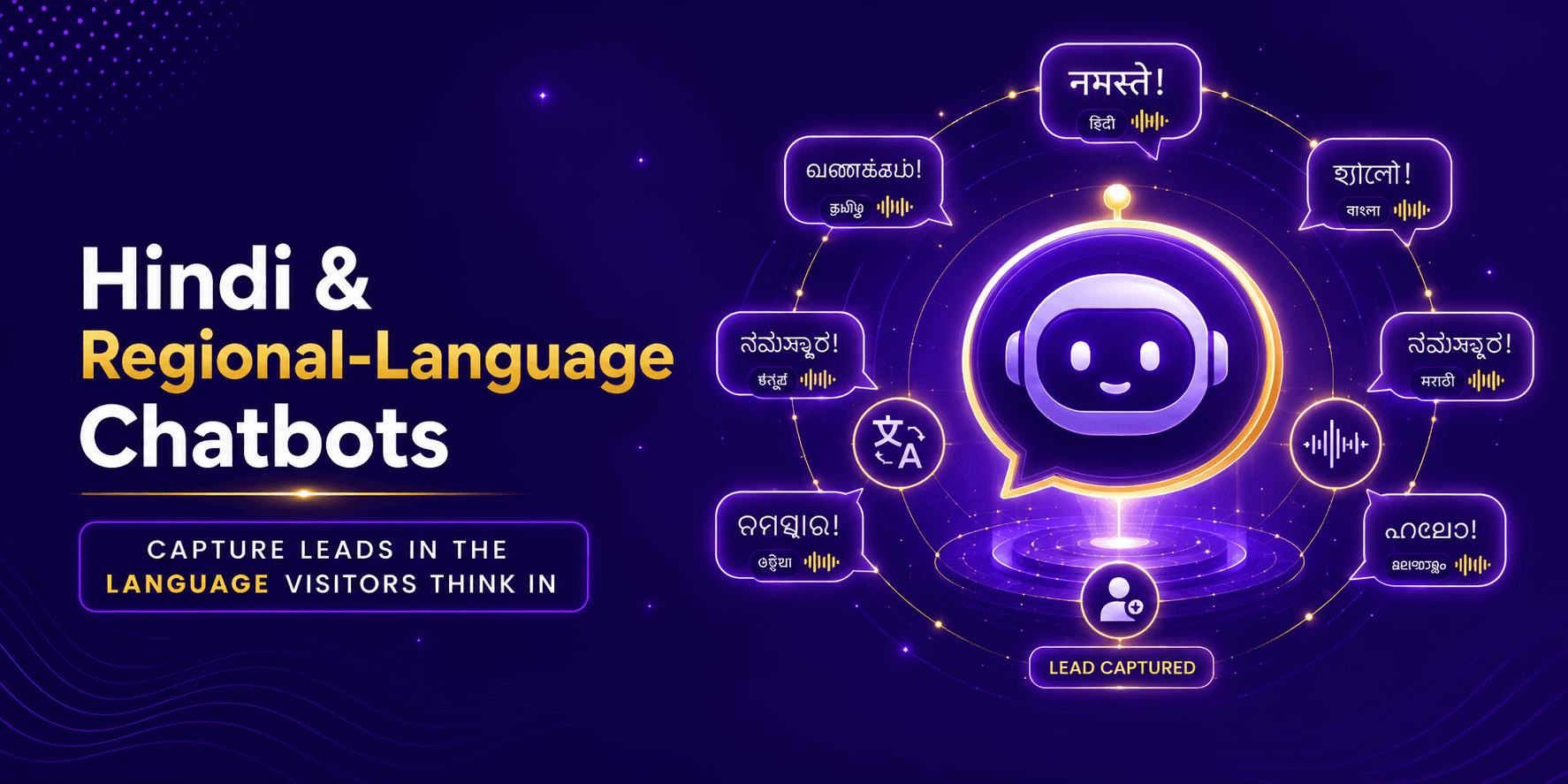
The other side of the problem is language. Indian college prospects, especially in tier-2 and tier-3 cities, often think and enquire in Hindi or a regional language. An English-only form silently filters out a majority-audience segment before your counselling team even sees the enquiry. For a deeper look, see our piece on multi-language admissions capture.
Add to this the fact that admissions teams spend most of their time answering the same handful of questions ('What is the fee?', 'Am I eligible?', 'Is there a scholarship?'), and the pattern becomes clear: a lot of qualified interest is lost between the enquiry moment and the counselling call.
2. What an AI chatbot for admissions actually does
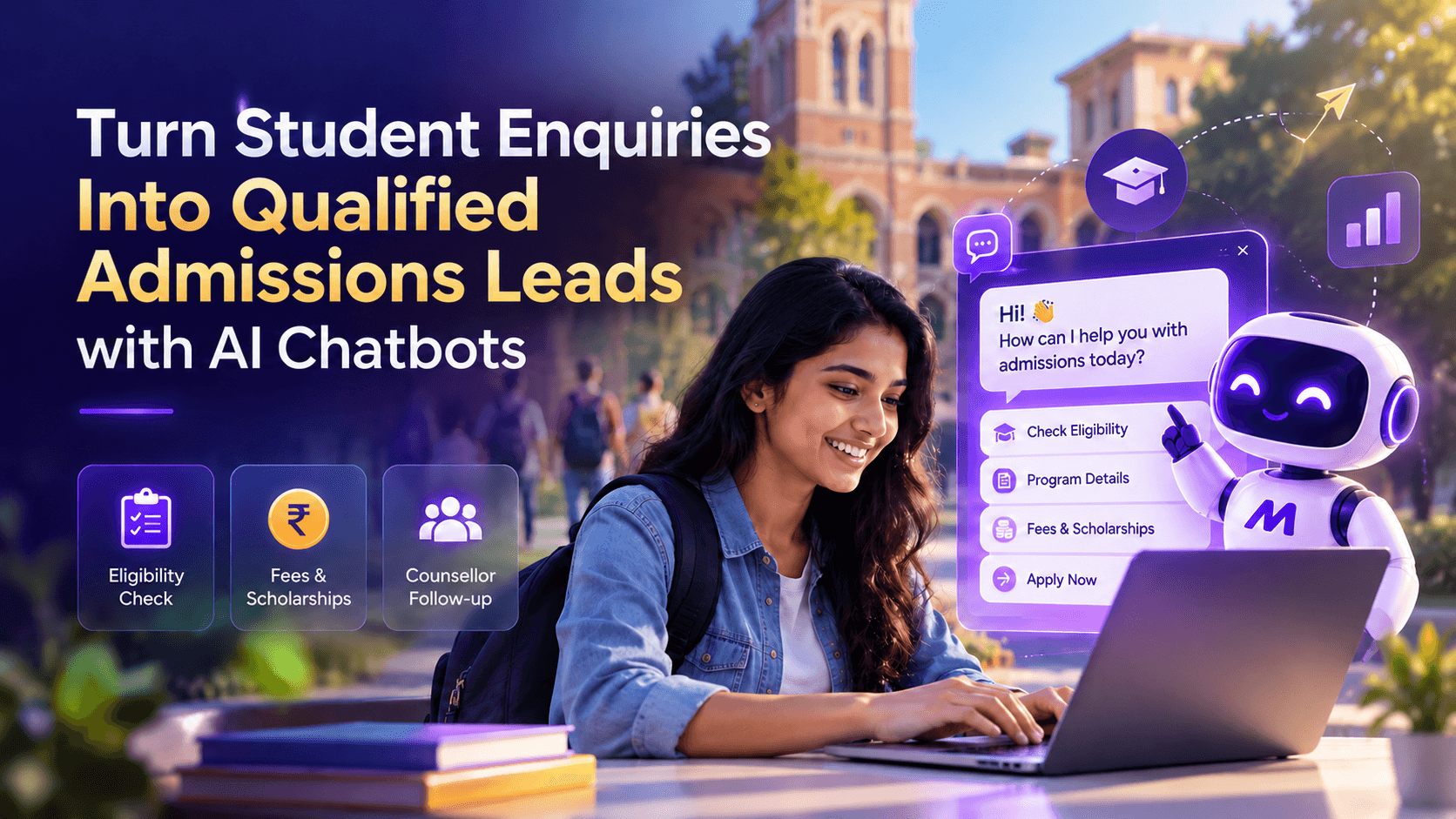
An AI chatbot on your admissions website changes the pattern by handling the first conversation for every visitor, at any time of day, in any language they open the conversation in. For most Indian colleges, the chatbot handles four types of work.
Eligibility qualification
The chatbot asks the questions your counsellors would ask on a first call: 10th percentage, 12th percentage, entrance exam scores, field of interest. Against the rules you set, it tells the student instantly which programs they qualify for.
Fee and financing explanation
Many students never ask about fees because they are unsure. A well-configured chatbot volunteers fee information along with financing options: EMI availability, payment timelines, scholarship thresholds.
Scholarship automation
'Your 12th percentage of 78 qualifies you for the merit scholarship of Rs 50,000 annually. Would you like to apply?' No admissions staff time required. No delay.
Follow-up sequences
After the first conversation, the chatbot sends automated touchpoints: Day 1 eligibility summary, Day 3 scholarship reminder, Day 7 application deadline nudge.
For enquiries that need judgment or negotiation, such as career counselling, family financial situation, or non-standard eligibility profiles, the chatbot routes to a human counsellor with the full conversation context attached.
3. The enrollment math
The clearest way to see chatbot value on an admissions website is to compare cost per qualified counselling call before and after. Take a mid-sized Indian college running admissions campaigns in peak season.
| Before the chatbot | After the chatbot goes live | |
|---|---|---|
| Monthly admissions campaign spend | Rs 2,00,000 | Rs 2,00,000 (same) |
| Traffic | 400 enquiries per month | Same traffic |
| Contact capture | Form conversion 55 percent = 220 leads | Conversation completion 70 percent = 280 conversations with contact details |
| Qualified for counselling call | 45 percent = 99 leads | 60 percent = 168 leads |
| Cost per qualified counselling call | Rs 2,020 | Rs 1,190 |
Same budget, same team, more qualified calls
The chatbot has moved the cost per qualified counselling call down by around 40 percent, on the same budget and the same team. The admissions team has not grown. The ad spend has not grown. The chatbot captured more of the traffic that was already arriving.
Actual numbers vary by institution, program mix, and traffic quality. The direction is consistent across the Indian college customers who have measured it.
4. A day in the life of an Indian admissions chatbot
To make the workflow concrete, here is what happens in three real-world scenarios.
Scenario 1: Sunday evening enquiry
A student browses a college website at 8 PM on a Sunday and starts typing in Hindi. The chatbot greets in Hindi, asks about program interest, checks eligibility against 12th percentage, shows two matching programs, and sends fee structure and scholarship options. The student books a counselling call for Wednesday. Contact captured, lead scored, waiting in the CRM when the admissions team logs in Monday morning.
Scenario 2: Repeat question at scale
Over a single admissions week, 240 students ask 'What is the fee for the MBA program?' The chatbot answers all 240 instantly with the fee structure and financing options. The admissions team spends zero minutes on this question and focuses instead on the students who wanted a conversation about program fit.
Scenario 3: Complex counselling need
A student asks about a career change from engineering to management, with questions about work experience credit and specialisation choice. The chatbot recognises this as a counselling case, captures context, and routes to a senior counsellor with a note: 'Career transition enquiry, wants to discuss specialisation options.'
5. What Indian colleges are actually seeing
Two Indian education customers of MagicFlow AI have reported measured outcomes after going live.
Both institutions describe the same underlying shift: less time spent on repeat questions, more time spent on students ready to convert.
Distance MBA College
Distance MBA College, a distance education institution serving prospects across India, added multi-language capture and automated eligibility responses to their admissions website. They reported 41% more qualified counselling calls in the first 30 days, at zero additional ad spend. The primary mechanism was capturing Hindi-first and regional-language prospects who were previously bouncing off an English-only form.
Dnyanal Educon Pvt. Ltd.
Dnyanal Educon Pvt. Ltd., operating across 14 locations in Maharashtra with a Marathi and Hindi prospect mix, achieved 34% faster appointment qualification across all locations. The chatbot handled the initial qualification conversation so counsellors received leads with intent, timeline, and program interest already captured.
6. Setting up an admissions chatbot: the four things to configure
Before your admissions chatbot goes live, four things need to be documented and loaded into the platform.
1. Program list and eligibility rules
Every program you offer, with its eligibility criteria. For example: 'MBA program requires 50 percent or above in graduation, valid CAT, MAT or CMAT score, and English proficiency.'
2. Scholarship rules and thresholds
For each scholarship you offer, the qualifying criteria and the value. The chatbot uses these to auto-calculate scholarship eligibility.
3. Follow-up sequence content
What message goes out at Day 1, Day 3, Day 7 after the first conversation. The chatbot handles the timing.
4. CRM handoff configuration
Which CRM to send qualified leads to (HubSpot, Salesforce, Zoho), which fields to populate, which lead score threshold triggers an alert.
For MagicFlow AI, the team configures all four during the managed 48-hour launch so the college's admissions team does not need to run an internal implementation project.
7. What to do next
If you run admissions campaigns for an Indian college and you want to see what an AI chatbot would change about your cost per qualified counselling call, start with a free trial and connect it to your admissions website.
For the deeper context on how MagicFlow AI is configured for education institutions, see the AI Chatbot for Education page.
Common questions from this article.

Founder, MagicFlow AI | MagicWorks IT Solutions Pvt. Ltd.
Swapnil has been building AI-first digital marketing products and running MagicWorks IT Solutions Pvt. Ltd. since 2012. MagicFlow AI is his latest venture: an intelligent conversational AI platform designed for businesses and agencies that need more than a chatbot and less than a full autonomous agent stack.