The Indian SME chatbot landscape today
The Indian chatbot market has three broad categories of providers, and each solves a different problem well.
Global chatbot tools
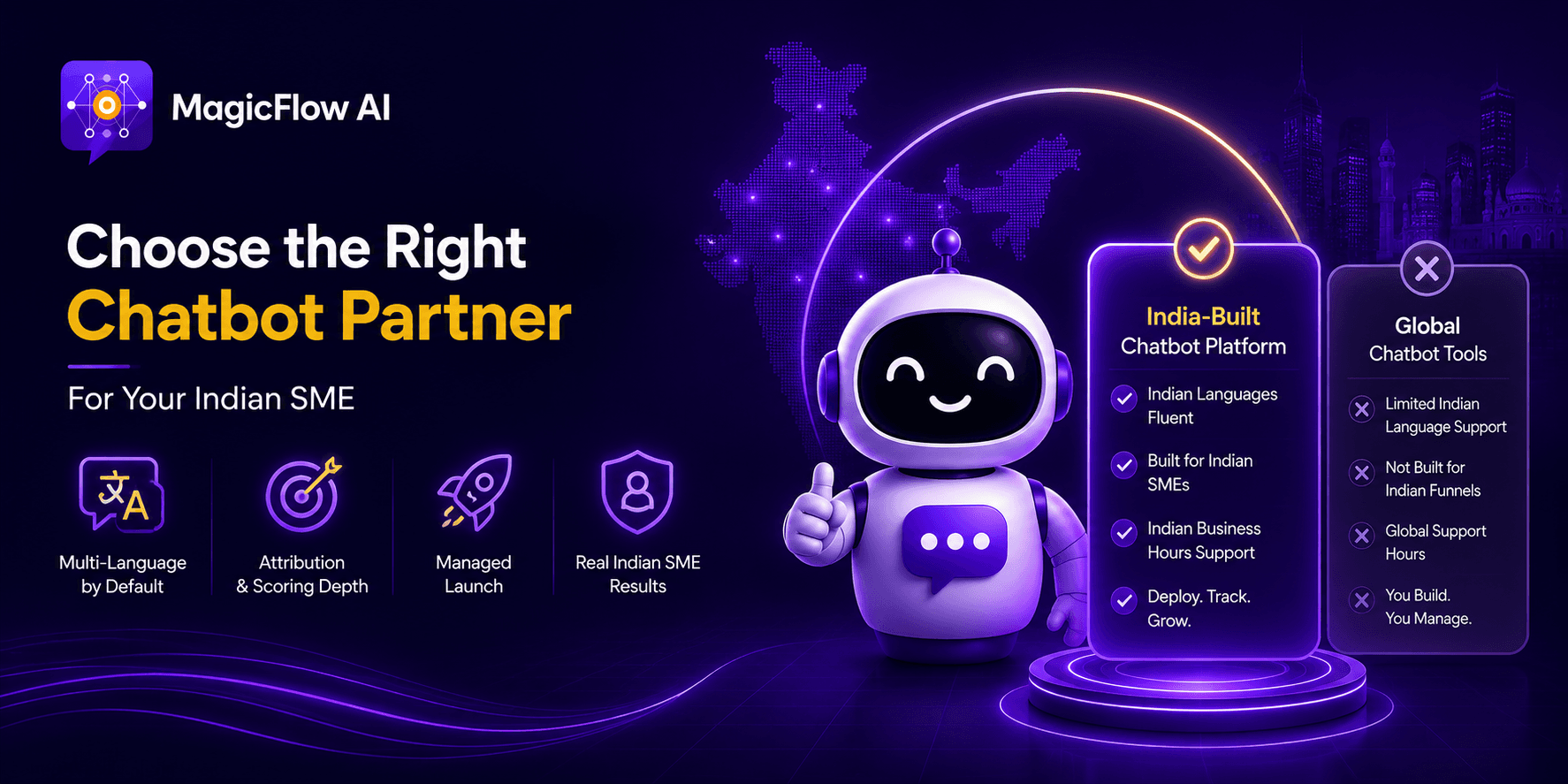
These are platforms built primarily for US and European markets that have added India as an expansion market. They usually cover feature breadth well, integrate with a wide range of global tools, and carry familiar brand names. What they often miss is India-specific fit: fluent Hindi and regional language support, understanding of Indian SME sales patterns, and support in Indian business hours.
India-built chatbot tools
These are platforms built in India, for Indian SMEs, with an understanding of the local funnel. They tend to be strong on multi-language, on attribution for paid Indian traffic, and on managed deployment for SMEs without an internal implementation team. They may cover fewer edge-case global integrations. For most Indian SMEs, that trade is worth making.
Custom or in-house builds
Some SMEs and agencies build a chatbot in-house or commission one from a development firm. This suits organisations with technical teams and unusual requirements. For most Indian SMEs running paid traffic and needing a chatbot live within weeks, a productised platform is usually the faster path to results.
For most Indian SMEs, the decision comes down to a global tool versus an India-built platform.
What to expect from a serious Indian chatbot company
A serious chatbot company for the Indian SME market should be able to demonstrate four things during evaluation, without asking for a paid pilot to prove them.
| What to look for | What it means |
|---|---|
| Multi-language as a default, not an add-on | Hindi and regional Indian languages should be included on every plan, not gated behind a language module. |
| Attribution and scoring depth | UTM source tracking, live lead scoring and CRM handoff should be part of the product, not a services engagement. |
| Managed launch | The company's team should configure the chatbot for your website, not hand you a setup wizard and wish you luck. |
| Real Indian SME references | Named customers in your industry or a comparable one, with reported outcomes on paid traffic that resemble yours. |
Global companies vs Indian companies: the trade-off
The global-versus-Indian question is not about which category is better. It is about which trade-offs suit your funnel.
Where a global tool usually wins
Global tools tend to have wider integration ecosystems, larger third-party app marketplaces, and enterprise features useful for organisations that need them. For an Indian SME whose primary use case is capturing leads from paid Indian traffic, most of that breadth stays unused.
Where an India-built tool usually wins
India-built tools tend to be sharper on the capabilities Indian SMEs actually use every day: fluent Hindi and regional language conversation, UTM attribution set up for Indian paid channels, sales handoff that matches how Indian SMEs work, and managed onboarding that does not require an in-house implementation team. For an SME with those needs, an India-built tool is often the shorter path to value.
The honest test
Run the same evaluation on both. Start a conversation in Hindi and see how each responds. Look at how each captures UTM data. Ask each provider how deployment actually works, and how long it takes. The company that can demonstrate India fit end-to-end within a short evaluation is usually the right choice for an Indian SME.
Eight criteria for evaluating chatbot companies in India
When shortlisting chatbot companies, these are the eight questions that separate a serious platform from a widget.
| Question | What a good answer looks like |
|---|---|
| Does the platform handle Indian languages fluently? | Not as a checkbox. Test the actual response quality in Hindi and at least one regional language you care about. A fluent reply is table stakes. |
| Is UTM source attribution captured by default? | Every conversation should carry campaign, source, medium and landing page. If attribution is an integration project, budget a delay. |
| How does the platform score leads? | A live score built from qualification answers, source quality and engagement is what makes the sales queue useful. A static hot-or-cold flag is not scoring. |
| How does CRM handoff work? | Ask specifically about API integration and which CRMs are supported. Ask how integration is configured for less common CRMs. |
| Is deployment managed or self-serve? | For SMEs without an internal implementation team, a managed launch by the company's team is worth more than a 'go live in five minutes' claim. Ask what is included and how long it takes. |
| What is the uptime and support commitment? | Ask for the number and the support response times. MagicFlow AI runs at 99 percent uptime, with ticket-based support at 24 hours on Starter, 12 hours on Pro, and 2 hours on Enterprise. |
| Does the company understand Indian SME sales? | Ask about typical customers, their traffic profiles, and what outcomes look like at 30 and 60 days. A company that knows Indian SME funnels will answer in specifics. |
| Are the customer references real, and are they yours to talk to? | Named customer outcomes are stronger than generic case study prose. Ask for references you can actually reach for a five-minute conversation. |
Red flags when evaluating chatbot companies
Some patterns are worth treating as warning signs during evaluation.
| Red flag | Why it matters |
|---|---|
| Multi-language priced as a paid module | It signals that the platform sees Indian languages as a niche upsell, not a default. |
| "Get started in five minutes" | Usually true only if you accept the default configuration, which usually leaves attribution and scoring off. |
| No support in Indian hours | A support ticket answered eight hours later is a bad experience for a live SME website. |
| Vague on uptime or on lead score methodology | Companies that avoid these questions usually avoid them for a reason. |
| "Cheapest in India" positioning | A chatbot company competing on lowest price is often competing there because it cannot compete on outcome. |
What Indian SMEs are seeing after making the choice
The clearest evidence that a chatbot company fits an Indian SME is what the customer reports after 30 to 45 days.
| Customer | Why they chose it | Outcome |
|---|---|---|
| Distance MBA College | Multi-language conversation and managed launch. | 41 percent more qualified counselling calls in the first 30 days, at zero additional ad spend. |
| Dnyanal Educon | Needed a chatbot that could handle multi-location traffic across Maharashtra. | 34 percent faster appointment qualification across 14 locations. |
| The Holistic Care | Needed better qualification for B2B demo leads. | 29 percent lift in demo-ready leads within 45 days. |
Each chose an India-built chatbot company for a specific reason tied to their funnel. The outcomes reflect that fit.
What to do next
Shortlist three chatbot companies. Run the same evaluation on each: multi-language test, UTM check, deployment sequence, named references.
Common questions from this article.

Founder, MagicFlow AI | MagicWorks IT Solutions Pvt. Ltd.
Swapnil has been building AI-first digital marketing products and running MagicWorks IT Solutions Pvt. Ltd. since 2012. MagicFlow AI is his latest venture: an intelligent conversational AI platform designed for businesses and agencies that need more than a chatbot and less than a full autonomous agent stack.