1. The property enquiry problem for Indian builders and brokers
An active real estate project in India generates a lot of enquiries. Facebook ads, Google campaigns, property portals, direct website traffic, and referral sources all feed into a single inbox. A mid-sized builder with five active projects in Pune, Mumbai or Bengaluru can see 400 to 800 enquiries a month across all channels.
The problem is not volume. The problem is quality. A meaningful share of these enquiries are speculative: browsers researching options, investors gathering data, curious visitors who signed up for a brochure with no real intent to buy this year.
Mixed in with the browsers are the serious buyers: a family with a shortlisted budget looking at 2BHK units within 6 months of possession, an NRI comparing three projects for investment, a working couple pre-approved for a home loan.
If your sales team treats every enquiry the same, three things go wrong. First, the team burns hours on speculative enquiries that were never going to convert. Second, real buyers get delayed responses and drift to competitors. Third, site visits, which cost real time and money to arrange, go to browsers who never intended to book. The sales team ends up frustrated and the pipeline shows misleading numbers.
2. What a real estate qualification chatbot actually does
A qualification chatbot on your project pages changes the pattern by taking the first conversation itself and separating serious enquiries from speculative ones before the sales team ever sees them. Four things happen automatically.
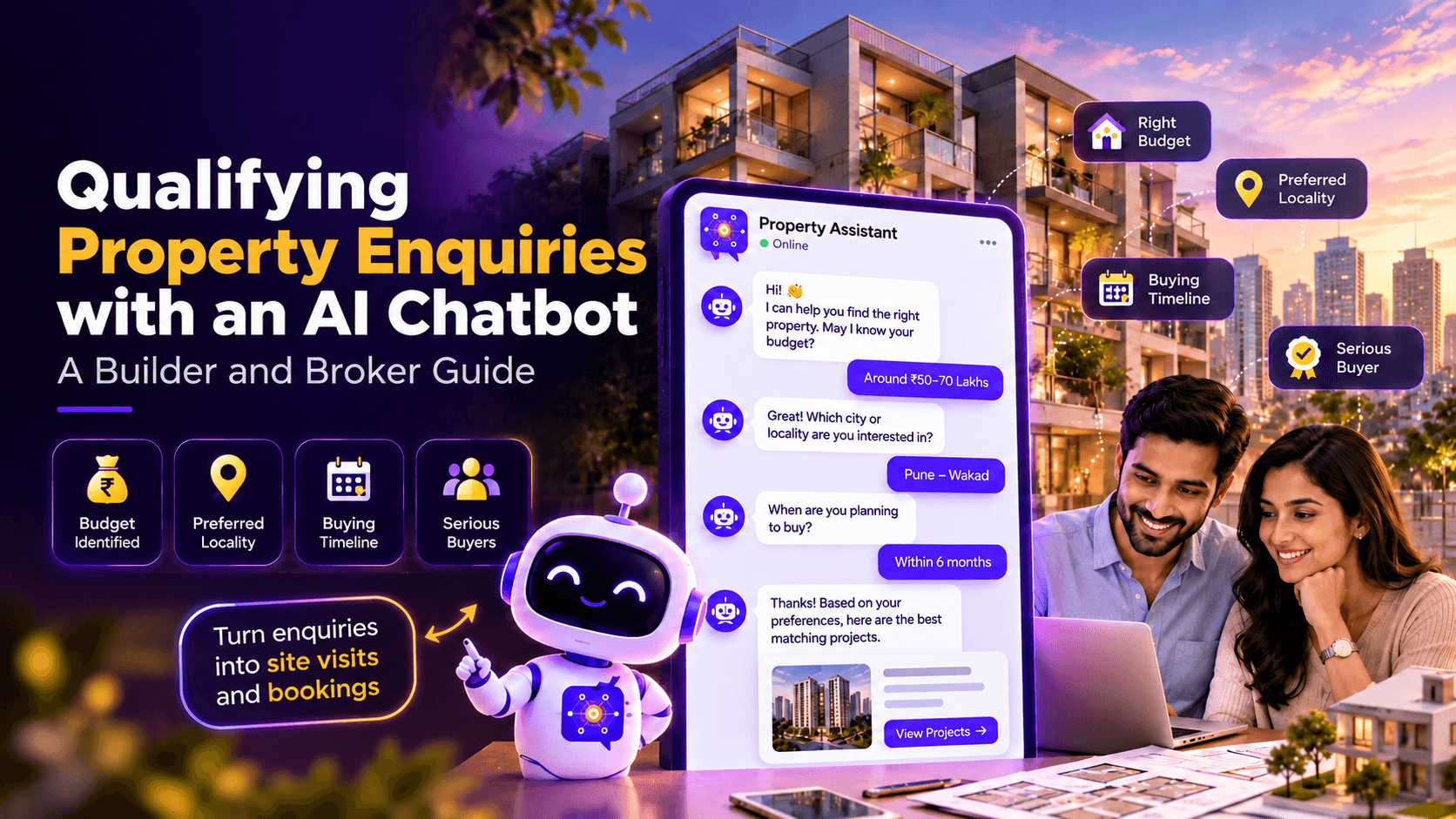
Qualification against the right four questions
The chatbot asks the questions that reveal buying intent: budget, locality preference, timeline, and purpose (self-use vs investment). Against your rules, it flags each lead as hot, warm, or cold.
Multi-language enquiry handling
An enquiry from a tier-2 buyer who types in Hindi gets a Hindi response. A Marathi family gets Marathi. A Tamil investor gets Tamil. The chatbot handles the full qualification flow in whichever language the visitor opens the conversation in. For more on this, see our guide to Hindi and regional Indian languages.
Contextual document delivery
Once qualified, the chatbot shares the right materials automatically: brochure, floor plans, RERA-registered project details, price sheet, current offers. No delay for a sales team member to email these manually.
Real-time routing on hot leads
If the qualification answers indicate a hot lead (matching budget, matching locality, timeline within 3 months), the chatbot sends an immediate SMS or email alert to the sales team so they can follow up while the buyer is still on the page. Warm and cold leads go into automated nurture sequences instead of the sales queue.
3. The four qualifying questions, and why order matters
Not seven questions. Not fifteen. Four questions that separate a serious enquiry from a speculative one. The order is deliberate.
1. Budget range
Opens the conversation and filters obvious mismatches. If your project starts at Rs 80 lakhs and the buyer is looking at Rs 40 lakhs, both sides save time.
2. Locality preference
Which micro-market are they looking at? If your project is in Kharadi and they only want Baner, the chatbot politely acknowledges and captures the enquiry for future projects.
3. Timeline
Are they looking to book in the next 3 months, 6 months, or investing for later? Timeline is the single biggest predictor of whether a buyer will show up for a site visit.
4. Purpose
Self-use or investment? The chatbot uses this to suggest different unit types (larger for family, smaller high-yield for investment) and different financing paths.
The order matters. Ask contact details first and the visitor closes the widget. Give value (project match, brochure) in exchange for details after qualification.
4. A worked example: matching qualification to sales pipeline
Take a mid-sized builder with five active projects in Pune, running Facebook and Google campaigns. The figures below are illustrative.
Before the chatbot, 400 monthly enquiries across all projects produce 120 site visits (30 percent), and a 15 percent booking conversion on those visits gives 18 bookings. The sales team spends roughly 20 hours per booking across qualification calls, visit and follow-up, and 102 site visits produce no booking.
After the chatbot goes live, the same 400 monthly enquiries are qualified against project fit and buyer intent. 40 percent qualify as hot or warm leads, giving 160 qualified leads. Site visits are arranged only from qualified leads: 60 percent, or 96 visits. Booking conversion on qualified site visits rises to 25 percent, or 24 bookings, and sales team hours per booking come down to roughly 12.
The chatbot has increased bookings from 18 to 24, cut wasted site visits from 102 to 72, and reduced sales team hours per booking by roughly 40 percent. On the same enquiry volume. On the same ad spend.
Actual figures depend on baseline lead quality, project mix, and how tight the qualification rules are. The direction is consistent.
| Metric | Before the chatbot | After the chatbot goes live |
|---|---|---|
| Monthly enquiries | 400 | 400 |
| Qualified hot or warm leads | Not separated | 160 (40%) |
| Site visits arranged | 120 (30% of enquiries) | 96 (60% of qualified leads) |
| Booking conversion on site visits | 15% | 25% |
| Bookings | 18 | 24 |
| Site visits with no booking | 102 | 72 |
| Sales team hours per booking | Roughly 20 | Roughly 12 |
5. A day in the life of a real estate chatbot
Three illustrative scenarios show the pattern.
Scenario 1: Serious NRI buyer at midnight IST
A software engineer based in Dubai lands on your project page at 1 AM IST. The chatbot greets, asks about budget (Rs 1.5 to 2 crore), locality (Hinjewadi or Kharadi), timeline (looking to book within 4 months for possession next year), and purpose (self-use on return to India in 2027). All four answers indicate a hot lead. The chatbot sends the brochure, books a virtual site visit for the following weekend, and alerts the sales team. When your sales lead logs in at 9 AM, the appointment is booked and the buyer is expecting the call.
Scenario 2: Warm lead for future reference
A family in Marathwada opens your website and qualifies as a warm lead: they like the project, have the budget, but their timeline is 12 months away (waiting for employment relocation). The chatbot automatically adds them to a monthly nurture sequence: project updates, possession schedule, timeline announcements. Nine months later, when they are ready to visit, they are already educated on the project and the sales team has context.
Scenario 3: Speculative enquiry caught early
An investor from Mumbai is browsing your luxury project as one of ten they are researching. The chatbot qualifies them as a cold lead: they want to invest but are comparing everywhere and haven't narrowed down. The enquiry goes into a low-touch automated sequence rather than consuming a sales team member's day. If they show serious intent later, the sales team can re-engage.
6. Compliance and RERA: how a chatbot handles regulated properties
Every project loaded into the chatbot carries its RERA registration number, and RERA-registered project details are shared automatically with every serious enquiry. The chatbot does not misrepresent project status or possession timelines. Multi-language capability means a Hindi-speaking buyer gets the same RERA details in Hindi as an English speaker gets in English, with identical accuracy.
MagicFlow AI is built for this level of compliance. Project inventory, pricing, and legal details are updated centrally, so every conversation delivers consistent information across every channel.
7. Setting up a real estate chatbot across projects and cities
A single chatbot instance can manage your full project inventory across cities and micro-markets. Here is what needs to happen before the chatbot goes live.
1. Project inventory upload
Define your projects, localities, price ranges, unit types, and RERA registration numbers. The chatbot uses this to qualify enquiries against actual project fit.
2. Qualification rules engine
Set your rules: what budget range qualifies as hot vs warm, what timeline matters (3 months, 6 months, or longer), which localities map to which sales teams.
3. CRM and alert routing
Wire the chatbot to your CRM (HubSpot, Salesforce, Zoho) so hot leads go directly into your pipeline and SMS/email alerts go to the right sales rep based on locality and project.
4. Material templates
Upload brochures, floor plans, RERA-registered details, and price sheets. The chatbot serves the right materials automatically after qualification, in the language the visitor is using.
8. Get started with MagicFlow AI for real estate
Ready to qualify more leads and cut wasted site visits? Start your 30-day free trial or talk to an expert to see how MagicFlow AI works for builders and brokers.
Learn more in our AI Chatbot for Real Estate resource center, or read the AI Chatbot for India buyer's guide.
Common questions from this article.

Founder, MagicFlow AI | MagicWorks IT Solutions Pvt. Ltd.
Swapnil has been building AI-first digital marketing products and running MagicWorks IT Solutions Pvt. Ltd. since 2012. MagicFlow AI is his latest venture: an intelligent conversational AI platform designed for businesses and agencies that need more than a chatbot and less than a full autonomous agent stack.