1. The appointment enquiry pattern in Indian clinics
Most Indian clinics see appointment enquiries in three peak windows: early morning before commute (7 to 9 AM), evening after work (7 to 10 PM), and Sunday afternoons. The receptionist typically works 9 AM to 7 PM. That means a large share of enquiries land when nobody is at the front desk.
The enquiries that do come in are also repetitive. Front-desk staff at a typical Indian clinic answer the same questions dozens of times a day: "What are your timings today?", "Do you have a slot tomorrow morning?", "What is the consultation fee?", "Do you accept my insurance provider?", "Do I need to bring anything to the first appointment?"
Add to this the language mix. In tier-2 and tier-3 Indian cities, and increasingly in tier-1 as well, patients (especially older patients and family members booking on their behalf) type in Hindi or a regional language. An English-only contact form or enquiry line handles them poorly.
The visible symptoms of this pattern are: no-show rates in the 15 to 25 percent range, receptionist overtime on repetitive questions, patients complaining that phone lines are busy, and appointment bookings that never happened because the enquiry cooled overnight.
2. What an AI appointment booking chatbot actually does
An AI chatbot on your clinic website handles four categories of work automatically.
Appointment booking against live availability
The chatbot connects to your calendar (Google Calendar, Microsoft Outlook, or a practice management system), sees which slots are open, and books directly. No waiting for the receptionist to open the appointment book in the morning.
Multi-language patient conversation
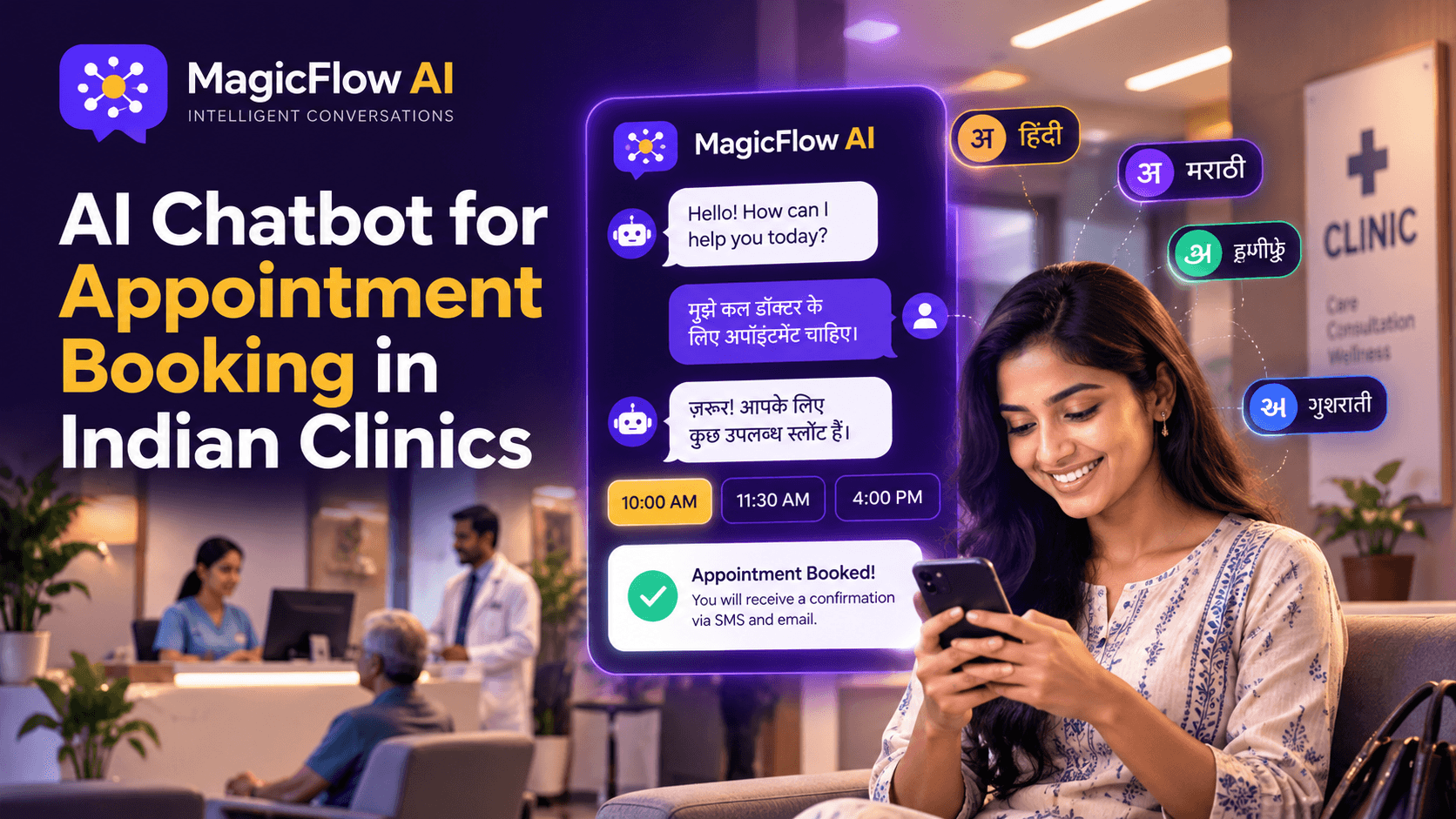
A patient enquiring in Hindi gets the response in Hindi. A family member typing in Marathi gets Marathi. The chatbot handles the full booking flow (name, phone, appointment reason, preferred slot) in whichever language the enquiry opened in.
Confirmation and reminder flow to reduce no-shows
Once an appointment is booked, the chatbot sends SMS and email confirmation immediately, and reminder messages 24 hours and 2 hours before the appointment. Patients who need to reschedule click a link and pick a new slot. No-show rates drop as a direct result.
Handoff for clinical judgment
For enquiries that need medical judgment (symptom questions, treatment queries, medication concerns), the chatbot does not attempt a diagnosis. It captures the enquiry, flags it as clinical, and routes to a doctor or nurse for follow-up. The chatbot handles administration. The clinical team handles clinical decisions.
3. How the appointment booking workflow actually runs
Three real-world scenarios show the pattern.
Scenario 1: Evening enquiry from a working patient
A working professional finishes their day at 8:30 PM and remembers they need a dental cleaning. They open the clinic's website, and the chatbot greets them. In three exchanges, they specify "dental cleaning", pick a slot on Saturday morning from the shown availability, and receive an SMS confirmation. The clinic sees a new booking in their calendar the next morning. The receptionist did not touch this transaction.
Scenario 2: Family member booking on behalf
An adult child in Bengaluru is booking a consultation for their elderly mother in Pune. The chatbot handles the enquiry in the language they prefer, asks for the patient's name and age, checks slot availability for the following week, and books. Reminder messages go to the phone number provided.
Scenario 3: Reschedule request
A patient booked for Tuesday morning cannot make it. They click the reschedule link in the reminder message, see current availability, and pick Thursday afternoon. The Tuesday slot opens up automatically. The receptionist did not touch this transaction either.
4. The no-show reduction math
Indian clinic no-show rates typically run 15 to 25 percent for booked appointments. On a schedule of 40 appointments a day, that is 6 to 10 empty slots that could have been filled.
Take a clinic with a 20 percent no-show rate before automated reminders. After implementing chatbot-driven confirmation and reminder flow (immediate confirmation, 24-hour reminder, 2-hour reminder), the no-show rate typically drops to 10 to 12 percent. That is 3 to 4 additional filled appointments a day, or roughly 90 additional filled appointments a month.
At an average consultation fee of Rs 800, that is roughly Rs 72,000 a month in reclaimed revenue on a single-doctor clinic, without adding any patients to the funnel. On a multi-doctor practice, the number scales linearly.
Actual figures depend on baseline no-show rates and how strong the reminder cadence is. The direction is consistent.
| Metric | Before reminders | After reminder flow |
|---|---|---|
| No-show rate | 20% | 10 to 12% |
| Empty slots a day | 8 | 4 to 5 |
| Filled appointments a month | Baseline | Roughly 90 more |
| Revenue a month | Baseline | Roughly Rs 72,000 reclaimed |
5. What Indian healthcare businesses are seeing
The Holistic Care, an Indian healthcare business, uses MagicFlow AI on their website and has reported a 29% lift in qualified enquiries within 45 days. Their configuration focuses on B2B partnership capture rather than patient appointment booking, but the underlying platform capabilities (multi-language conversation, qualification, CRM handoff) are the same capabilities that power clinic appointment workflows.
For Indian clinics specifically, the reported pattern from customer conversations is consistent: no-show reduction from the confirmation flow, capture of after-hours enquiries that would otherwise cool overnight, and reduced front-desk burden on repetitive questions.
6. Setting up a clinic appointment chatbot
Four things need to be configured before the chatbot goes live.
1. Calendar integration
Connect to Google Calendar, Microsoft Outlook, or your practice management system. The chatbot needs read/write access so it can see availability and book directly.
2. Appointment types and durations
Define your appointment types (consultation, follow-up, procedure, specialist referral) with the duration for each. The chatbot uses this to offer only appropriate slots.
3. Confirmation and reminder message content
Draft the message templates in each language you support. Set the timing (immediate confirmation, 24-hour reminder, 2-hour reminder). The chatbot handles delivery.
4. Handoff protocol for clinical enquiries
Tell the chatbot which types of enquiries need clinical review, and where to route them (email to a specific doctor, SMS to a nurse coordinator). The chatbot captures the enquiry and routes. Your team handles the response.
7. Get started with MagicFlow AI
Ready to reduce no-shows and capture after-hours appointment enquiries? Start your 30-day free trial today or talk to an expert to explore how MagicFlow AI can work for your clinic.
Learn more about AI chatbots for healthcare in our AI Chatbot for Healthcare cornerstone.
Common questions from this article.
Founder, MagicFlow AI | MagicWorks IT Solutions Pvt. Ltd.
Swapnil has been building AI-first digital marketing products and running MagicWorks IT Solutions Pvt. Ltd. since 2012. MagicFlow AI is his latest venture: an intelligent conversational AI platform designed for businesses and agencies that need more than a chatbot and less than a full autonomous agent stack.