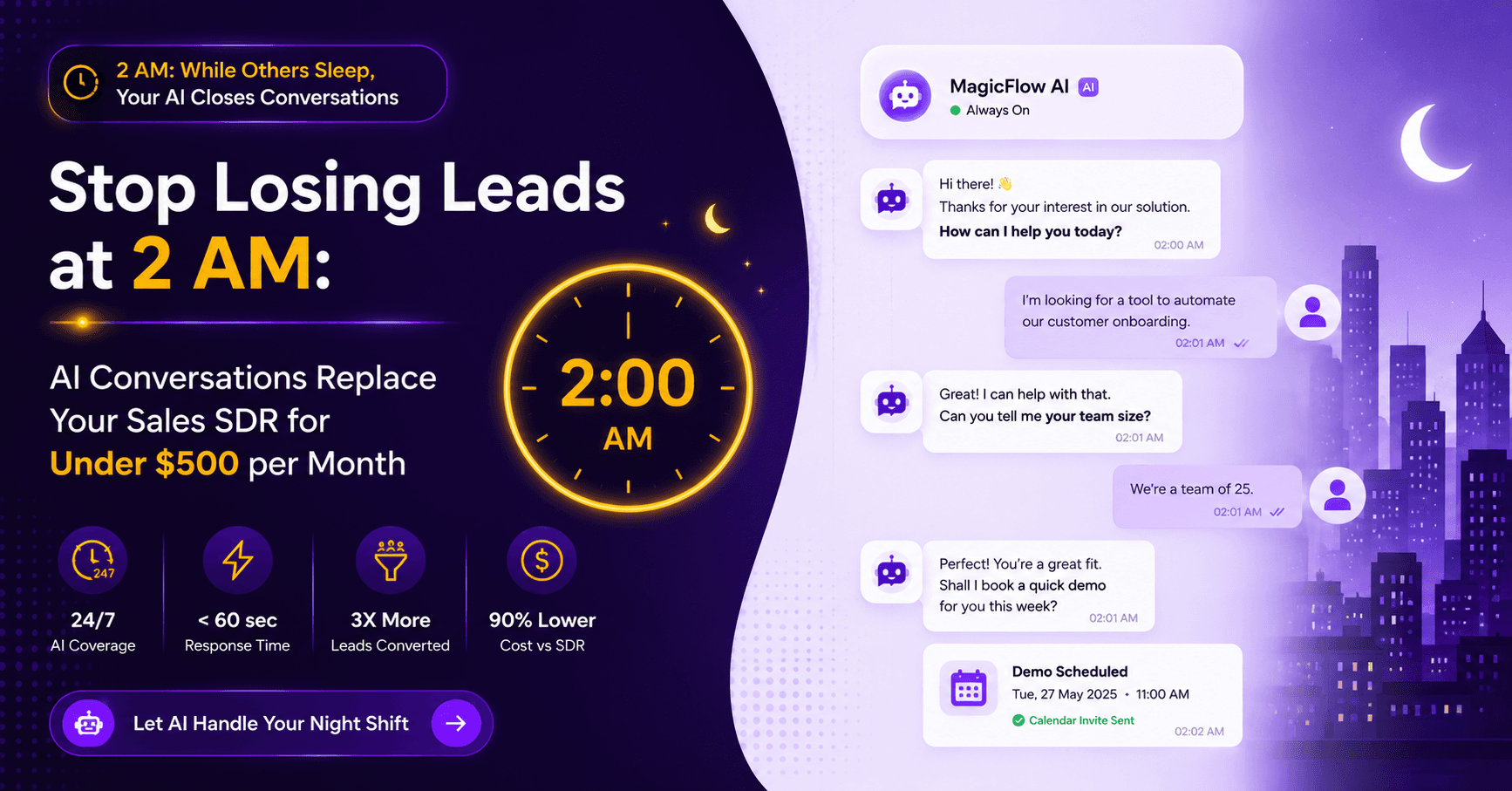
The 2 AM problem nobody is solving
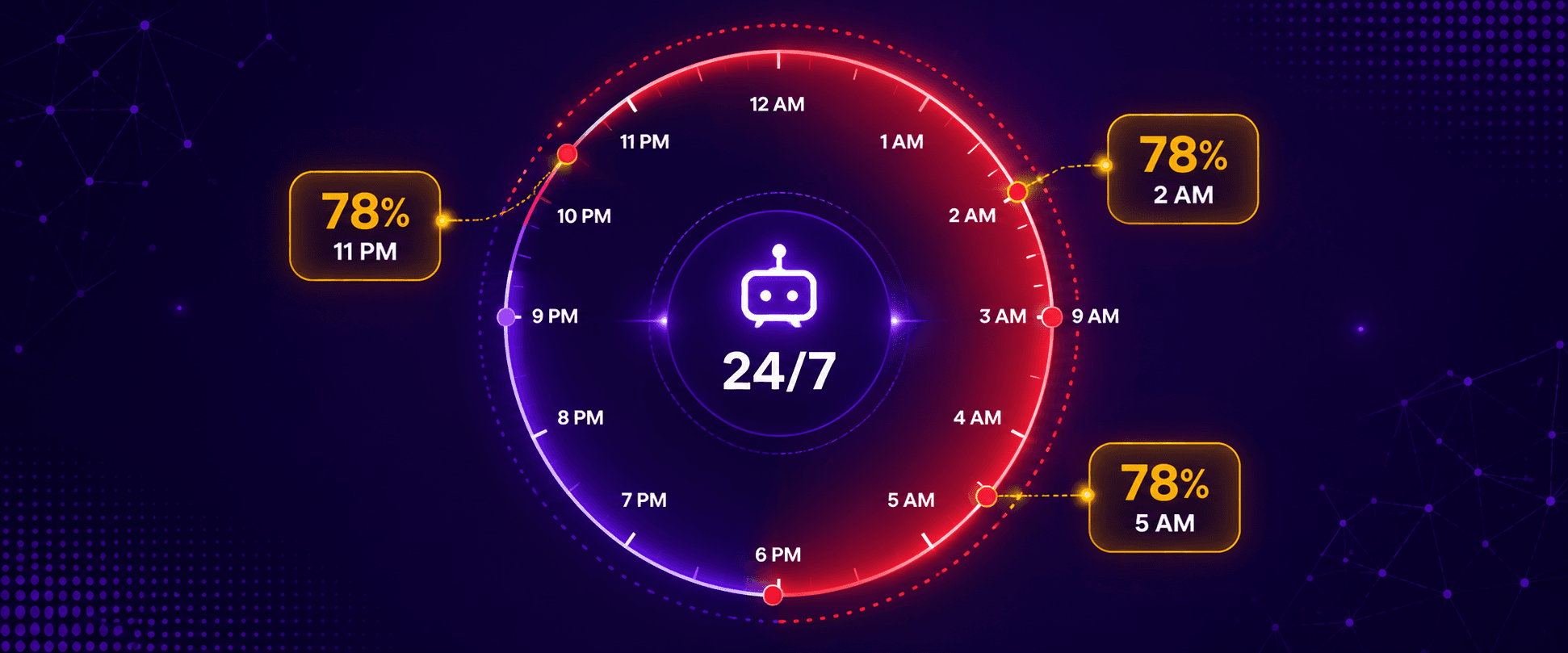
Last night, somewhere between 11 PM and 6 AM, someone who needs exactly what your business sells visited your website. They read your homepage. They watched your demo. They almost filled out the contact form. Then they got distracted, closed the tab, and tomorrow they will message your competitor instead.
You never knew they existed. You will never know what they were worth.
This is not a hypothetical. It is one of the most predictable revenue leaks in modern B2B and B2C sales. Until recently, the only solution was to hire someone, pay them like a full-time sales rep, ask them to cover business hours, and accept that the other 16 hours of every day were largely lost.
That trade-off is over. Intelligent AI conversations now handle the inbound qualification work an SDR does, around the clock, for under $500 a month. This is not a marginal cost saving. It is a structural change in how sales pipelines get built.
Most companies treat after-hours leads as an unavoidable cost of doing business. They are not. They are the cost of doing business the way it was done in 2015.
Between 35 and 50 percent of B2B inbound leads arrive outside the seller's normal business hours. For B2C and D2C businesses, that figure can rise to 50 to 60 percent. Late evenings, early mornings, weekends, and time zone gaps account for more website traffic than many sales teams realise.
The conversion penalty on that traffic is severe. Studies and industry benchmarks consistently show that faster response improves conversion. By the time a typical human SDR responds the next morning, the lead has often bought from a competitor, lost interest, or postponed the decision.
78 percent of buyers purchase from the company that responds first. Not best. First.
Why businesses keep accepting the leak
Cost is the first reason. Hiring a 24/7 SDR rotation is economically impossible for most companies. The math does not work below a certain pipeline volume.
Quality is the second reason. Even when companies hire late-shift SDRs, the response consistency usually drops. Night shifts are difficult to staff and harder to manage.
Belief is the third reason. Many sales leaders still believe meaningful sales conversations require a human. That was true ten years ago. It is no longer true for the qualification and scheduling stages of the pipeline.
What an SDR actually does, and what AI now does better
Before talking about replacement, it helps to be specific about what an SDR's job actually is. The job has shifted over the last decade. Most SDRs today spend the majority of their time on five activities.
| Activity | What it means | AI fit |
|---|---|---|
| Inbound lead qualification | Responding to website forms, chat messages, and email enquiries to determine fit. | High |
| Outbound prospecting | Cold email, LinkedIn outreach, and follow-up cadences to qualified prospects. | Medium |
| Meeting scheduling | Booking qualified prospects with account executives. | High |
| Pipeline hygiene | Updating CRM records, logging context, and maintaining lead status. | High |
| Re-engagement | Reviving dormant leads and re-qualifying old opportunities. | High |
The practical replacement boundary
Of these five activities, qualification, scheduling, and most follow-up are now done faster, more consistently, and at fractional cost by AI conversations. Pipeline hygiene becomes automated as a side effect because the AI logs every interaction natively.
Re-engagement is one of the highest-leverage AI use cases because it automates work that humans rarely do well at scale. Old leads are easy to ignore manually. AI can keep them warm without fatigue.
What does that leave for human SDRs? Outbound prospecting in complex enterprise sales, where relationship-building and tailored discovery still benefit from human nuance. Even there, AI increasingly handles first-touch outreach and qualification, with humans entering for high-value conversations.
The important reframe
AI is not replacing the SDR profession. It is replacing the qualification and scheduling tasks that SDRs were never the right tool for in the first place.
The same SDR rebuilt around AI becomes dramatically more productive, focuses on higher-value work, and produces better pipeline per quarter.
The actual cost math
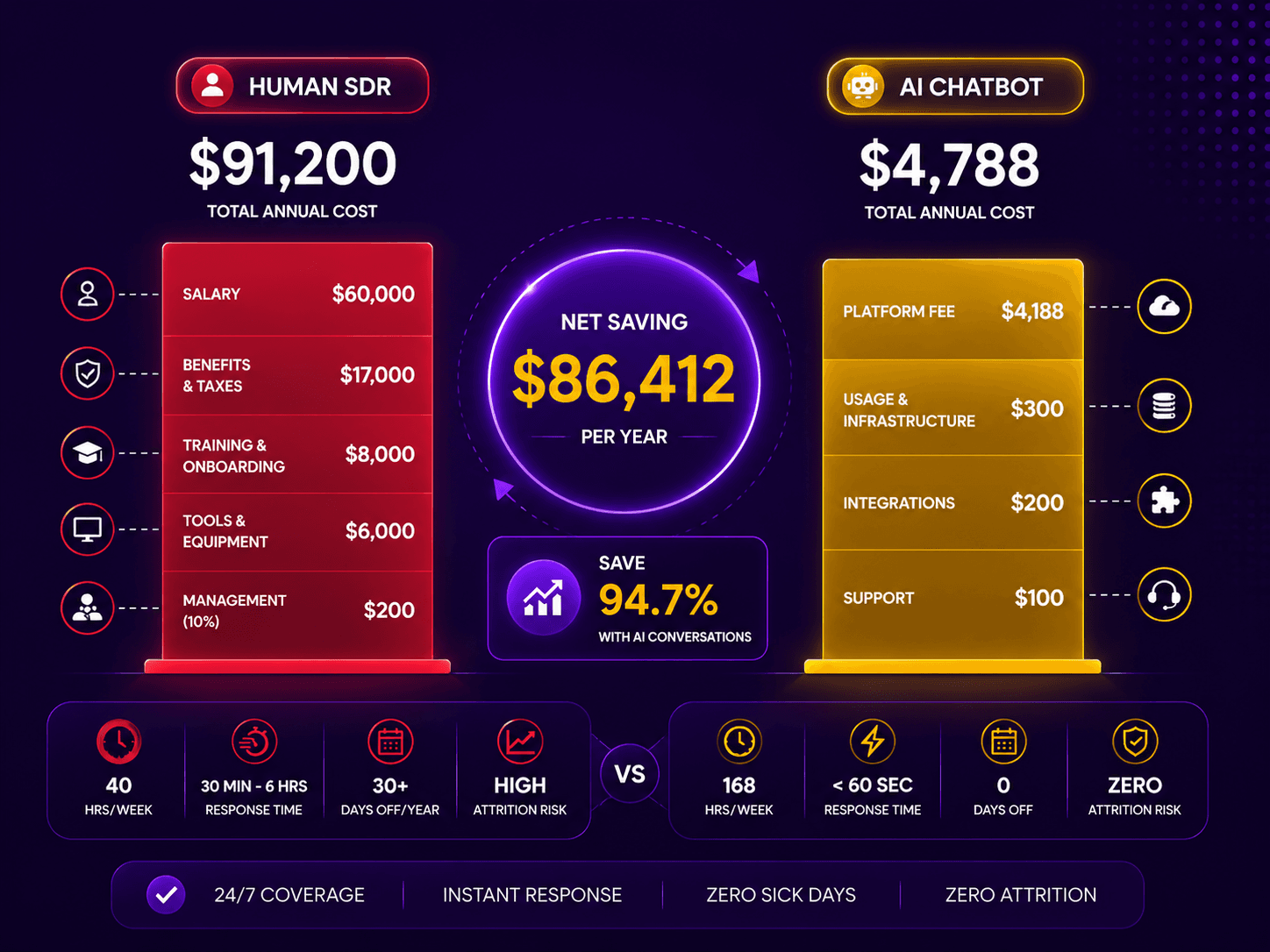
Headline claims about replacing an SDR for $500 a month are easy to dismiss without the full math. The real comparison is not software subscription versus salary. It is fully loaded sales coverage versus AI-led qualification capacity.
These are realistic, directional comparisons. Exact numbers vary by city, seniority, market, benefits, and sales motion, but the cost structure is clear.
| Line item | Human SDR | AI conversation platform |
|---|---|---|
| Annual salary and benefits | Approximately $91,000 fully loaded | Included in platform cost |
| Annual platform or tooling cost | CRM, sequencing, enrichment, and enablement stack extra | Under $5,000 per year for many SMB deployments |
| Coverage | Roughly 40 working hours per week | 24/7 coverage |
| Response time | Minutes to hours depending on queue and working hours | Under 60 seconds |
| Annual saving | Baseline | Typically $85,000 to $90,000 per SDR function replaced |
| Line item | Human SDR / inside sales rep | AI conversation platform |
|---|---|---|
| Annual people cost | Often Rs 10 Lakh to Rs 14 Lakh fully loaded | A fraction of equivalent headcount cost |
| Coverage | Business hours, weekends depending on staffing | 24/7 coverage |
| Attrition risk | Meaningful for inside sales teams | None at the workflow layer |
| Annual saving | Baseline | Approximately Rs 9 Lakh per SDR function replaced |
Why this math is no longer controversial
The cost of running an AI conversation has fallen sharply as foundation model pricing has compressed. The cost of hiring and managing an SDR has not fallen. The gap that has opened up is not a minor competitive advantage. It is a structural cost shift.
Businesses that move first capture three compounding advantages: lower customer acquisition cost, faster response times that lift conversion, and full 24/7 pipeline coverage competitors cannot match without making the same shift.
What AI actually handles in your sales funnel
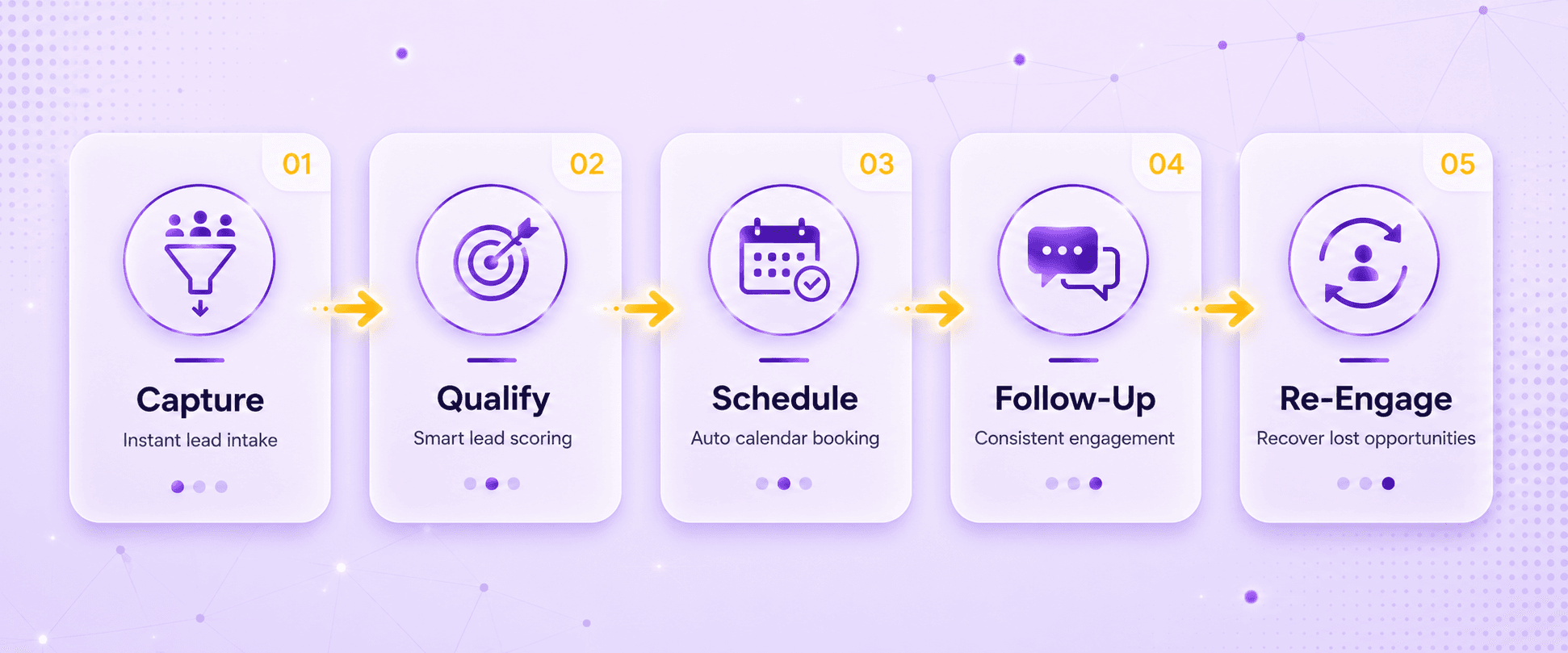
Replace your SDR sounds like a single switch. In practice, it is five distinct workflows the AI runs simultaneously. Here is what each one looks like in production.
Stage 1: Real-time lead capture
A visitor lands on a marketing page. AI initiates a conversation within seconds through the chat widget. It identifies intent, captures contact details, and starts qualification before the visitor would have closed the tab.
This stage often captures more leads than a static contact form because it meets the visitor while intent is still active.
Stage 2: Intelligent qualification
AI runs the brand's qualification framework inside the conversation. That can be BANT, MEDDIC, or a custom set of sales questions.
It asks about budget, timeline, decision-making, use case, and current solution in a tone that feels like a sharp colleague, not a form. By the end of the conversation, the AI knows whether the lead is sales-ready, marketing-nurture, or disqualified.
Stage 3: Calendar booking
When the lead is sales-ready, the AI books a calendar slot directly. It can pull live availability from the account executive's calendar, offer specific time options, confirm the booking, send a calendar invite, and notify the team.
Stage 4: Multi-touch follow-up
For leads that are not sales-ready, the AI runs an automated follow-up cadence with educational content, case studies, and re-qualification check-ins.
Most importantly, it does this consistently for every lead, which is something even disciplined human SDRs struggle to do at scale.
Stage 5: Re-engagement of dormant leads
Old leads who went cold get re-engaged proactively. The AI scans dormant pipeline by recency and last-known interest, then sends targeted re-engagement messages at the right time.
Recovered pipeline from this stage alone can pay for the AI platform several times over.
Where AI is still wrong, and where humans still win
Honesty is the only thing that keeps a blog like this useful. There is a clear boundary between what AI does well and what humans should still own.
| Humans still own | AI handles better |
|---|---|
| Discovery calls for complex enterprise deals | Inbound qualification at scale |
| Negotiation around non-standard pricing or contracts | Speed of response under 60 seconds |
| Relationship-driven closing for high-ticket B2B | 24/7 coverage without burnout |
| Executive escalations and sensitive account moments | Pipeline hygiene and CRM record-keeping |
| Crisis or empathy-heavy conversations | Multi-touch follow-up and dormant lead re-engagement |
The model that wins in 2026
The right model is not no SDRs. It is AI handles 80 percent of inbound volume, plus one or two senior closers handle the highest-value 20 percent.
The closers become dramatically more productive because they spend time only on conversations that matter. Quota attainment per rep usually rises when teams stop spending human attention on repetitive qualification work.
How MagicFlow AI runs your night shift
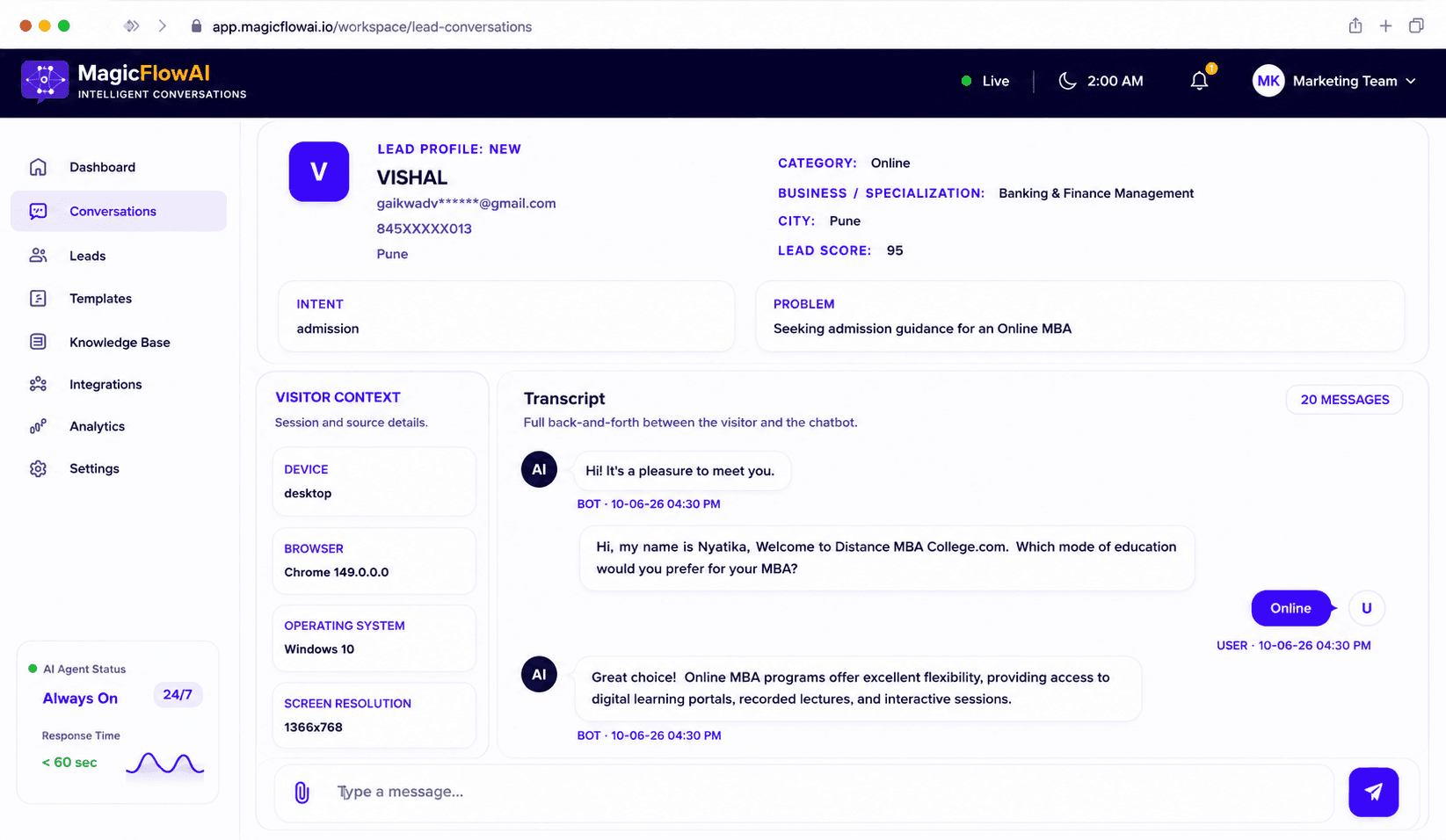
MagicFlow AI was built as an intelligent conversational AI platform for the inbound qualification and scheduling work that consumes most SDR time today. It is not a generic chatbot dressed up with sales features. It is a sales-AI platform that operates inside the same conversation surface your customers already use.
Deployment from signup to live customer conversations typically takes 2 to 3 weeks for a normal business. First measurable conversion lift is usually visible inside 30 days. Payback on the annual platform cost is often achieved inside 60 days.
After that, every additional lead the AI captures during the hours your human SDRs were not working is incremental revenue your business previously was not earning.
| Capability | What it does |
|---|---|
| Live website chat widget | Engages visitors quickly and follows your brand voice and qualification framework. |
| WhatsApp Business use cases | Supports Indian and global D2C workflows where customer conversations already happen. |
| Calendar handoff | Moves qualified visitors from chat to booked meetings. |
| CRM-ready context | Preserves conversation context so teams can follow up with the right details. |
| Multi-language support | Supports English, Hindi, and code-mixed Hinglish-style customer journeys. |
| Conversation analytics | Tracks capture rate, qualification rate, booking rate, and lead-to-meeting conversion. |
Why the platform foundation matters
The safety guardrails that protect every customer conversation matter because an AI sales assistant is a live customer-facing system. It needs approved context, domain controls, rate limits, and safe fallback paths.
MagicFlow AI is also built on multi-tenant architecture, which makes the unit economics work for both end businesses and agencies who deploy the product on behalf of clients.
The night shift is no longer a cost
Every lead lost between 10 PM and 8 AM is not a small leak. It is a structural revenue gap that compounds every month it stays unfixed.
The businesses that win the next two years of sales pipeline competition are not the ones with the biggest SDR teams. They are the ones that realise 80 percent of SDR work can be automated, free up the budget, redeploy it into senior closers and paid acquisition, and start capturing the leads competitors are still missing every night.
The math is no longer debatable. The technology is no longer experimental. The platforms are no longer fragile. The only remaining variable is when your business chooses to make the shift.
Every month spent running an SDR-heavy inbound model costs your business pipeline that AI could capture for a fraction of the cost. The decision is not whether to automate. It is when.
References
The references below are provided for readers who want to inspect the research base and related industry benchmarks.
- Bridge Group. SDR Metrics and Compensation Research: Annual Sales Development Benchmark Report. https://bridgegroupinc.com/sdr-metrics-research/
- Glassdoor. Sales Development Representative Compensation Benchmarks, United States. https://www.glassdoor.com/Salaries/
- Salesforce Research. State of Sales Report. https://www.salesforce.com/resources/research-reports/state-of-sales/
- Drift. Conversational Marketing and Sales Research. https://www.drift.com/insider/learn/research/
- Harvard Business Review. The Short Life of Online Sales Leads. https://hbr.org/2011/03/the-short-life-of-online-sales-leads
- McKinsey and Company. The state of AI in 2024. https://www.mckinsey.com/capabilities/quantumblack/our-insights/the-state-of-ai
- Gartner. Sales technology and generative AI research. https://www.gartner.com/en/sales/research
- AmbitionBox. Sales Development Representative salary trends in India. https://www.ambitionbox.com/salaries/
- MagicFlow AI. Intelligent Conversations Platform. https://magicflowai.io
Common questions from this article.

Founder, MagicFlow AI | MagicWorks IT Solutions Pvt. Ltd.
Swapnil has been building AI-first digital marketing products and running MagicWorks IT Solutions Pvt. Ltd. since 2012. MagicFlow AI is his latest venture: an intelligent conversational AI platform designed for businesses and agencies that need more than a chatbot and less than a full autonomous agent stack.