The terminology problem costing businesses money
Right now, somewhere in a boardroom, a business owner is writing a six-figure cheque for an AI implementation that will not solve their problem. Not because they made a bad decision, but because they made the wrong decision based on the wrong terminology.
AI agent and AI chatbot are often used interchangeably in vendor pitches, LinkedIn posts, and conference keynotes. They are not the same thing. The difference is not a footnote; it is the difference between a tool that transforms your customer experience and one that sits idle, costing money every month.
By the end of this guide, you will know what separates an AI chatbot from an AI agent, which one your business actually needs right now, and why getting this decision wrong is one of the most expensive mistakes in enterprise AI adoption.
What is an AI chatbot?
An AI chatbot is a software application designed to simulate human conversation. When a user sends a message, the chatbot responds. It waits. It replies. That is the core loop.
Modern AI chatbots fall into two broad categories. The first is rule-based chatbots: systems built on decision trees and predefined scripts. A user asks about business hours, and the chatbot matches the query to a trigger and returns a preset answer. Fast, predictable, and limited.
The second category is LLM-powered chatbots, built on large language models. These understand natural language at a more sophisticated level. They can handle follow-up questions, interpret ambiguous phrasing, and generate contextually relevant responses in real time.
What AI chatbots are genuinely excellent at
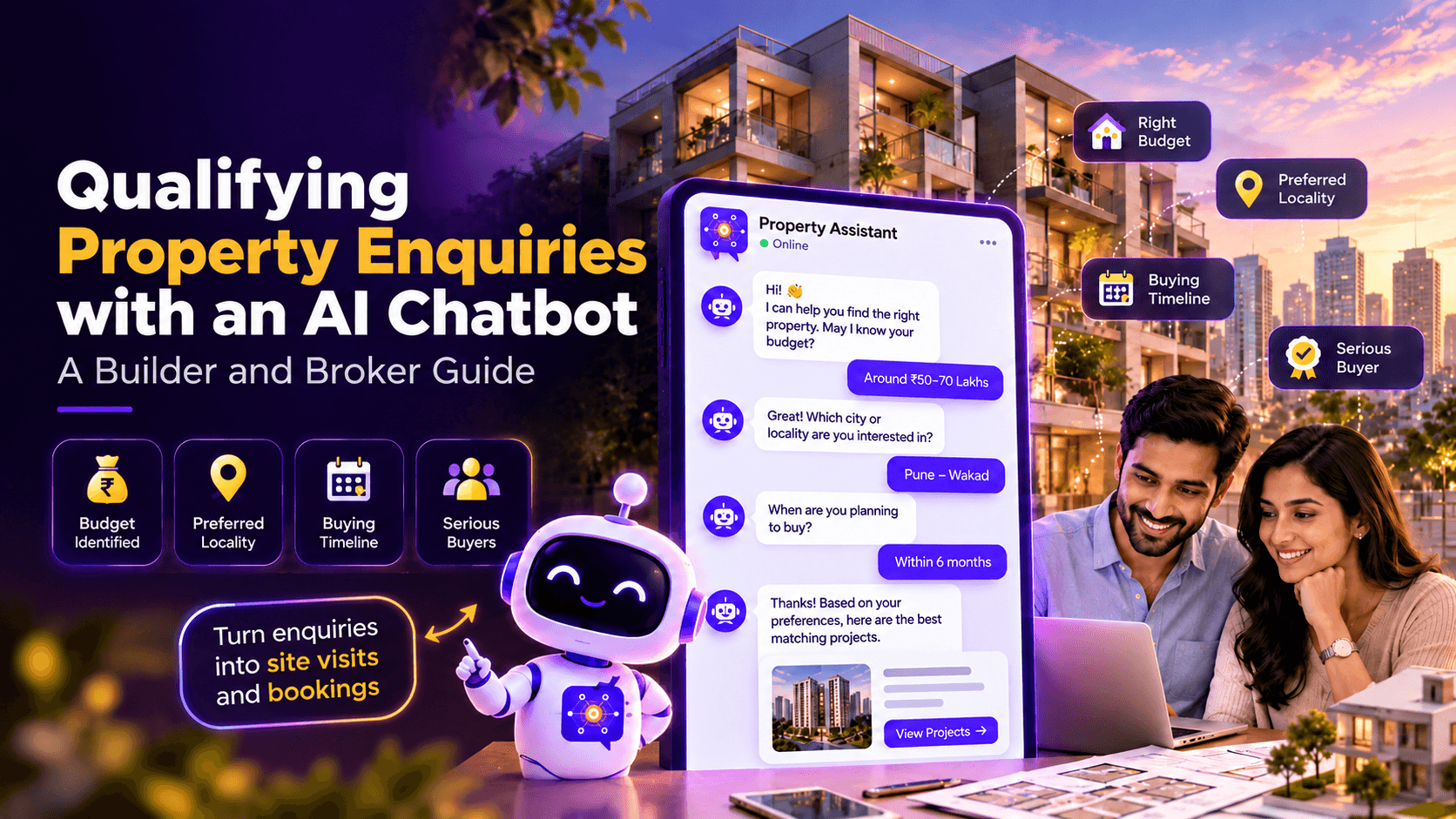
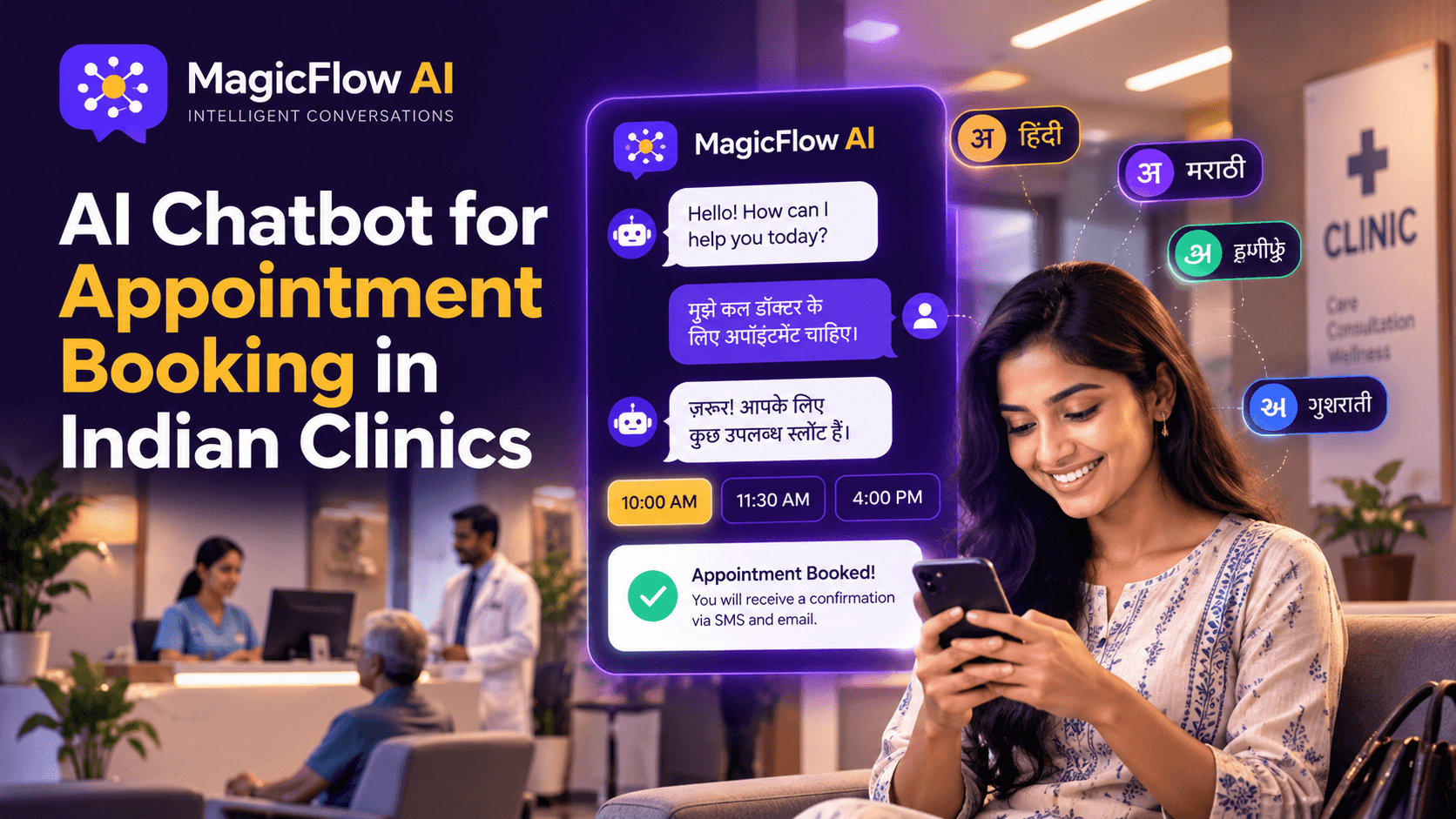
Chatbots are strong at handling high volumes of repetitive queries: support FAQs, order status checks, business hour enquiries, lead capture, appointment booking, basic scheduling, and first-response support.
For example, a D2C brand can deploy an AI chatbot on its website to answer order-related queries 24/7. If it handles 2,000 common queries a month that would otherwise clog a support inbox, that is exactly the right use of a chatbot.
Where chatbots have clear limits
A chatbot is reactive by nature. It usually activates only when a user starts the conversation. It may not remember the visitor tomorrow, and it cannot independently take actions in external systems unless it has been designed with those integrations.
What is an AI agent?
An AI agent is a system designed not merely to answer questions but to complete goals. The distinction is fundamental.
While a chatbot waits for input and responds, an AI agent is given an objective and works autonomously to achieve it across multiple steps. It can use tools, make decisions, and coordinate actions without requiring a human at every stage.
AI agents are usually built around three capabilities that chatbots typically lack: multi-step reasoning, tool use, and persistent memory. That is what allows them to move from conversation into execution.
What AI agents are built for
AI agents make sense for autonomous sales pipeline management, complex workflow orchestration, research and summarisation across multiple sources, and customer journey handling that spans multiple systems and time periods.
For example, a B2B SaaS company might use an AI agent that qualifies a new lead, pulls company data, drafts a personalised outreach email, books a calendar slot, and updates the CRM before the sales manager opens their laptop.
Where AI agents introduce complexity
Greater capability comes with greater responsibility. AI agents making autonomous decisions in live business systems require robust governance, escalation protocols, monitoring, and error handling.
An agent that takes the wrong action in a CRM or sends an incorrect email is harder to unwind than a chatbot giving a suboptimal answer.
AI agents vs AI chatbots: the definitive comparison
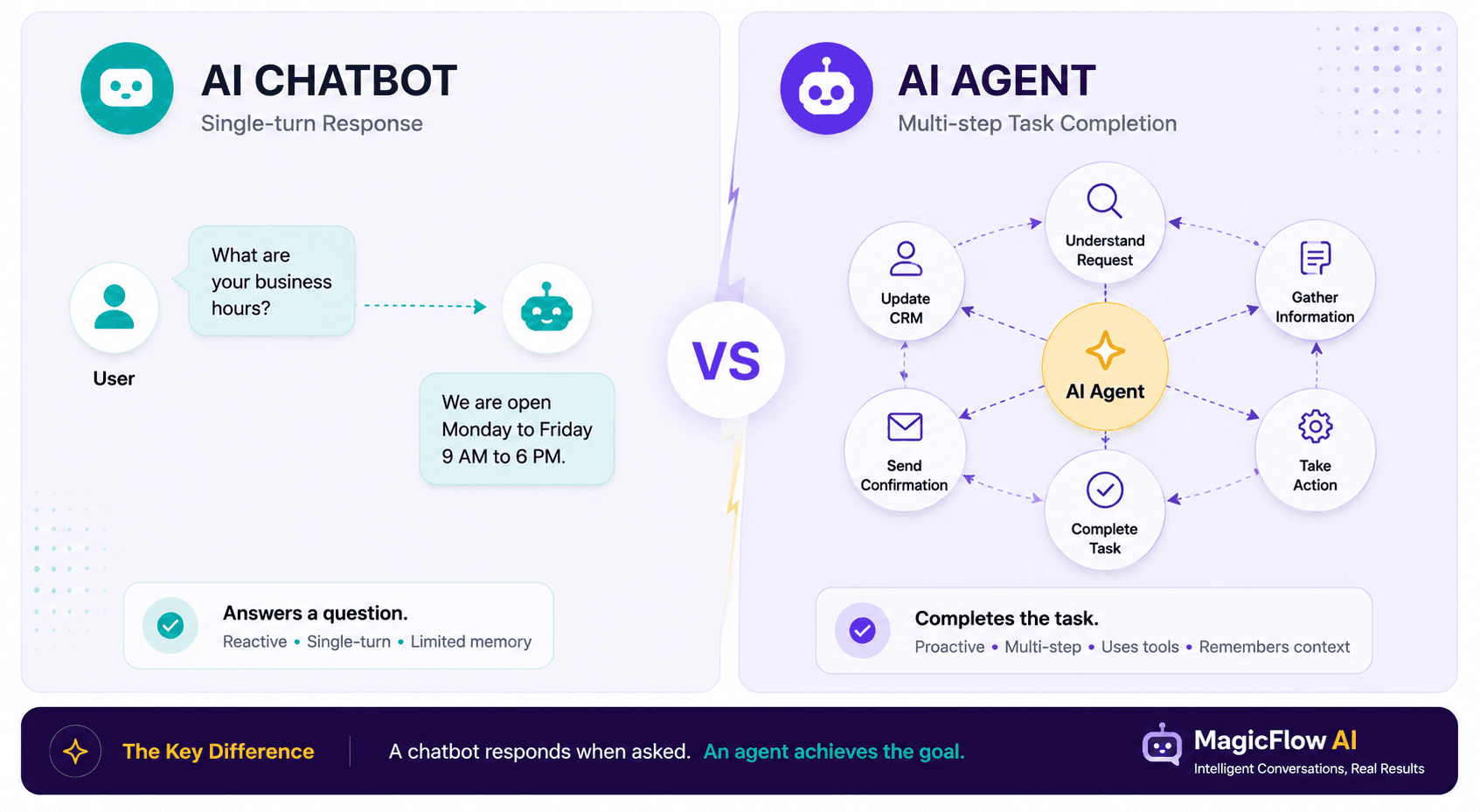
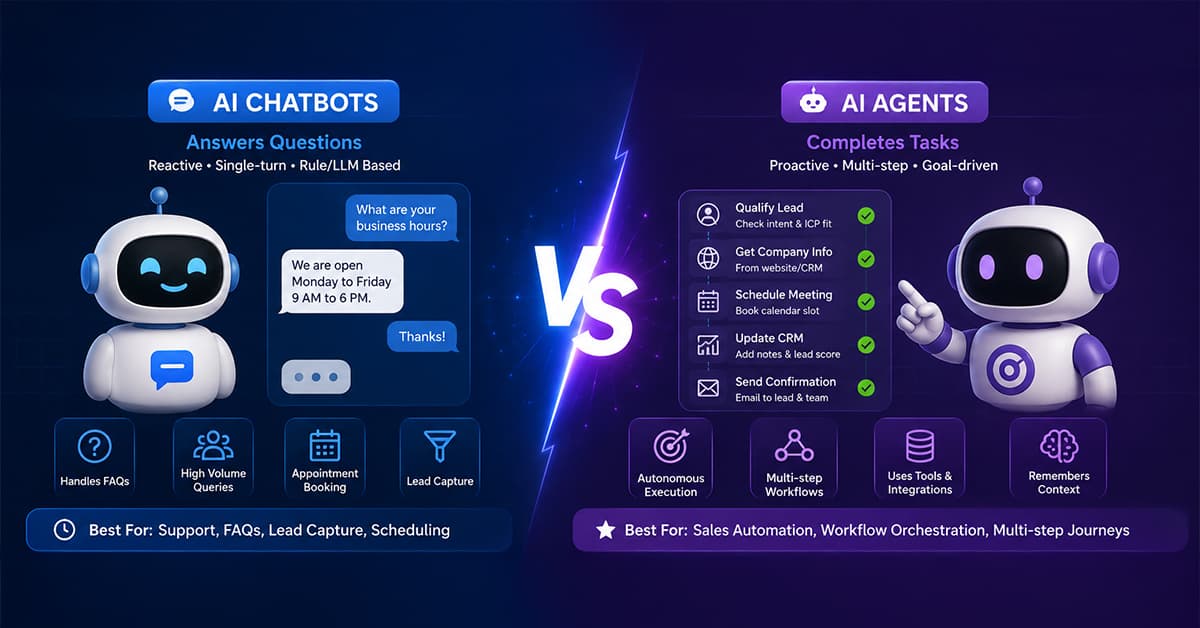
If you only have 30 seconds, the distinction is simple: a chatbot responds, while an AI agent acts. That single difference determines which tool your business should invest in.
The most important row in the comparison is interaction mode. A chatbot is reactive: it responds when asked. An AI agent is proactive: it plans, executes, and completes tasks on a timeline determined by the objective, not only by user prompts.
| Dimension | AI chatbot | AI agent |
|---|---|---|
| Primary job | Respond to user questions | Complete goals across steps |
| Interaction mode | Reactive | Proactive and goal-driven |
| Memory | Usually session-bound | Can persist across sessions and systems |
| Tool use | Limited or configured integrations | Designed for external tools and workflows |
| Best fit | FAQs, lead capture, first response | Workflow execution, CRM actions, multi-step automation |
| Implementation | Faster and lighter | More complex and governance-heavy |
When does your business need a chatbot vs an AI agent?
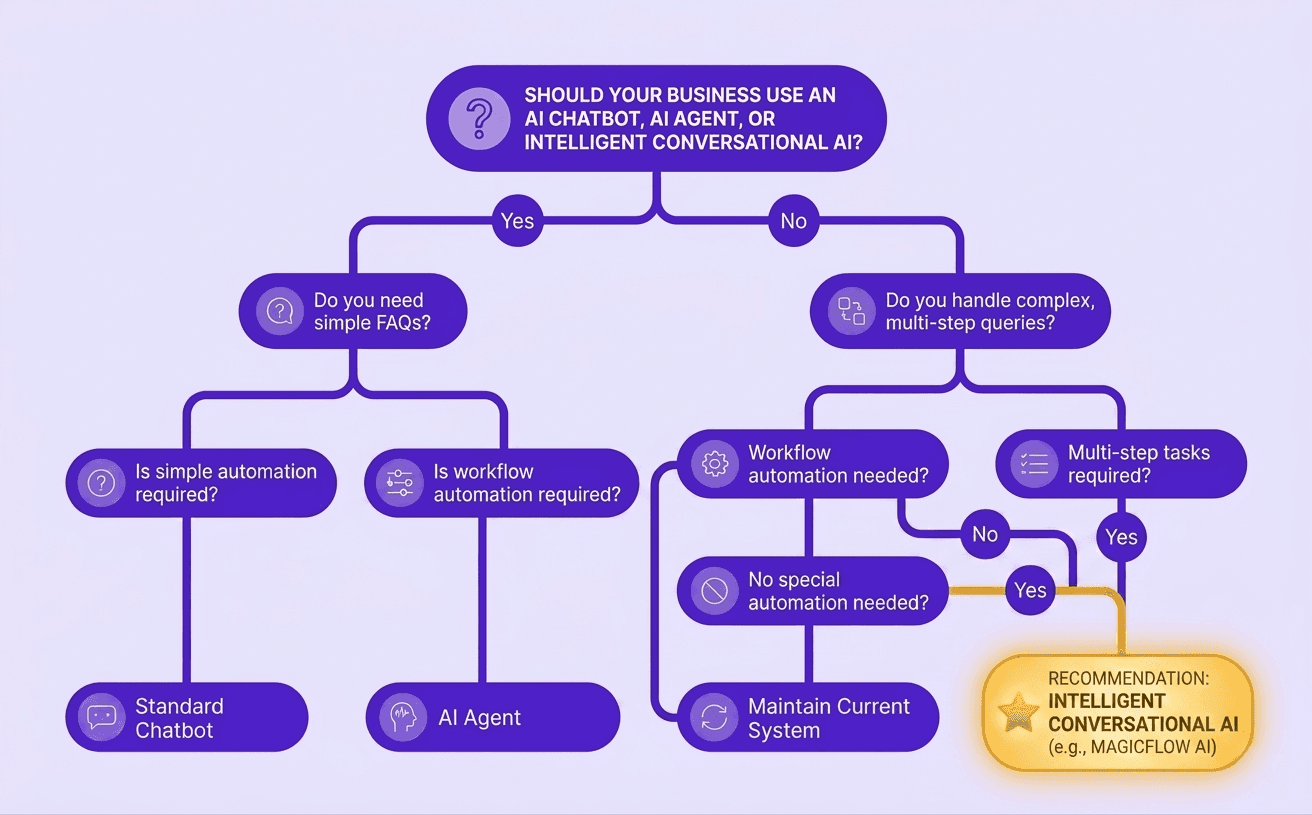
Here is the decision framework distilled into three clear signals.
Choose an AI chatbot if
Your use cases are primarily one question and one answer, you need to handle high volumes of repetitive queries at low cost, customers need immediate 24/7 responses to predictable questions, or you want fast deployment with minimal integration overhead.
Lead capture, FAQ deflection, appointment scheduling, and first-response support all sit squarely in chatbot territory.
Choose an AI agent if
Your use cases require autonomous multi-step execution across business systems, you want to automate full workflows without human intervention at each step, or you need the system to initiate actions proactively.
Sales pipeline automation, cross-system orchestration, and complex customer journey management are where AI agents deliver disproportionate value.
Consider intelligent conversational AI if
Your business has outgrown a basic chatbot but is not ready for full AI agent complexity. You need conversations that are context-aware, business-aware, and goal-oriented without the governance overhead of a custom autonomous agent system.
Most growing businesses sit in this third group. They need more than a FAQ bot and less than a fully autonomous agent stack.
Why choosing the wrong tool can cost your business millions
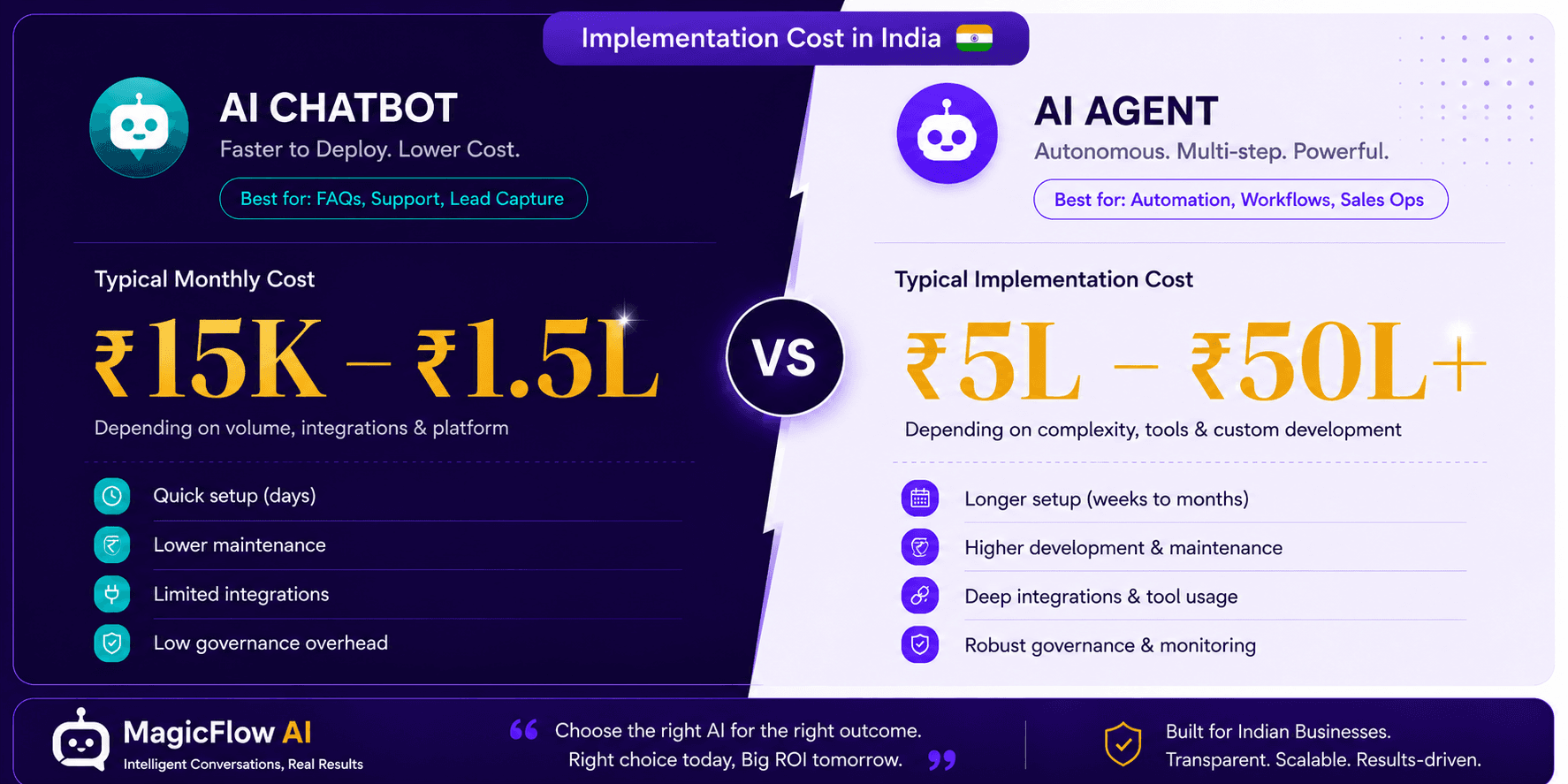
The cost of an AI implementation mistake is not just direct spend. It is the compounding effect of months invested in the wrong solution before the decision gets revisited.
The over-engineering problem
Some businesses deploy full AI agent stacks for problems a well-configured chatbot would solve faster and cheaper. When the actual use case is answering customer questions 24/7, the ROI equation can quickly collapse under custom implementation, governance, and maintenance costs.
The under-investment problem
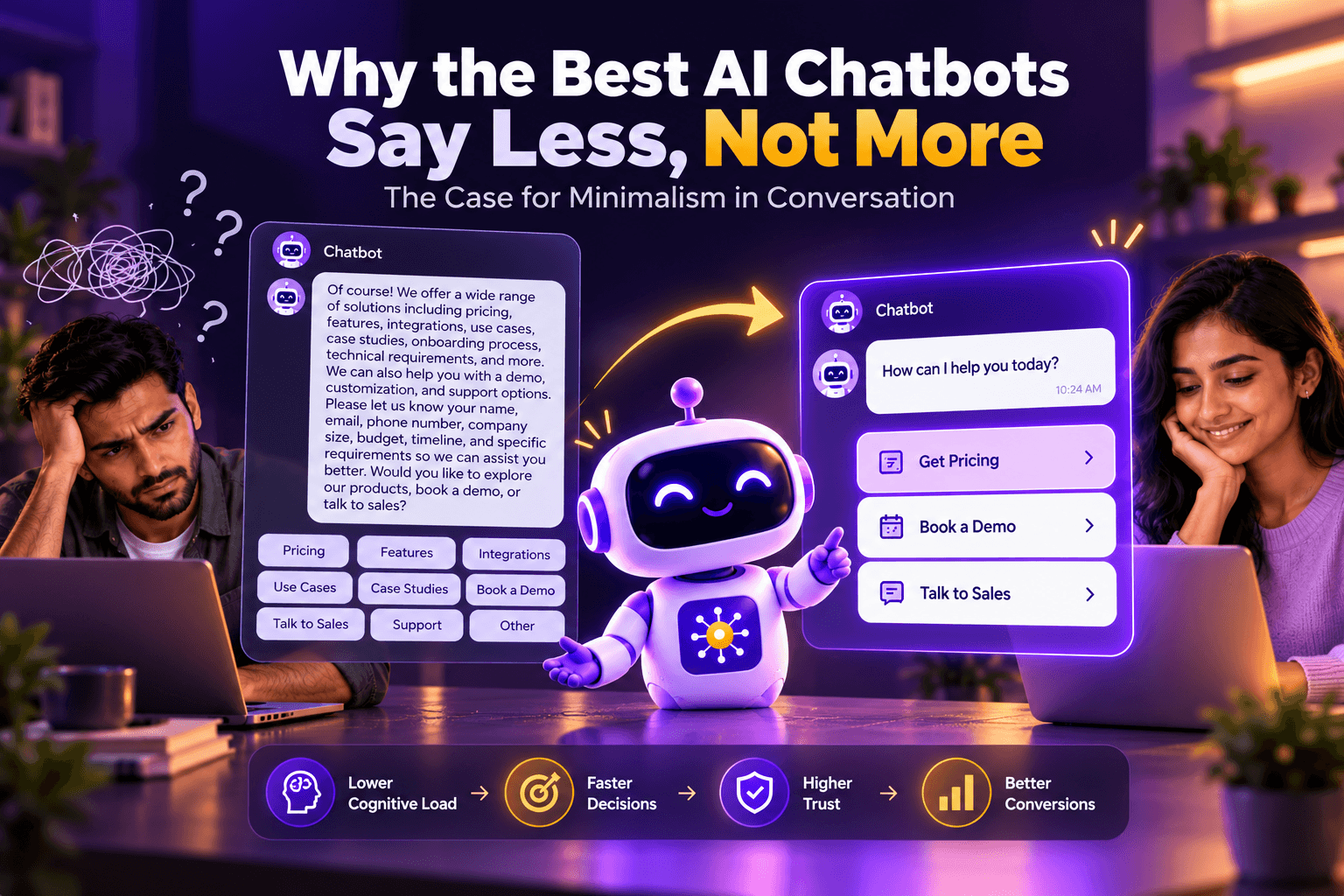
Other businesses deploy basic rule-based chatbots for customer journeys that require context, memory, and multi-step reasoning. A rule-based bot hitting an unscripted edge case returns a dead-end response. In a sales context, that abandoned conversation is a lost customer.
The hidden cost nobody talks about
Customer trust eroded by a poor AI experience is harder to rebuild than implementation spend. The first AI interaction a customer has with your business sets a long-term expectation, and a poorly chosen tool sets the wrong one.
The smarter middle ground: intelligent conversational AI
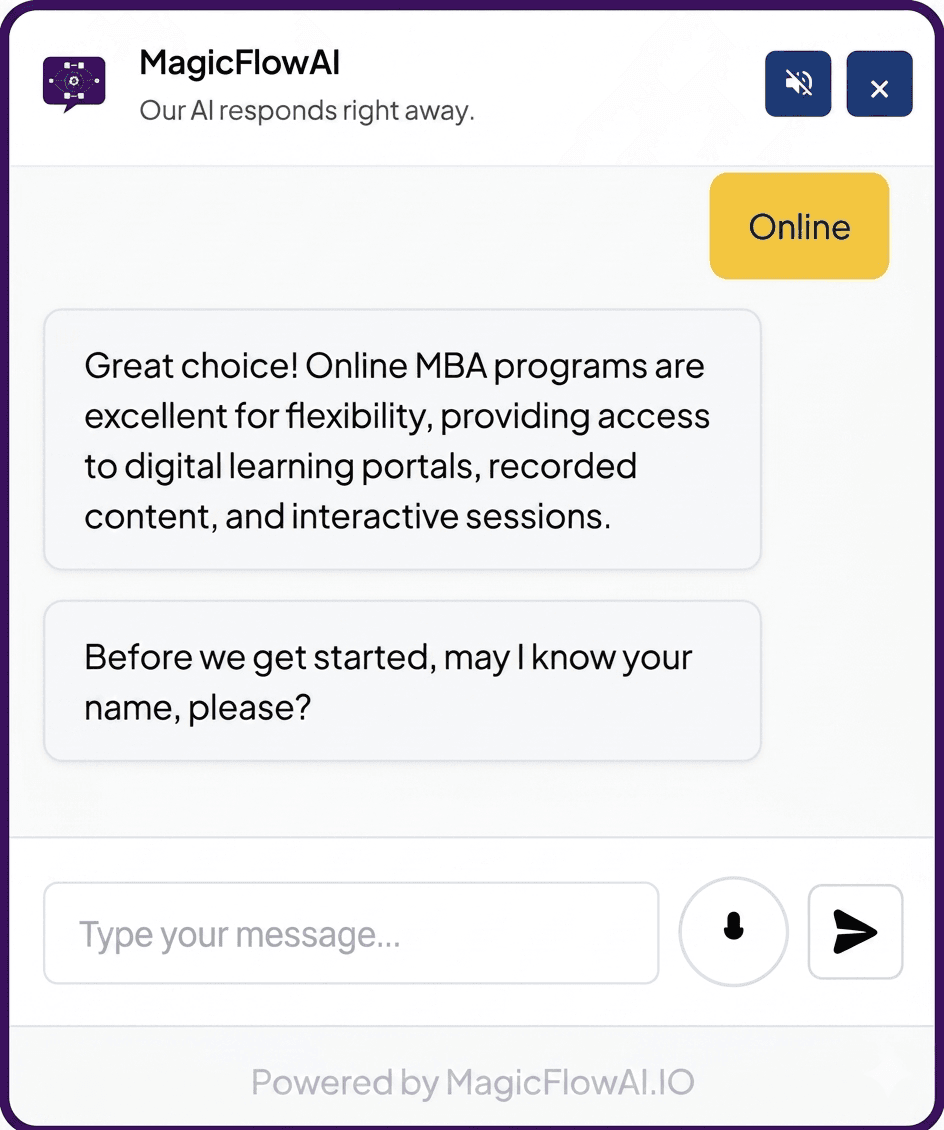
Most businesses considering AI for customer engagement or lead qualification do not need a fully autonomous agent. And many have specific goals that a basic chatbot cannot reliably meet.
The gap between those two poles is where intelligent conversational AI operates. Not reactive and script-bound like a rule-based bot. Not autonomous and complex like a full AI agent. Genuinely intelligent: context-aware, business-aware, and capable of guiding users through goal-oriented conversation flows that produce real outcomes.
MagicFlow AI was built for this category. It is a multi-tenant intelligent conversation platform designed for agencies and businesses managing multiple client relationships at scale. Every conversation is configured to the specific business context it operates in, without the governance overhead and implementation complexity of a custom-built agent system.
The decision is simpler than the market makes it seem
The difference between an AI agent and an AI chatbot is not one of quality. It is one of purpose.
A chatbot is the right tool when the job is to respond: reliably, at scale, around the clock. An AI agent is the right tool when the job is to act: autonomously, across systems, without a human in the loop at every step.
Intelligent conversational AI is the right tool when the job is to engage with context, business awareness, and outcomes in mind.
For most businesses in 2026, the most valuable AI investment is not the most technically complex one. It is the one that fits the actual problem, deploys within a realistic timeline, and delivers measurable outcomes from week one.
References
The following references informed the market context and definitions used in this article.
- McKinsey Global Institute. The State of AI in 2023: Generative AI's Breakout Year. https://www.mckinsey.com/capabilities/quantumblack/our-insights/the-state-of-ai-in-2023-generative-ais-breakout-year
- Gartner Inc. Top Strategic Technology Trends for 2024. https://www.gartner.com/en/articles/gartner-top-10-strategic-technology-trends-for-2024
- Anthropic. Claude Model Documentation and Capabilities Overview. https://docs.anthropic.com
- Salesforce Research. State of Service Report, 6th Edition. https://www.salesforce.com/resources/research-reports/state-of-service/
- IBM Institute for Business Value. CEO's Guide to Generative AI: Agents. https://www.ibm.com/thought-leadership/institute-business-value/report/ceo-generative-ai
- Forrester Research. Predictions 2024: Artificial Intelligence. https://www.forrester.com/report/predictions-2024-artificial-intelligence/
- NASSCOM. Generative AI: Supercharging the IT Industry. https://nasscom.in/knowledge-center/publications/generative-ai-supercharging-it-industry
- Zendesk. Customer Experience Trends Report 2024. https://www.zendesk.com/blog/customer-experience-trends/
- MagicFlow AI. Intelligent Conversations Platform. https://magicflowai.io
Common questions from this article.

Founder, MagicFlow AI | MagicWorks IT Solutions Pvt. Ltd.
Swapnil has been building AI-first digital marketing products and running MagicWorks IT Solutions Pvt. Ltd. since 2012. MagicFlow AI is his latest venture: an intelligent conversational AI platform designed for businesses and agencies that need more than a chatbot and less than a full autonomous agent stack.