.png&w=3840&q=75&dpl=dpl_9MV7dSxCVTkKC3SxGujg9VbenxzN)
The Rs 40 Lakh WhatsApp team problem
You hired five WhatsApp sales executives at Rs 35,000 a month each to handle your D2C brand's customer messages. That is Rs 21 Lakh a year in base salaries alone. Add the team lead, the supervisor, the training cost, the inevitable attrition, the Sunday cover, and the leads that slip through at 11 pm. The real number is closer to Rs 40 Lakh.
You are spending Rs 40 Lakh a year to do work that an AI chatbot now does better, faster, and twenty four hours a day, for under Rs 2 Lakh annually.
This is not a future prediction. This is what Indian D2C founders are already doing, quietly, with results, while their competitors keep hiring. The economics flipped sometime in the last eighteen months, and most brands have not done the maths yet.
This guide breaks down exactly how that shift is happening, what it actually saves, the use cases where it works, the cases where it does not, and how to think about making the move for your own brand.
How WhatsApp quietly became India's biggest sales channel
Before we talk about replacing the team, it helps to understand why the team existed in the first place. WhatsApp is no longer just a messaging app in India. It is the country's primary commerce surface.
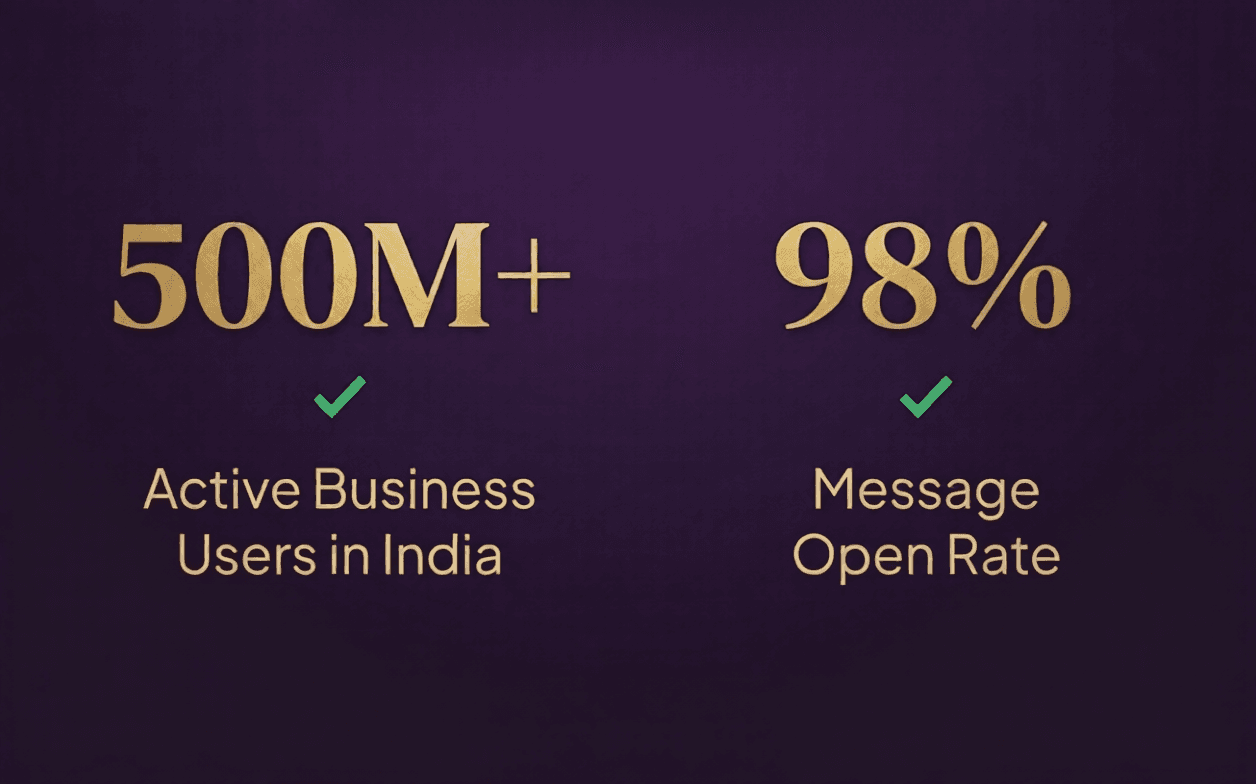
India has the world's largest WhatsApp user base, with more than 500 million active users. WhatsApp Business serves over 50 million businesses globally, and India is the single largest market.
Message open rates on WhatsApp consistently sit at 98 percent, compared to roughly 20 percent for email. The platform's response rates are typically 40 to 50 percent within the first hour. For an Indian D2C brand, that engagement gap is the difference between a sale and an abandoned cart.
So D2C founders built sales teams to live inside WhatsApp: five to ten executives replying to product enquiries, sharing catalog images, taking orders, chasing abandoned carts, and handling complaints. This model worked at small scale. At growth scale it became a budget black hole.
WhatsApp message open rates in India sit at 98 percent. Email open rates sit at roughly 20 percent. That is the gap your competitors are exploiting.
The real cost of a WhatsApp sales team in Indian D2C
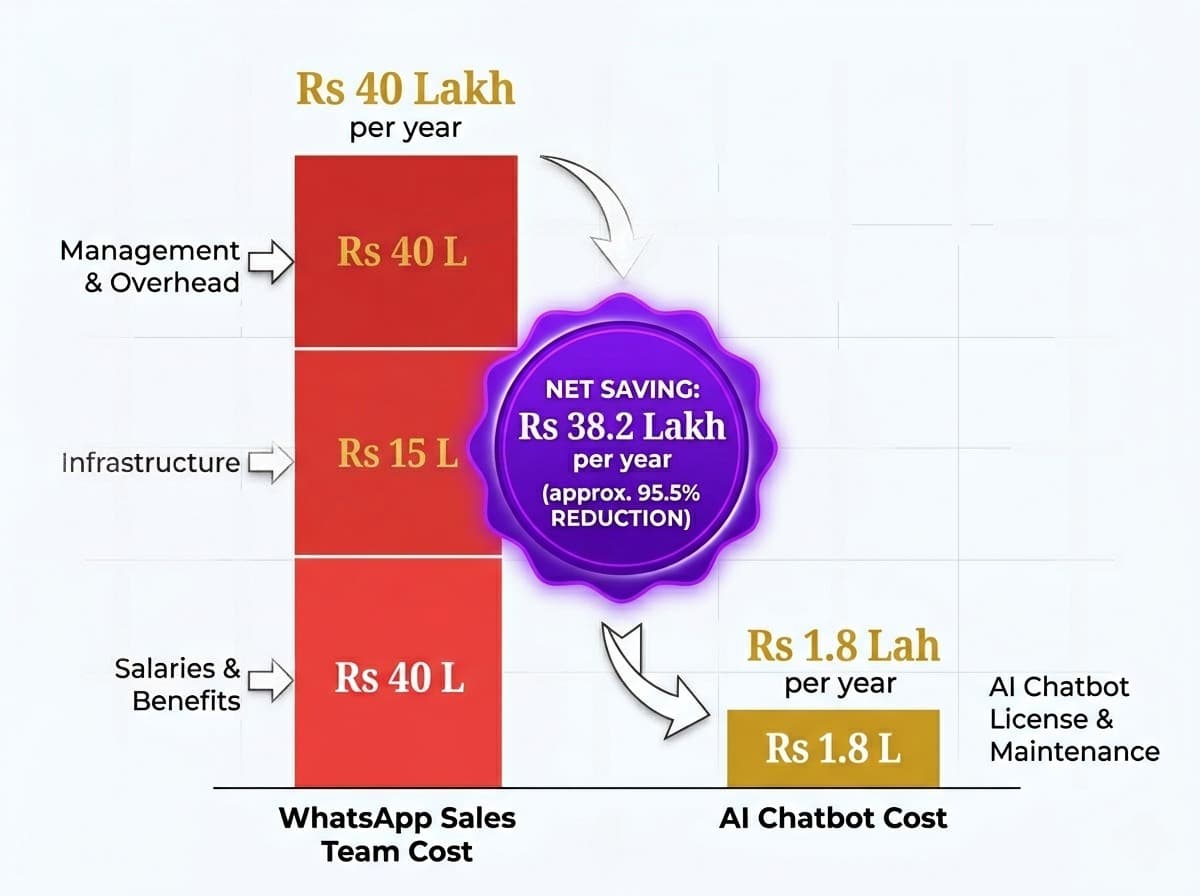
Most founders quote the headline number when asked about their WhatsApp team cost: five people at Rs 35,000 a month, or Rs 21 Lakh a year. That number is wrong. It is the floor, not the actual cost.
The Rs 40 Lakh figure is not an exaggeration. It is the median fully loaded annual cost for a growing Indian D2C brand processing 8,000 to 15,000 WhatsApp conversations per month, once salary benchmarks, attrition, coverage gaps, and lost leads are included.
| Cost area | What it includes | Annual impact |
|---|---|---|
| Base sales team | Five executives at Rs 35,000 per month | Rs 21 Lakh |
| Lead and supervision layer | Team lead, quality checks, reporting, escalations | Rs 6-8 Lakh |
| Hiring and training | Recruitment, onboarding, attrition replacement | Rs 3-5 Lakh |
| After-hours coverage | Weekend, festival, and late-night support | Rs 4-6 Lakh |
| Lead leakage | Slow replies, missed chats, abandoned follow-ups | 15-25% revenue risk |
| Typical fully loaded range | Five to seven person D2C WhatsApp desk | Rs 35-45 Lakh |
Why this cost scales badly
Every new product launch increases enquiry volume, which means more executives. Festival spikes require temporary hires at premium rates. Entry-level chat role attrition in India can run at 30 to 50 percent annually, multiplying recruitment and training costs.
As message volume grows, response time degrades. That directly hurts conversion. Lead leakage after 9 pm and on Sundays is harder to see in dashboards, but it consistently bleeds potential revenue.
What AI chatbots actually do for D2C on WhatsApp
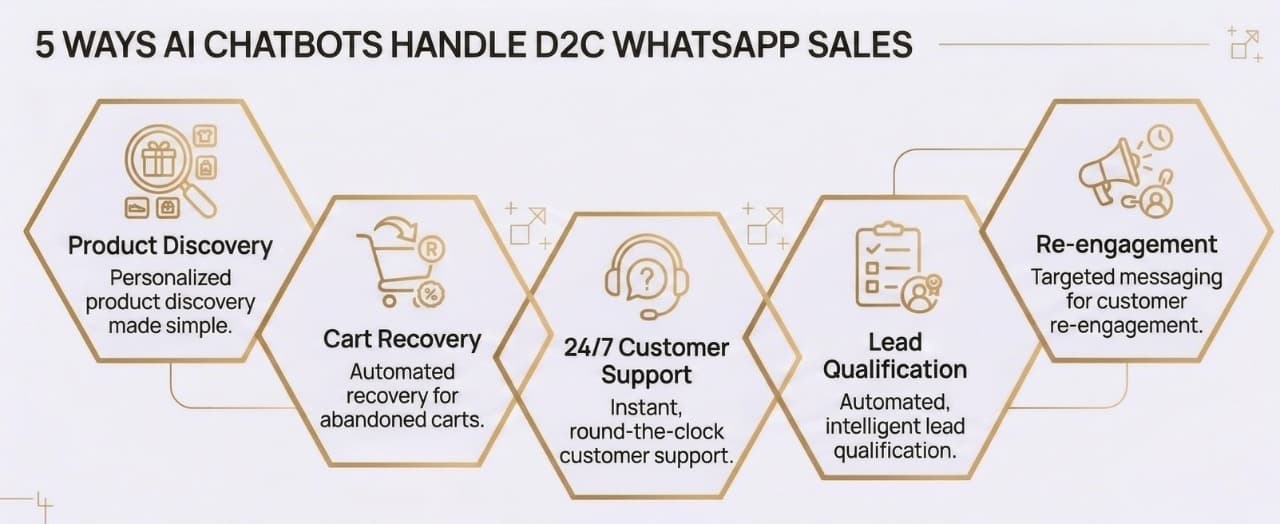
Before diving into the five core use cases, one clarification matters. AI chatbots are not the same thing as AI agents, and using the wrong tool for the wrong job is one of the most expensive mistakes in this space.
For most Indian D2C WhatsApp use cases, what you need is an intelligent conversational AI chatbot, not a full autonomous agent. The chatbot needs to reply accurately, retrieve product knowledge, qualify intent, and route conversations when human help is needed.
1. Product discovery and recommendation
A customer messages, 'Looking for a moisturiser for oily skin under Rs 500.' The AI matches the query to the brand's catalog, surfaces relevant products with images and prices, and offers the option to add one directly to the cart. It does this twenty four hours a day, every day.
2. Cart abandonment recovery
WhatsApp cart recovery converts far better than email cart recovery in Indian D2C. AI chatbots automate the flow: detect abandonment, send a personalised follow-up message, offer a small incentive if needed, and close the order without a human touching the conversation.
3. Order tracking and post-purchase support
'Where is my order?' is consistently the highest-volume query in any Indian D2C support inbox. AI chatbots integrate with shipping providers, pull live tracking data, and respond to the customer in seconds. This use case alone can deflect 40 to 60 percent of support tickets.
4. Lead qualification before sales handoff
For higher-ticket D2C categories such as appliances, premium beauty, or jewellery, AI chatbots qualify the lead first: budget, intent, timeline, location, and preferences. By the time a human sales executive enters, the prospect is pre-qualified and ready to buy.
5. Re-engagement and retention campaigns
AI chatbots run proactive WhatsApp campaigns: new product alerts to past buyers, restock notifications for viewed items, and festival offers segmented by purchase history. The flow operates within WhatsApp Business API template messaging rules, so the brand stays compliant while customers engage.
The use cases where AI does not replace humans
Honesty matters here. AI chatbots are not the right answer for every WhatsApp conversation. The brands that succeed with this shift are the ones that draw the line clearly.
Keep humans on the conversation for high-ticket consultative sales, genuine complaints and refund disputes, influencer or celebrity customer interactions, and wholesale or B2B enquiries that involve price negotiation or custom terms.
The right model is hybrid: AI handles 80 to 90 percent of conversation volume automatically and escalates the remaining 10 to 20 percent to a small human team focused on high-value, high-context interactions. The team does not disappear. It gets smaller, more skilled, and dramatically more productive.
How MagicFlow AI fits Indian D2C specifically
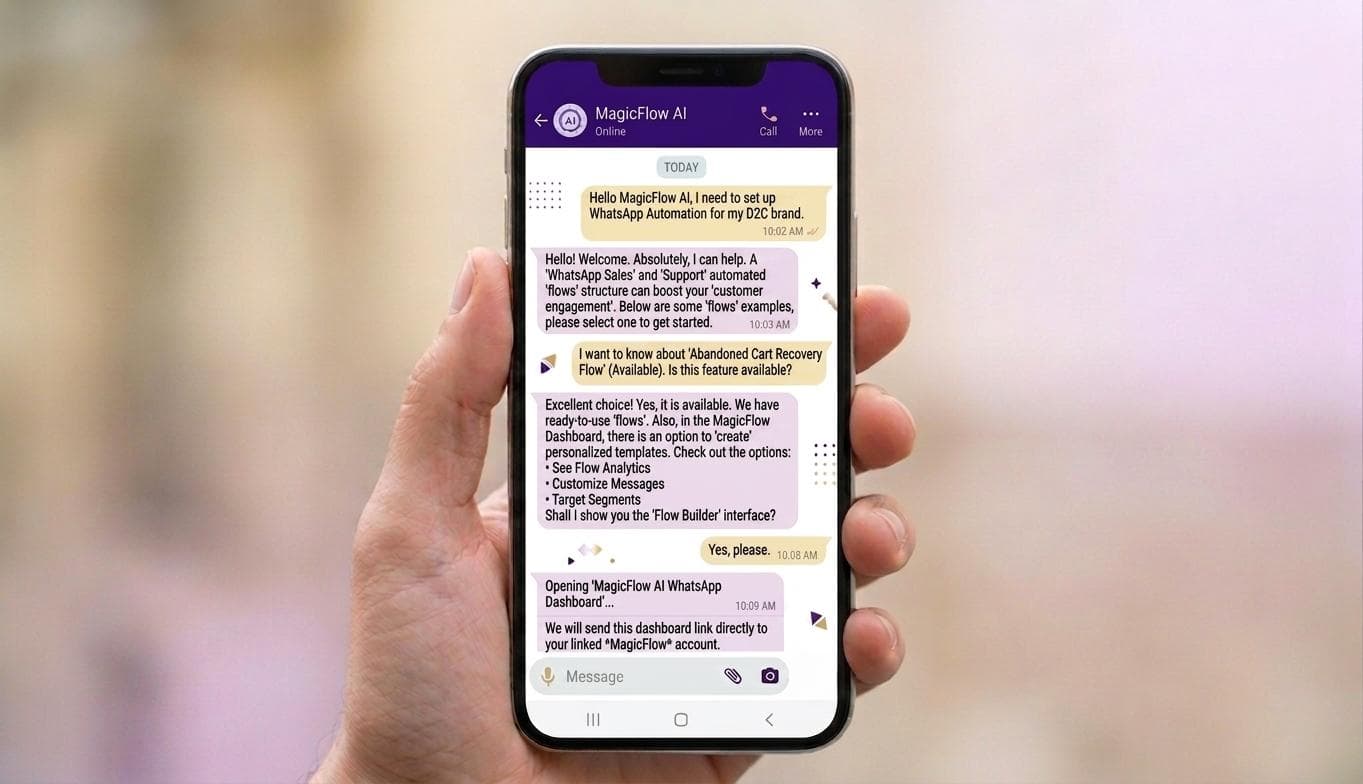
Most global AI chatbot platforms were built for the US or European market. They handle English well, integrate with Salesforce and HubSpot, and price in dollars. None of that is built for an Indian D2C founder running on Shopify or Zoho, talking to customers in Hinglish, and watching margins to the rupee.
MagicFlow AI was built differently. The platform is purpose-built for the Indian conversational commerce stack.
That means WhatsApp Business API integration that can go live quickly, Meta verification support, native Hindi, English, and code-mixed Hinglish handling, support for Indian regional languages, multi-tenant architecture for brands and agencies, INR-denominated pricing, and an Indian customer success team working in your timezone.
MagicFlow AI is not a chatbot builder you configure for six months. It is an intelligent conversational AI platform that goes live in two to three weeks, starts deflecting WhatsApp volume on day one, and can pay back the annual subscription in roughly 60 days for a typical mid-sized D2C brand.
When to make the switch and when to wait
Not every D2C brand should switch to AI on WhatsApp today. The signal framework is simple.
Make the switch now if you are running a three-person or larger WhatsApp sales team, processing more than 3,000 WhatsApp conversations per month, seeing response times above 30 minutes during business hours, missing late-night or weekend demand, or spending most of the team's time on order tracking and basic product enquiries.
Wait, or build a narrower hybrid model, if you are below 1,000 WhatsApp conversations per month, if your category is genuinely consultative, or if your product catalog changes drastically every 30 days and you do not have content operations to keep AI knowledge current.
For everyone in the first group, the economics are no longer debatable. Every month spent running a manual WhatsApp sales operation at scale is roughly Rs 3 Lakh of cash that does not need to leave the business.
The maths has flipped. The market has not caught up yet.
Eighteen months ago, deploying AI on WhatsApp at scale was complicated, expensive, and uncertain. Today it is none of those three things.
Indian D2C brands that move first capture two compounding advantages: dramatically lower customer service costs and dramatically faster response times that lift conversion. The brands that wait will keep paying salary inflation on a team doing work the market no longer rewards.
The decision is no longer whether to automate WhatsApp sales conversations. The decision is whether to start in the next 30 days or the next 30 weeks. The brands that decide quickly compound the saving across every festival season, every product launch, and every customer cohort.
References
The following references informed the market context, benchmark claims, and D2C automation framing used in this article.
- Meta Platforms Inc. WhatsApp Business and Consumer Statistics: India Market Overview. Meta Newsroom and WhatsApp Business reports, 2024. https://about.meta.com/in/news/
- Inc42 Plus and RedSeer Strategy Consultants. State of Indian D2C: Market Outlook 2024. https://inc42.com/reports/
- Mailmodo and Twilio. WhatsApp Business Messaging Benchmark Report. Twilio Inc., 2024. https://www.twilio.com/en-us/reports/
- Zendesk. Customer Experience Trends Report 2024. https://www.zendesk.com/blog/customer-experience-trends/
- McKinsey Global Institute. The Economic Potential of Generative AI: The Next Productivity Frontier. https://www.mckinsey.com/capabilities/mckinsey-digital/our-insights/the-economic-potential-of-generative-ai
- AmbitionBox and Glassdoor India. Customer Support Executive Salary Trends in India. 2024 data. https://www.ambitionbox.com/salaries/
- NASSCOM. India D2C and E-commerce: Technology Adoption Outlook. https://nasscom.in/knowledge-center/publications/
- Forrester Research. The Total Economic Impact of Conversational AI in Retail. https://www.forrester.com/report/
- MagicFlow AI. Intelligent Conversations Platform for Indian D2C. https://magicflowai.io
Common questions from this article.

Founder, MagicFlow AI | MagicWorks IT Solutions Pvt. Ltd.
Swapnil has been building AI-first digital marketing products and running MagicWorks IT Solutions Pvt. Ltd. since 2012. MagicFlow AI is his latest venture: an intelligent conversational AI platform designed for businesses and agencies that need more than a chatbot and less than a full autonomous agent stack.