What is an AI chatbot for real estate?
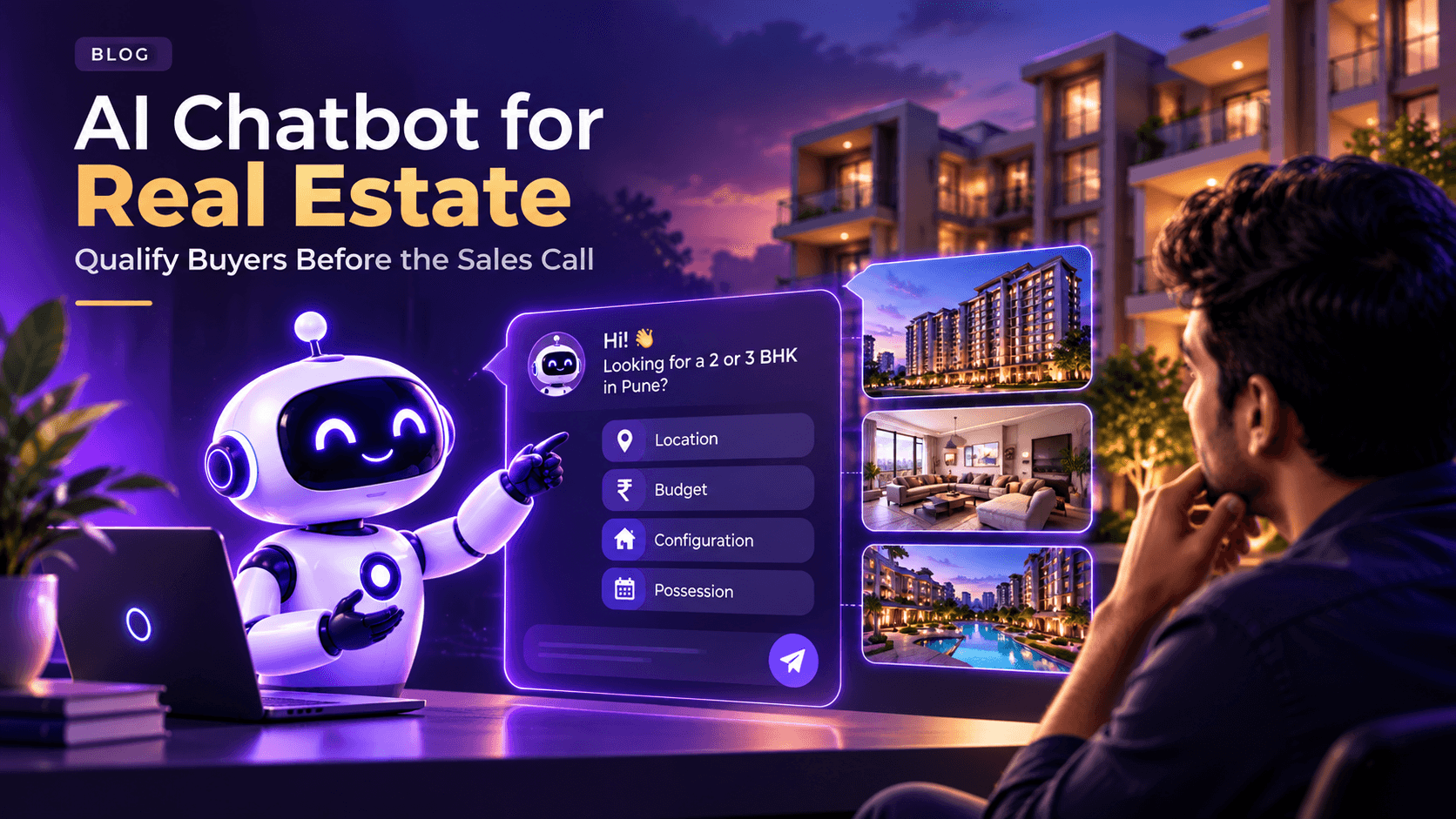
A real estate AI chatbot is a conversational system that interacts with property buyers or investors on a website and helps move them from browsing to a qualified enquiry.
It can ask questions such as these.
| What it learns | Example question |
|---|---|
| Location | Which city or locality are you interested in? |
| Budget | What is your approximate budget? |
| Configuration | Are you looking for 1, 2, 3 or 4 BHK? |
| Purpose | Is this for self-use or investment? |
| Timeline | When do you plan to purchase? |
| Financing | Do you require a home loan? |
| Possession | Are you looking for ready possession or under-construction property? |
| Next step | Would you like the sales team to contact you? |
Answering approved project questions
At the same time, it can answer approved questions about project location, configuration, amenities, price range, possession, builder information, nearby infrastructure, floor plans, financing information and availability.
MagicFlow AI has a dedicated AI Chatbot for Real Estate solution built around this type of qualification and routing workflow.
Why real estate websites generate leads but not enough sales conversations
Most property websites are designed around discovery.
They do an increasingly good job of presenting project imagery, video tours, location maps, amenities, specifications, floor plans, builder information, pricing and brochures.
The problem appears after the visitor develops interest.
The website usually presents one of three options: call now, WhatsApp or fill an enquiry form. Each requires the visitor to take a significant step.
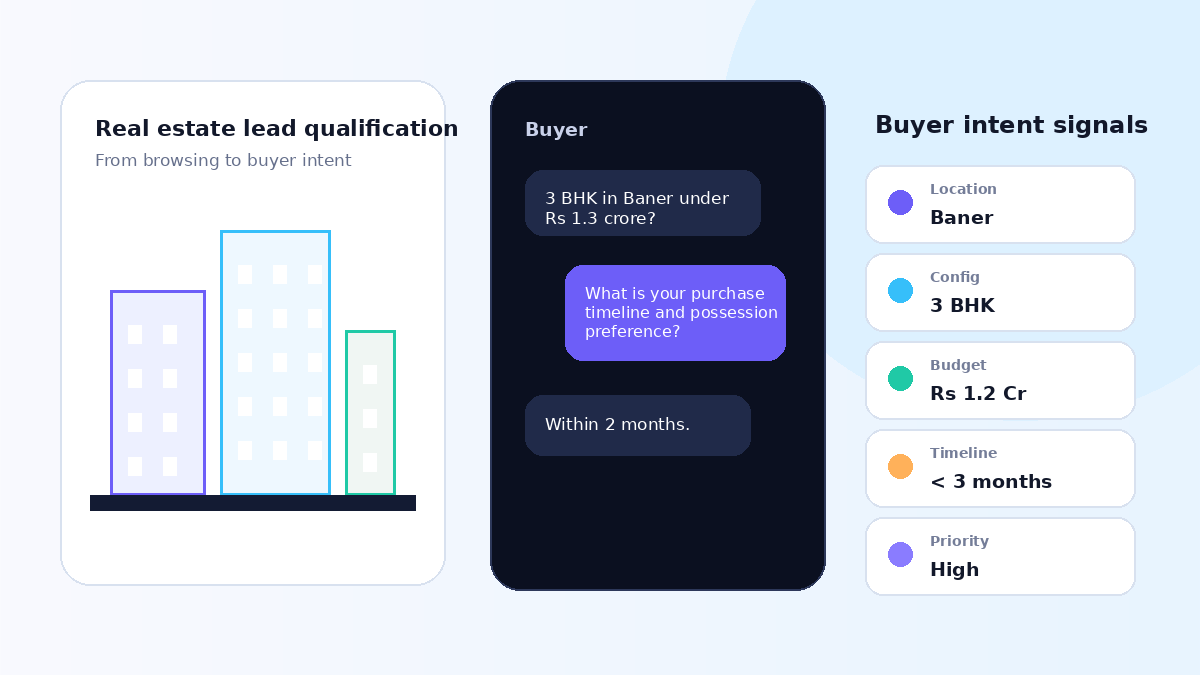
A prospect who is only partly convinced may not be ready to speak with a salesperson. But that same prospect may happily ask, "Is the 3 BHK under Rs 1.2 crore?"
That first question is important. It is the beginning of a sales conversation.
A conversational interface gives the buyer a lower-friction way to begin.
A real estate chatbot should qualify, not merely collect leads
Adding a chatbot that says, "Hi. Please enter your name and phone number," is not much better than adding another form.
The real value appears when the chatbot understands buyer intent.
Consider two leads.
The first contains only a name and phone number.
The second contains the same contact details plus location, configuration, budget, purchase timeline, financing status, possession preference, traffic source, campaign name and the fact that the buyer asked for a Saturday site visit.
Both records represent the same person. Only one tells the sales executive what to do next.
This is the difference between lead capture and lead qualification.
For a broader explanation of the approach, read AI Chatbot for Lead Generation.
The six questions that reveal property buyer intent
Every developer or brokerage will have different qualification criteria, but several dimensions are particularly useful.
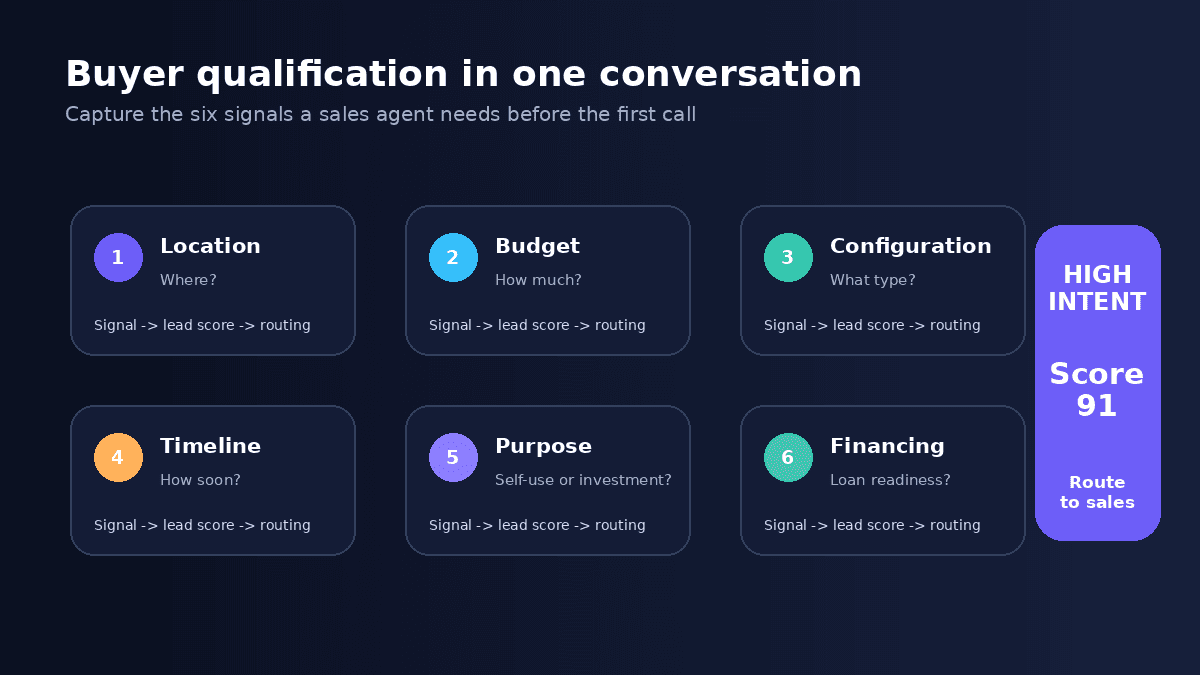
1. Location
A buyer searching for Baner should not automatically be routed to inventory in another part of the city simply because both projects are in Pune. Location intent should be preserved.
2. Budget
Budget is one of the strongest qualification signals in property sales.
The question should be asked naturally, not aggressively. Instead of demanding an exact figure, the chatbot can ask which price range the buyer would be most comfortable exploring.
3. Property configuration
Examples include 1 BHK, 2 BHK, 3 BHK, villa, plot, commercial office, retail or warehouse. This information helps match the enquiry with relevant inventory.
4. Purchase timeline
A buyer planning to purchase within one month should normally receive different sales priority from someone conducting early research for next year.
Useful categories might include immediately, within 1 to 3 months, within 3 to 6 months, 6 months or more, and researching only.
5. Purpose
Self-use and investment buyers often ask different questions.
A self-use buyer may focus on schools, commute, amenities, neighbourhood, possession and family suitability. An investor may care more about rental demand, location development, inventory, project stage and likely exit considerations.
Understanding intent helps the next conversation become more relevant.
6. Financing readiness
A buyer with a home loan pre-approval and immediate purchase timeline may require fast sales follow-up. A buyer who is only beginning to understand financing may need educational information first.
Lead scoring can help sales teams decide who to call first
Real estate teams frequently receive leads from multiple channels at the same time: Google Ads, Meta Ads, property portals, organic search, referral campaigns, landing pages, events, social media and direct traffic.
If every record enters the same queue, the sales team has to manually determine which leads deserve immediate attention.
Lead scoring provides another approach.
| Signal | Possible priority |
|---|---|
| Purchase within 30 days | High |
| Budget matches inventory | High |
| Home loan approved | High |
| Requested site visit | High |
| Asked detailed possession questions | Medium to high |
| Purchase after 12 months | Low |
| Budget significantly below inventory | Low |
| General browsing only | Low |
Surface urgency before the call
The exact score should be designed around the developer or brokerage's actual sales process.
MagicFlow AI's approach to real-time scoring is described in AI Lead Scoring for Indian SMEs.
Real estate advertising needs qualification-level attribution
Property advertising can become expensive.
A campaign may produce many enquiries but very few serious buyers. Another may produce fewer enquiries but a much higher proportion of qualified prospects.
Raw cost per lead does not show this distinction.
Consider an illustrative example. Campaign A spends Rs 1,50,000 and produces 150 leads, for a cost per lead of Rs 1,000. Campaign B spends the same amount and produces 90 leads, so its cost per lead is Rs 1,667.
Campaign A wins on cost per lead.
But if Campaign A produces only 20 qualified buyers and Campaign B produces 38, the picture changes. Campaign B can be much more valuable despite the higher headline CPL.
| Campaign A | Campaign B | |
|---|---|---|
| Spend | Rs 1,50,000 | Rs 1,50,000 |
| Leads | 150 | 90 |
| Cost per lead | Rs 1,000 | Rs 1,667 |
| Qualified buyers | 20 | 38 |
| Cost per qualified buyer | Rs 7,500 | Rs 3,947 |
Keep campaign context attached to the buyer
That is why an AI chatbot should preserve campaign context such as UTM source, medium, campaign, landing page and, where available, ad or creative details, then connect that context to qualification data.
This turns "Google Ads generated 150 leads" into a more useful statement: a specific campaign generated buyers matching inventory, budget and near-term purchase criteria.
Read UTM Attribution for AI Chatbots for the technical and marketing logic behind this approach.
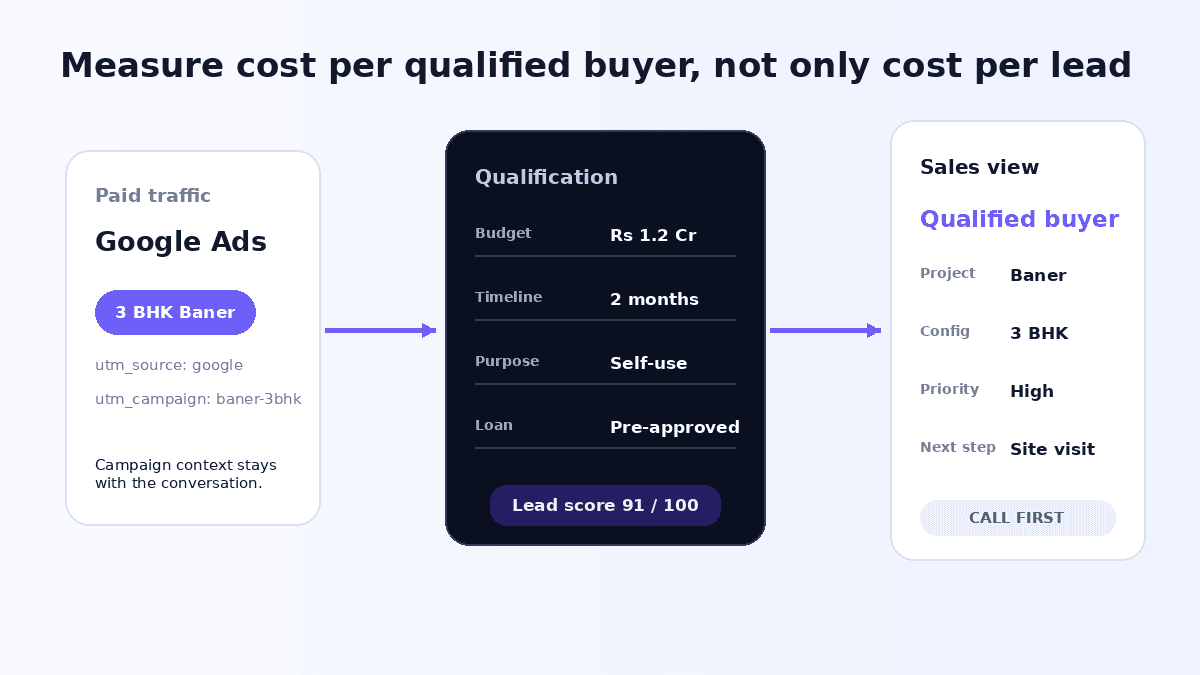
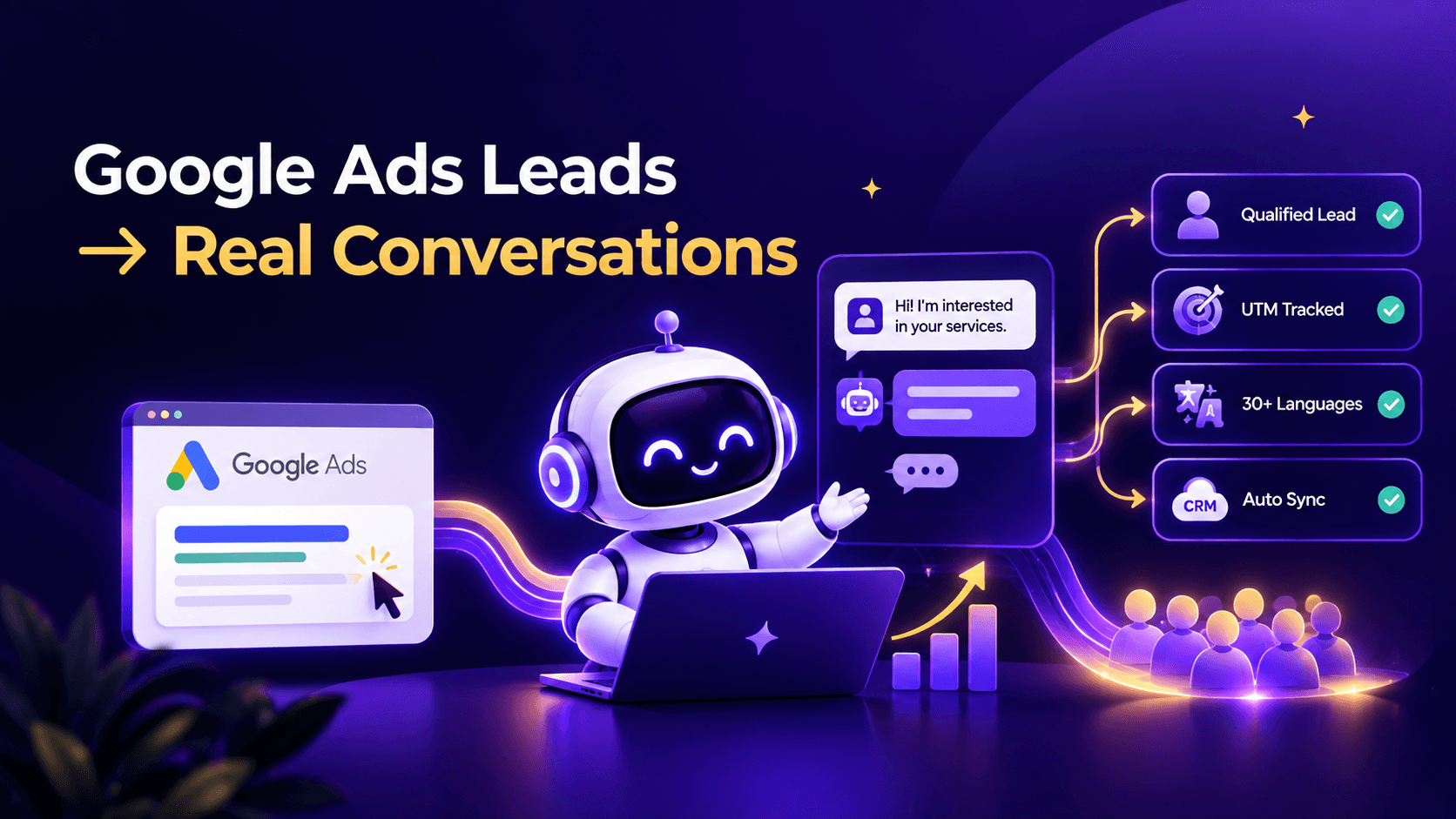
How an AI chatbot can improve Google Ads traffic
Google Search traffic often carries explicit intent.
Someone searching for "3 BHK apartment in Baner Pune" is telling you something valuable before reaching the site.
But a standard landing page can still lose the visitor after the click.
An AI chatbot can continue the context by asking whether the visitor wants to check available options, budget range or possession status.
Campaign source can stay attached to the resulting conversation. Qualification information can then be passed to the sales team.
For a deeper discussion of this workflow, see AI Chatbot for Google Ads Leads.
The chatbot should know the property, not invent the property
Accuracy is particularly important in real estate.
A conversational system should never casually manufacture price, inventory, possession date, RERA details, floor area, amenities, financing terms or project status.
The correct architecture is grounded knowledge.
MagicFlow AI's knowledge base capability is designed to use approved website and document content for responses. The broader system is described on the Features page.
The knowledge base could include project pages, brochures, price sheets, approved FAQs, floor plans, location details, builder information, possession information and policy documents.
When project information changes, the source content needs to be updated as part of the operating process.
AI does not remove the requirement for accurate property data. It increases the importance of it.
A practical real estate chatbot journey
Imagine a buyer arrives at a property page.
Stage 1: Opening
The chatbot recognises that the visitor is on a Pune project page and offers help with configuration, budget and possession questions.
Stage 2: Location intent
The buyer identifies Baner as the preferred location.
Stage 3: Configuration
The chatbot asks whether the buyer is looking for a 2 BHK, 3 BHK or another configuration.
Stage 4: Budget
The chatbot asks for a comfortable budget range.
Stage 5: Timeline
The chatbot asks whether the buyer is looking to purchase immediately, within three months or later.
Stage 6: Financing
The chatbot asks whether home loan assistance is required.
Stage 7: Site visit intent
The buyer asks whether a Saturday visit is possible.
At this point, the system has substantial context. It can capture the visitor's contact information and route the lead for human follow-up.
The salesperson does not receive "Rahul, interested in property." They receive a near-term 3 BHK buyer with budget fit and financing readiness.
Why multilingual chat matters in real estate
Real estate conversations are often naturally multilingual.
A buyer may read the project website in English and ask a question in Hindi or Marathi. Another may switch languages during the same conversation.
Forcing that person into formal English creates unnecessary friction.
A multilingual chatbot can let prospects ask questions in the language in which they are most comfortable while keeping the lead qualification structure consistent.
This is especially relevant when selling properties across cities and regions.
The topic is covered more extensively in Hindi and Regional-Language Chatbots.
AI chatbot versus contact form for real estate
| Capability | Property enquiry form | AI real estate chatbot |
|---|---|---|
| Answers property questions | No | Yes |
| Captures budget | If field exists | Conversationally |
| Captures timeline | Sometimes | Yes |
| Understands follow-up questions | No | Yes |
| Handles after-hours visitors | Form submission only | Interactive |
| Qualification | Limited | Adaptive |
| Campaign attribution | Possible | Can remain connected |
| Lead scoring | Usually separate | Can be integrated |
| Multilingual interaction | Rare | Possible |
| Knowledge base answers | No | Yes |
| Sales context | Limited fields | Conversation plus structured data |
Forms should not disappear completely
They remain useful for booking requests, detailed applications, download forms, formal registrations and structured submissions.
The chatbot's strength is earlier in the journey, where the visitor still has questions.
Ten real estate chatbot use cases
1. Project discovery
Help visitors identify projects relevant to their location and budget.
2. Configuration qualification
Separate 1 BHK, 2 BHK, 3 BHK, villa and other requirements.
3. Budget qualification
Determine whether the buyer matches available inventory.
4. Possession questions
Answer using approved project information.
5. Home loan enquiries
Provide approved information and identify buyers who need financing assistance.
6. Site visit intent
Capture buyers who want to visit and route them quickly to the relevant sales team.
7. Investment enquiries
Identify whether the prospect is purchasing for investment or self-use.
8. After-hours lead capture
Continue the conversation when the sales office is unavailable.
9. Multilingual enquiries
Allow prospects to communicate more naturally.
10. Campaign qualification
Connect paid media traffic with actual buyer quality rather than raw enquiry count.
What should the salesperson receive?
The handoff should be concise. An overloaded CRM record is not useful.
A practical lead card could include buyer name, location, configuration, budget, timeline, purchase purpose, financing status, main question, source, campaign, priority and a short summary.
This gives the salesperson a reason to call and a clear way to open the conversation.
MagicFlow AI is designed to send structured lead information into the next workflow rather than leaving valuable context trapped inside the chatbot. See MagicFlow AI Integrations.
What not to automate
Property purchases are major financial and emotional decisions.
AI should not replace humans for conversations involving negotiation, legal interpretation, binding commitments, individual financial advice, complex financing, exceptional pricing, contract interpretation, sensitive complaints or final closing.
The AI should make human salespeople more effective.
Automate repetition, accelerate qualification and preserve human judgement.
Metrics a real estate company should track
Do not stop at chatbot engagement.
| Area | Metrics |
|---|---|
| Engagement | Conversations started, contact capture rate |
| Lead quality | Qualified buyer rate, high intent buyer rate, average lead score by campaign, site visit intent rate |
| Cost | Cost per qualified buyer |
| Lead mix | Leads by project, configuration, budget, purchase timeline and campaign |
| Sales outcomes | Sales response time, site visits completed, bookings from chatbot-originated leads |
| Gaps to fix | Questions the AI could not answer, human escalation rate |
One funnel for every team
Marketing, sales and management should ideally be looking at the same funnel.
A 30-day implementation framework
Week 1: Analyse real sales conversations
Collect the questions agents repeatedly answer. Review CRM notes, call transcripts, WhatsApp conversations, website forms, campaign landing pages and sales FAQs.
Week 2: Structure property knowledge
Prepare approved information for your priority projects. Include inventory categories, price ranges, configuration, possession, amenities and common questions.
Week 3: Build qualification logic
Define what makes a lead high priority, medium priority, nurture or not currently matched. Configure routing rules around territory, project or sales team.
Week 4: Launch and review
Test the complete journey: Ad → Landing page → Chat → Qualification → Contact capture → Attribution → CRM → Sales follow-up.
Then review actual conversations.
The launch is the beginning of optimisation, not the end.
How much does a real estate AI chatbot cost?
The answer depends on website traffic, conversation volume, number of projects, CRM requirements, lead scoring, multilingual support, knowledge base size, reporting and routing complexity.
Rather than comparing only monthly software price, calculate your current cost per qualified property buyer.
Then evaluate whether better conversational capture and qualification can improve that figure.
MagicFlow AI's current plans are available on the Pricing page.
From property traffic to qualified buyer conversations
The biggest mistake is thinking about a real estate chatbot as another website feature.
The better question is whether your website can continue a sales conversation when the salesperson is not yet involved.
A buyer arrives. They ask a question. The website answers. Their requirements become clearer. Their campaign source remains attached. Their intent is scored. Their contact information is captured. The right salesperson receives the enquiry with context. Then the human conversation begins.
That is very different from asking every visitor to fill out the same five-field form.
For real estate businesses investing heavily in digital lead generation, the opportunity is not simply to generate more enquiries. It is to understand the enquiries you already generate much earlier.
Explore MagicFlow AI for Real Estate, review the complete MagicFlow AI Features, or read the AI Chatbot for India guide if you are evaluating how conversational AI can fit into your property lead-generation funnel.
Common questions from this article.

Chief Marketing and AI Officer (CMAIO), MagicWorks IT Solutions
Mohan Chute is Chief Marketing and AI Officer at MagicWorks IT Solutions, with 23+ years across go-to-market strategy, technology, and digital transformation. He built and scaled MagicFlow AI from concept to client deployment and pioneered the agency's AEO/GEO practice, helping brands earn visibility in AI-generated answers across ChatGPT, Perplexity, and Gemini.