The short answer
Every website has two kinds of visitors. The first group fills in the form. The second group reads, scrolls, compares, thinks it over, and leaves without saying a word.
The second group is almost always the larger one, and it is almost always invisible. In your analytics it shows up as sessions and bounce rate. In your sales pipeline it does not show up at all. Yet these are people who found you, spent time with you, and had a reason to be there.
An AI chatbot for your website exists to speak to that silent majority. It is a conversational assistant, built on a language model and grounded in your own content, that greets visitors, answers their questions, asks qualifying questions one at a time and captures the enquiry with campaign context attached. Unlike a scripted bot that follows fixed paths, it understands free text and holds the context of the conversation. It addresses the biggest leak in most funnels: visitors who never submit the form.
What is an AI chatbot for a website?
The word "chatbot" covers two very different technologies, and the difference matters for lead capture.
A scripted or rule based chatbot follows a decision tree. It offers a menu of pre written options, and when a visitor types something it did not anticipate, it repeats itself, shows the menu again or hands off with a generic apology.
An AI based chatbot is built on a language model. It interprets natural language however it is phrased, keeps track of what was said earlier in the conversation, and, when it is connected to a knowledge base, retrieves answers from your own website, documents and PDFs instead of reciting a script. This approach is called retrieval augmented generation, or RAG.
MagicFlow AI is built on the second model. It is a RAG based AI chatbot, not a script, which is why the rest of this guide assumes an AI based system.
| Capability | Contact form | Scripted chatbot | AI based chatbot |
|---|---|---|---|
| Understands a question phrased in any way | Not applicable | Only if it matches a script | Yes |
| Remembers what was said earlier | Not applicable | Limited | Yes |
| Answers from your own content | No | Only pre written answers | Yes, when grounded in a knowledge base |
| Qualifies the visitor | Fixed fields | Fixed branches | Conversationally, one question at a time |
| Captures campaign source | Needs extra setup | Needs extra setup | Can be stamped automatically |
| Available at 2 AM | Passive | Yes | Yes, and it can respond |
The silent visitor problem, in numbers
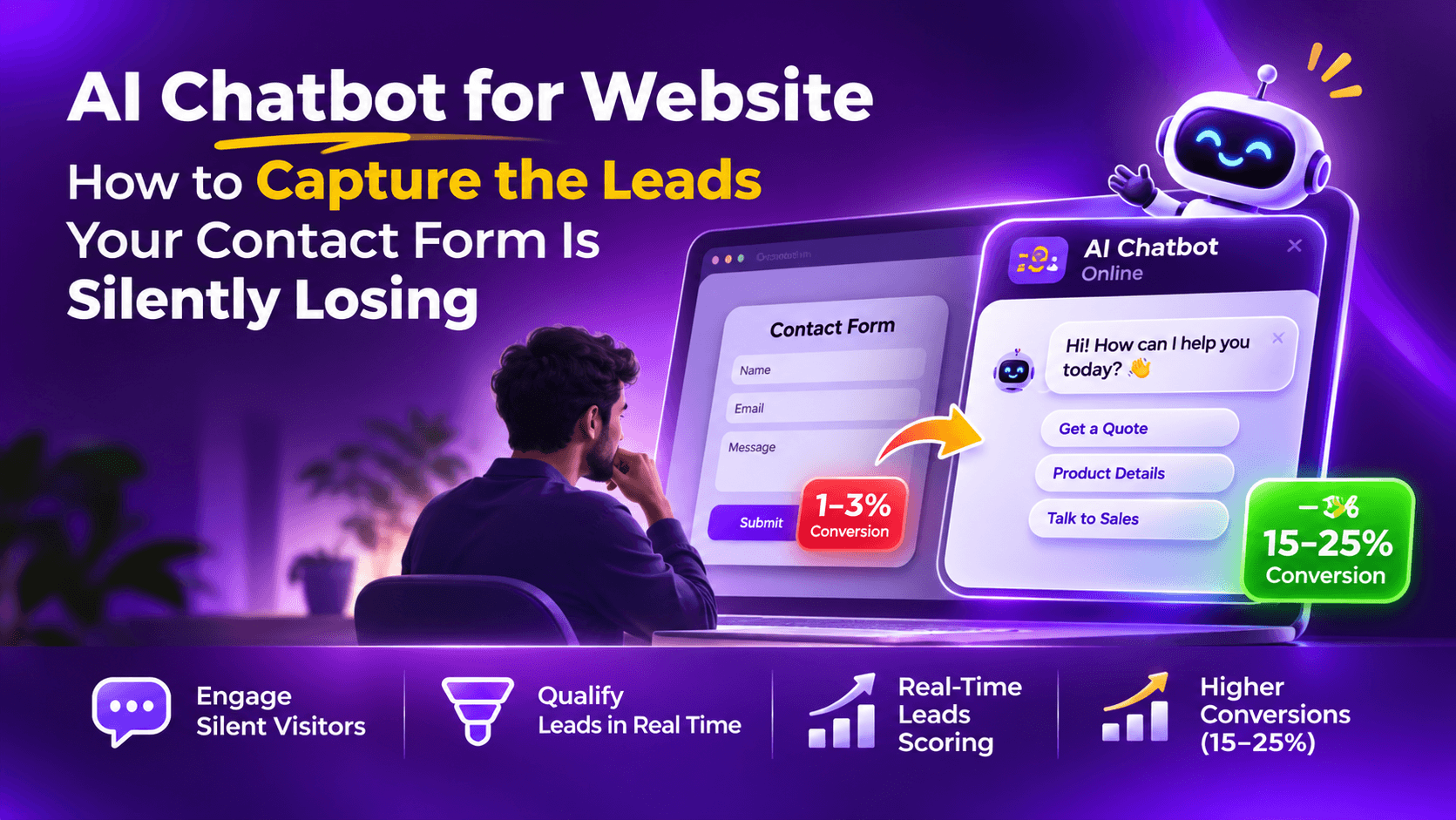
The case for change starts with what forms actually achieve. Contact forms convert roughly 1 to 3 percent of the visitors who reach the page that hosts them. About 81 percent of people who begin filling in a contact form abandon it before submitting. Completion falls as fields increase, from around 23 percent for a form with three fields to under 7 percent for forms with ten or more.
Conversational channels report much higher figures. Vendor benchmark reports put conversational AI conversion at 15 to 25 percent, against 2 to 3 percent for static forms, while an aggregator of chat statistics reports chat engagement rates of 10 to 20 percent across verticals.
A word of caution is needed here. Most chatbot benchmarks are published by chatbot vendors, and some measure only the visitors who choose to engage with the chat, not all traffic. Treat them as a direction, not a promise. The honest way to know your own number is to test it on your own traffic, which this guide covers later.
| Measure | Benchmark |
|---|---|
| Contact form conversion | 1 to 3 percent of visitors |
| Visitors who start a form and abandon it | About 81 percent |
| Completion, three field form | Around 23 percent |
| Completion, ten or more fields | Under 7 percent |
| Conversational AI conversion (vendor reported) | 15 to 25 percent |
Three shifts making this urgent in 2026
1. Visitors now arrive mid-conversation
A growing share of visitors reach websites after asking an AI assistant a question. The data on how well they convert is mixed, and it should be read carefully.
Adobe's April 2026 AI traffic report found that visitors referred by generative AI tools in March 2026 were 42 percent more likely to purchase and generated 37 percent more revenue per visit than visitors from other channels. Against that, an October 2025 academic study of ChatGPT referrals to e-commerce sites found that ChatGPT accounted for less than 0.2 percent of traffic and that organic search converted about 13 percent better.
Both can be true, and AI referrals are still a small share of traffic. What matters for your website is the behaviour behind the click. These visitors have usually already asked questions and received answers before they arrive. A page that greets them with a blank form asks them to start again. A chatbot can continue the conversation.
2. Privacy law now shapes lead capture
India's Digital Personal Data Protection Rules, 2025 were notified by MeitY in November 2025. The substantive obligations, including those on notice and consent, apply 18 months after publication, which is 13 May 2027. Law firm summaries of the rules note that a notice in the prescribed form must accompany or precede a request for consent.
For a website chatbot, the practical meaning is simple. Before the chat collects a name, phone number or email address, it should tell the visitor what is being collected and why, and it should record their agreement. A conversational flow can do this far more naturally than a footer link nobody reads. This is general information, not legal advice, so confirm your own obligations with a qualified adviser.
3. Paid clicks keep getting more expensive
WordStream's benchmark study recorded an average Google Ads cost per click of $2.32 when it was first published in 2016. Its 2026 edition puts the figure at $5.42. When the price of a visit only rises, the share of visits you convert becomes the lever you control. Every paid visitor who leaves silently is a cost you have already paid. We work through the maths in why an AI chatbot is the best partner for paid campaigns.
How an AI chatbot captures a lead: five stages
A well configured AI chatbot works through five stages. Each one fixes a specific weakness of the form.
1. Greet with context
A generic "How can I help?" is easy to ignore. A greeting based on the page the visitor is on, or the campaign they came from, is harder to ignore. A visitor on a pricing page and a visitor on a blog post are in different moods, and the opening line should reflect that.
2. Answer before asking
Research on conversational agents shows that when a chatbot offers something first, users respond with deeper self-disclosure. In practice, answer the visitor's question before you ask for any details. This is the reciprocity that a blank form never provides.
3. Qualify one question at a time
Instead of ten fields at once, the chatbot asks a short sequence: what the visitor needs, their timeline, their location, their budget range. Each answer is acknowledged. The same information is gathered, with far less effort felt at any single moment.
4. Capture with consent
Once the visitor is ready to share contact details, the chat shows the notice, states the purpose and records consent. This is where the DPDP requirement sits naturally in the flow.
5. Route with context
The final step decides whether the lead is useful. MagicFlow AI stamps each conversation with UTM source, medium, campaign and landing page, scores it live using qualification answers, source quality, page intent and engagement, and passes it to your team with CRM ready fields and email alerts, so the sales team works the hot enquiries first. See the full list on our features page.
Where to place it and when to trigger it
Placement matters as much as technology. For a page by page walkthrough, see where to place an AI chatbot on your website.
High intent pages first
Pricing, service, product and campaign landing pages are where a question is most likely to be forming.
Match the opening to the source
A visitor from a Google search and a visitor from a Meta ad arrive with different expectations.
Do not interrupt on arrival
A chat window that opens before the visitor has read anything feels like pressure. A launcher that offers help, and a proactive message after meaningful engagement, respects the visitor's attention.
Keep the mobile window compact
On a phone, a large chat panel hides the very page the visitor came to read.
What to set up before you go live
An AI chatbot is only as good as the preparation behind it.
1. Build the knowledge base
Point the chatbot at your website, product or service documents and PDFs, so its answers come from your real content.
2. Write three to five qualification questions
Decide what your sales team actually needs to know before a call.
3. Set the handoff threshold
Decide when a conversation should go to a person, such as a high score, a complaint or a request for a call.
4. Configure routing and hours
Decide who receives which leads and what happens outside business hours. MagicFlow AI connects to the tools your team already uses; see integrations.
5. Choose the languages
If your visitors use Hindi, Marathi, Tamil or other regional languages, make sure the chatbot replies in them. MagicFlow AI auto detects the visitor's language.
6. Add the consent notice
Draft the wording with your legal adviser.
7. Test with real questions
Run twenty questions your customers actually ask, including awkward ones, before launch.
MagicFlow AI's team handles configuration, UTM tracking, CRM routing and brand styling as a managed setup, with a stated go-live time of 48 hours and a 30 day free trial. Plans are listed in rupees on the pricing page, and the embed guide shows how the widget goes on your site.
How to measure whether it is working
Do not judge a chatbot by the number of chats. Judge it by the quality of the leads it produces.
A simple illustration shows why modest gains matter. Suppose a site receives 5,000 visitors a month and its form converts 2 percent, which gives 100 leads. If a chatbot captures just one additional percent of visitors, that is 50 more leads, a 50 percent increase. This is an illustration, not a forecast. Your own numbers will differ.
To test properly, split traffic or run the chatbot for a defined period alongside the form, compare cost per qualified lead over several weeks, and use the UTM data on each conversation to see which campaigns produce the best enquiries.
| Metric | What it tells you |
|---|---|
| Chat engagement rate | How many visitors choose to start a conversation |
| Chat to lead rate | How many conversations end in captured contact details |
| Qualified lead rate | How many of those leads match your ideal customer |
| First response time | How quickly a visitor receives a useful reply |
| Cost per qualified lead | Ad spend divided by qualified leads, the number that matters most |
| Unanswered question rate | Gaps in your knowledge base |
Common mistakes to avoid
Choosing a scripted bot because it looks cheaper
Every failed conversation is a lead lost at the moment intent was highest.
Launching without a knowledge base
Vague or wrong answers destroy the trust the chatbot was meant to build.
Skipping the consent step
Collecting personal data without a clear notice creates avoidable legal risk as DPDP obligations come into force.
Never reviewing conversations
Transcripts show what visitors really ask and where your website fails to answer.
Leaving no route to a human
Customers dislike being trapped by automation, a point we return to in our guide to support triage.
What MagicFlow AI customers report
These are customer reported results published by MagicFlow AI, not guarantees.
A distance MBA college reported 41 percent more qualified counselling calls in the first 30 days, with no additional ad spend. Dnyanal Educon Pvt. Ltd. reported 34 percent faster appointment qualification across 14 locations. The Holistic Care reported a 29 percent lift in demo ready B2B leads within 45 days.
The takeaway
Your website is not short of visitors. It is short of conversations. The contact form was built for a time when a visitor who wanted something would simply fill it in, and most no longer do.
An AI based chatbot gives the silent majority a reason to speak: it answers first, asks gently, captures consent and passes your team a lead with context. Start with a clear goal, a good knowledge base and a way to measure cost per qualified lead. The rest is testing.
- SplitForms, Contact Form Conversion Rate: Benchmarks and 12 Fixes https://splitforms.com/blog/contact-form-conversion-rate
- Numen Technology, Contact Form Optimization: Fix 81% Abandonment Rate https://www.numentechnology.co.uk/blog/contact-form-optimization-conversion-rates
- Practical Ecommerce, Mixed Reports on AI Ecommerce Traffic (summarising Adobe Digital Insights, April 2026, and Kaiser and Schulze, October 2025) https://www.practicalecommerce.com/?p=1562711
- S.S. Rana and Co., MeitY Notifies Final Digital Personal Data Protection Rules 2025 https://ssrana.in/articles/meity-notifies-final-digital-personal-data-protection-rules-2025/
- AZB and Partners, Update: India's Digital Personal Data Protection Framework Comes Into Effect https://www.mondaq.com/india/privacy-protection/1708314/update-indias-digital-personal-data-protection-framework-comes-into-effect
- Digital Applied, Form Conversion Rate Benchmarks 2026: 100+ Data Points https://www.digitalapplied.com/blog/form-conversion-rate-benchmarks-2026-data-points
- Wonderchat, The B2B Website Conversion Benchmark Report 2026 (vendor report) https://wonderchat.io/blog/b2b-website-conversion-report-2026
- Which-50, Chat-to-Conversion Rate Statistics By Industry https://which-50.com/chat-to-conversion-rate-statistics-by-industry/
- PPC Land, Google Ads CPL drops for first time since 2020 as CPC hits $5.42 (WordStream 2026 benchmarks) https://ppc.land/google-ads-cpl-drops-for-first-time-since-2020-as-cpc-hits-5-42/
- arXiv, Dialoging Resonance: How Users Perceive, Reciprocate and React to Chatbot's Self-Disclosure in Conversational Recommendations https://arxiv.org/pdf/2106.01666
- MagicFlow AI, homepage (features, setup, pricing, customer results) https://www.magicflowai.io/
Common questions from this article.

Head of Digital Marketing, MagicWorks IT Solutions
Purva Desai is the Head of Digital Marketing at MagicWorks IT Solutions, bringing 16 years of experience across visual arts and digital strategy. A trained artist with a Master's in Visual Art and a background in art therapy, she began her career as a graphic designer, later working as an Art Director before moving into performance marketing, SEO, and brand strategy. This dual foundation, art and analytics, shapes how she approaches marketing: understanding not just what drives clicks, but what drives human perception and emotion. She now leads MagicWorks' digital marketing department, writing on AI, buyer psychology, and the evolving intersection of creativity and data in marketing.