The short answer
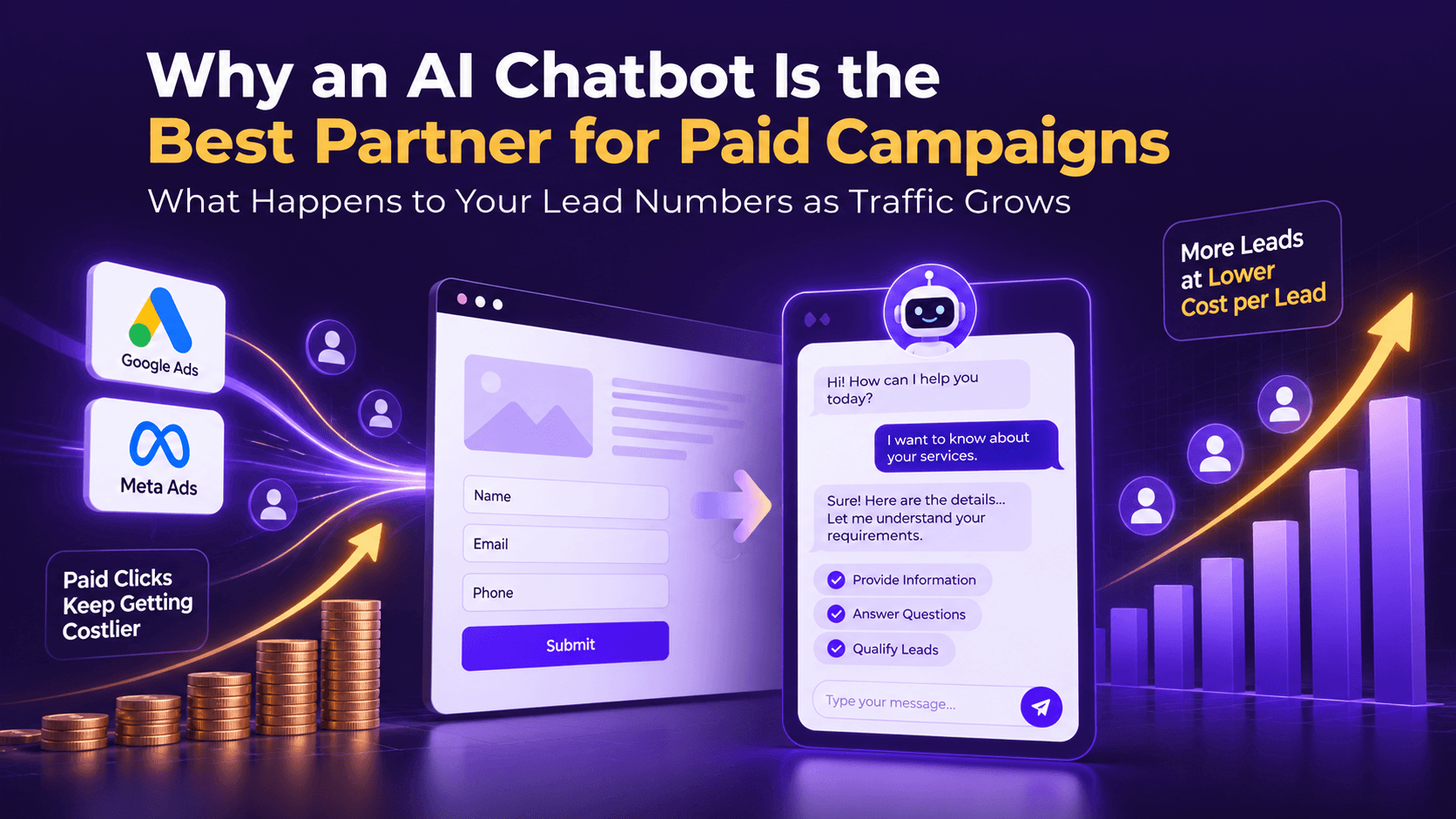
Cost per lead equals cost per click divided by conversion rate. Scaling traffic does not improve it. Improving the conversion rate does. An AI based chatbot that converts 10 to 25 percent of visitors, against 1 to 3 percent for a contact form, can reduce cost per lead several times over at the same ad spend.
The problem: clicks keep getting more expensive
Start with what has happened to the cost of the click itself. WordStream's benchmark study, first published in 2016, recorded an average Google Ads cost per click of $2.32. Its 2026 edition puts the figure at $5.42, more than double the starting point. Across Google and Microsoft Ads, the same report found an average conversion rate of 8.18 percent and an average cost per lead of $66.69.
These benchmarks come from United States advertisers, so treat the exact dollar values as reference points rather than predictions for the Indian market. The direction is what matters. Clicks cost more, year after year. The same report notes that the cost per lead fell in 2026 for the first time in five years, and that this reflects efficiency gains, not cheaper clicks: clicks cost more, but fewer of them are needed to produce a lead.
That observation is the whole argument of this article in one sentence. When the price of traffic only moves in one direction, the only reliable lever left is how much of that traffic you convert.
The formula every advertiser should keep in mind
Cost per lead is not a mysterious number. It is a simple division.
You can check it against the benchmark above. A $5.42 click at an 8.18 percent conversion rate gives a cost per lead of about $66, which matches the reported figure of $66.69.
This formula contains two useful facts. First, traffic volume does not appear in it. Doubling your visitors doubles your spend and doubles your leads, but your cost per lead stays exactly where it was. Second, the conversion rate sits in the denominator. Every time it rises, cost per lead falls by the same proportion. Moving from 2 percent to 10 percent is a fivefold change, and it cuts cost per lead to one fifth.
Cost per lead = Cost per click ÷ Conversion rate
The numbers: what happens as your traffic grows
To make this concrete, here is an illustrative model. It is not a prediction, and the assumptions are stated openly so that you can replace them with your own.
The model assumes an average cost per click of ₹40, an illustrative figure you should replace with the actual CPC from your Google Ads or Meta Ads account. It assumes contact form conversion of 2 percent, the middle of the 1 to 3 percent benchmark range, and AI based chatbot conversion of 10 percent, the low end of the 10 to 25 percent range reported in industry studies.
| Paid visitors | Ad spend | Leads with form (2%) | Cost per lead (form) | Leads with AI chatbot (10%) | Cost per lead (chatbot) | Extra leads |
|---|---|---|---|---|---|---|
| 1,000 | ₹40,000 | 20 | ₹2,000 | 100 | ₹400 | 80 |
| 5,000 | ₹2,00,000 | 100 | ₹2,000 | 500 | ₹400 | 400 |
| 10,000 | ₹4,00,000 | 200 | ₹2,000 | 1,000 | ₹400 | 800 |
| 25,000 | ₹10,00,000 | 500 | ₹2,000 | 2,500 | ₹400 | 2,000 |
The cost per lead never moves
Whether you send 1,000 visitors or 25,000, the form produces leads at ₹2,000 each and the chatbot at ₹400 each. Scaling traffic does not fix a conversion problem. It only scales it.
The gap grows in absolute terms
At 1,000 visitors, the chatbot produces 80 additional leads. At 25,000, it produces 2,000. The more you spend on paid traffic, the more leads a weak conversion layer costs you.
The leakage is enormous
At a 2 percent form conversion rate, 98 out of every 100 visitors you paid for leave without a trace. At 25,000 visitors, that is 24,500 people.
Flip the question: what does it cost to get 500 leads?
Many teams plan from the other direction. They start with a target number of leads and work backwards to a budget. Here is the same model, run that way.
In this scenario, the same target is reached with one fifth of the traffic and ₹8,00,000 less spend. Or, looked at another way, the same ₹10,00,000 budget would produce 2,500 leads instead of 500.
| Approach | Conversion rate | Visitors needed | Ad spend at ₹40 per click |
|---|---|---|---|
| With a contact form | 2% | 25,000 | ₹10,00,000 |
| With an AI based chatbot | 10% | 5,000 | ₹2,00,000 |
Stress testing the model: what if the numbers are wrong?
An honest model should show what happens when its assumptions are off. The chatbot conversion range of 10 to 25 percent comes largely from vendor published benchmark studies, and some of those figures are measured among visitors who engage with the chat rather than across all traffic. So here are the results at 10,000 paid visitors and a ₹4,00,000 budget, across a range of outcomes.
| Scenario | Conversion | Leads | Cost per lead |
|---|---|---|---|
| Form, weak | 1% | 100 | ₹4,000 |
| Form, typical | 2% | 200 | ₹2,000 |
| Form, strong | 3% | 300 | ₹1,333 |
| Chatbot, very conservative | 5% | 500 | ₹800 |
| Chatbot, low benchmark | 10% | 1,000 | ₹400 |
| Chatbot, mid benchmark | 15% | 1,500 | ₹267 |
| Chatbot, high benchmark | 25% | 2,500 | ₹160 |
What the stress test shows
Even the very conservative chatbot case, 5 percent, outperforms a strong form at 3 percent. And there is a more modest way to view the benefit. Where a business keeps its existing form and adds a chatbot alongside it, one industry source reports a 20 to 35 percent increase in captured leads. On the 200 leads in the table, that would mean 240 to 270 leads and a cost per lead of about ₹1,667 to ₹1,481. That is a smaller gain, but it is still a gain on spend that has already been committed.
The sensible way to use this model is as a starting hypothesis. Your real numbers will depend on your industry, offer, ad quality and traffic source, which is why the final section of this article explains how to test it properly.
Why the uplift happens: four mechanisms
It helps to understand where the improvement comes from, because it shows which campaigns benefit most.
1. Fewer visitors lost at the form
Roughly 81 percent of people who start a contact form abandon it, and only about 38 percent of those who interact with one go on to submit it. A conversation asks for one thing at a time, which keeps the effort at any single moment low. Form completion falls from around 23 percent at three fields to under 7 percent at ten or more.
2. Speed to lead
Paid traffic is high intent and perishable. A well known lead response study found that contacting a lead within five minutes, rather than 30, made the odds of reaching them about 100 times higher and the odds of qualifying them about 21 times higher. A Harvard Business Review analysis of more than 2,200 businesses found that the average first response to a web lead took 42 hours. An AI based chatbot replies in seconds, at any hour, and starts the qualification before a human has even seen the enquiry. It does not wait for a form to be reviewed on Monday morning.
3. Always on capture
Campaigns do not stop at 6 pm. Ads run in the evening, at weekends and during festival periods, when most sales teams are offline. One research firm using MagicFlow AI recorded 2.3 times more after hours enquiries converted within 28 days, without increasing ad spend.
4. Better attribution and qualification
A cost per lead figure is only as meaningful as the lead behind it. As Edigital's benchmark guide puts it in essence, a $60 lead that becomes a profitable sale is worth more than a $25 lead that never answers the phone. Conversations attach the UTM source, medium, campaign and landing page to every enquiry, and qualification questions filter the serious from the casual before a human spends time on them. You stop optimising for the cheapest lead and start optimising for the cheapest qualified one.
Why the effect is strongest for paid traffic
Not every channel gains equally. Paid campaigns benefit most because the visitor arrives with a specific message in mind. They clicked an ad about a particular course, product or service, and the first thing they see should continue that conversation, not restart it with a generic homepage and a form.
An AI based chatbot can open with context drawn from the campaign, and it can answer the exact question that the ad provoked, because it is grounded in the business's own website and documents. A scripted bot cannot do this. It can only offer the menu it was given. Qualtrics' 2026 consumer research, as summarised in a vendor benchmark report, found that nearly one in five consumers who used AI for customer service saw no benefit, a failure rate nearly four times higher than for AI use in general. The advantage in this article depends on the system being genuinely AI based, not a rule based bot with a friendly avatar.
There is a further, practical benefit. Google's Smart Bidding adjusts bids toward your conversion goal. A higher and better defined conversion rate generally gives the bidding system more signal to learn from, which can help it find more of the right visitors over time. Better conversion at the landing stage therefore improves the efficiency of the whole campaign, not just the final step.
Real results from MagicFlow AI
MagicFlow AI is an AI based chatbot built by MagicWorks IT Solutions for Indian SMEs and agencies running paid traffic. Outcomes reported by customers include a distance MBA college that saw a 41 percent increase in qualified counselling calls within 30 days with no additional ad spend, a research firm that converted 2.3 times more after hours enquiries within 28 days, and an education company that reduced appointment qualification time by 34 percent across 14 locations.
These are individual customer results, not guarantees, and they will vary by business. They do illustrate the pattern in the model above: the same traffic, converted better.
How to test this on your own campaigns
Do not take any benchmark, including those in this article, on trust. Test it on your own traffic.
1. Record your baseline
Note your cost per click, landing page conversion rate and cost per lead for the last 30 days.
2. Split the traffic
Send half of your visitors to the page with the form and half to the page with the chatbot, or run the chatbot alongside the form for a defined period.
3. Run it long enough
Allow several weeks and enough clicks that the difference is not noise, and avoid changing the ads during the test.
4. Compare cost per qualified lead
Cost per lead is a start, but the number that matters is how many leads became real conversations or sales.
5. Track by campaign
Use the UTM data on each conversation to see which campaigns, keywords and ads produce the best enquiries, and move budget accordingly.
To calculate your own figures, use the formula from earlier: divide your cost per click by your conversion rate. Then ask what your cost per lead would be at a rate that is twice as high.
The takeaway
Paid media rewards the advertisers who convert, not the ones who simply spend. Clicks have become more than twice as expensive in a decade, and no change to the auction will bring that back. What remains in your hands is the part after the click.
If your conversion layer is a form that loses 98 out of every 100 visitors you have paid for, growing your traffic only grows the loss. An AI based chatbot that holds a real conversation, qualifies the visitor and replies in seconds changes the denominator of the one formula that decides your cost per lead.
A note on the figures: the tables in this article are illustrative models built on stated assumptions and published benchmarks. They are not guarantees, and actual results depend on your industry, offer, targeting and traffic quality.
- SplitForms, Contact Form Conversion Rate: Benchmarks and 12 Fixes https://splitforms.com/blog/contact-form-conversion-rate
- Conferbot, Chatbot vs Forms: Which Gets More Leads? 2026 https://www.conferbot.com/blog/chatbot-vs-forms
- Wonderchat, The B2B Website Conversion Benchmark Report 2026 https://wonderchat.io/blog/b2b-website-conversion-report-2026
- PPC Land, Google Ads CPL drops for first time since 2020 as CPC hits $5.42, reporting WordStream's 2026 benchmarks https://ppc.land/google-ads-cpl-drops-for-first-time-since-2020-as-cpc-hits-5-42/
- Search Engine Journal, What Are Good Google Ads Benchmarks, reporting WordStream by LocaliQ 2026 data https://www.searchenginejournal.com/what-are-good-google-ads-benchmarks/546995/
- Zuko Analytics, 25 Conversion Rate Statistics You Need in 2025 https://www.zuko.io/blog/25-conversion-rate-statistics-you-need
- Scalify, Chatbot on Website Statistics 2026: Usage, Conversions, and ROI https://www.scalify.ai/blog/chatbot-on-website-statistics-2026-usage-conversions-roi
- Numen Technology, Contact Form Optimization: Fix 81% Abandonment Rate https://www.numentechnology.co.uk/blog/contact-form-optimization-conversion-rates
- Digital Applied, Form Conversion Rate Benchmarks 2026: 100+ Data Points https://www.digitalapplied.com/blog/form-conversion-rate-benchmarks-2026-data-points
- Callingly, State of Speed to Lead, summarising the MIT and InsideSales.com Lead Response Management Study https://callingly.com/blog/state-of-speed-to-lead
- TeleCRM, Lead Response Time: How Fast Should Your Sales Team Follow-Up? https://telecrm.in/blog/lead-response-time/
- Fronetics, 50% of Sales Go to the Vendor That Responds First, summarising the Harvard Business Review lead response study https://www.fronetics.com/50-of-sales-go-to-the-vendor-that-responds-first/
- Edigital, Google Ads Benchmarks https://www.theedigital.com/blog/google-ads-benchmarks
- Qualtrics, 2026 Consumer Experience Trends Report, as summarised in Wonderchat, The B2B Website Conversion Benchmark Report 2026 https://wonderchat.io/blog/b2b-website-conversion-report-2026
Common questions from this article.

Head of Digital Marketing, MagicWorks IT Solutions
Purva Desai is the Head of Digital Marketing at MagicWorks IT Solutions, bringing 16 years of experience across visual arts and digital strategy. A trained artist with a Master's in Visual Art and a background in art therapy, she began her career as a graphic designer, later working as an Art Director before moving into performance marketing, SEO, and brand strategy. This dual foundation, art and analytics, shapes how she approaches marketing: understanding not just what drives clicks, but what drives human perception and emotion. She now leads MagicWorks' digital marketing department, writing on AI, buyer psychology, and the evolving intersection of creativity and data in marketing.