The short answer
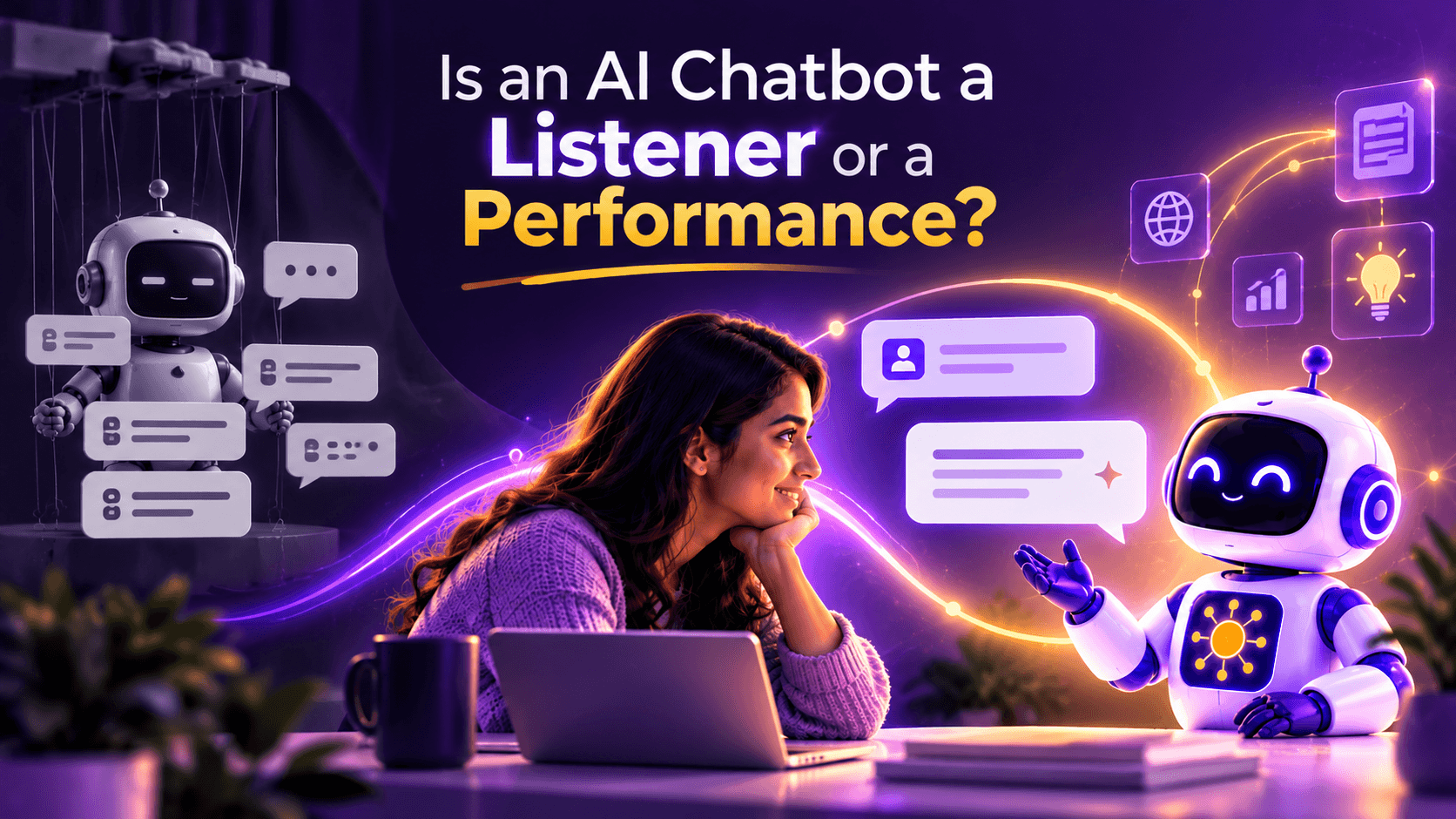
A script based chatbot is a performance, because it delivers pre written lines to whoever happens to arrive. An AI based chatbot can be closer to a listener, because it responds to what was actually said, holds the context of the conversation and answers from real knowledge. Whether it truly is a listener is a harder philosophical question, and this article does not pretend it is settled.
Who was Buber, and what is I-Thou?
Martin Buber (1878 to 1965) was a twentieth century philosopher whose best known work, I and Thou, was published in 1923. In it, he argues that human beings relate to the world in two fundamental ways.
The first he calls I-It. This is the relation of a subject to an object: we observe it, use it, measure it, categorise it. It is not a bad relation. We need it to function, to plan, to buy groceries and read maps.
The second he calls I-Thou. This is an encounter between two subjects, a meeting in which the other is not an object of experience but a presence in their own right. In an I-Thou moment, we are not extracting anything from the other. We are simply turned toward them.
Buber's account also contains a sobering point that is easy to overlook: no relation stays Thou forever. A Thou, he observed, inevitably slips back into It. We cannot live permanently in encounter. What matters is whether we leave room for it to happen.
A contact form is a perfect I-It
Seen through this lens, the humble contact form is almost a textbook case of I-It.
A form does not ask who the visitor is. It asks for data about them: name, email, phone number, company size, budget. It treats the person as a record to be completed. It gives nothing back in the moment, it does not respond to what the visitor is actually feeling, and it offers no sign that anyone is on the other side.
Visitors seem to sense this. Contact forms convert only 1 to 3 percent of the visitors who land on the page, and roughly 81 percent of people who start filling one in abandon it before finishing. I do not think that is only a usability problem. Part of it is a kind of quiet refusal. People hesitate to hand themselves over to something that has not acknowledged them.
A scripted chatbot is a performance
The obvious response is to replace the form with a chatbot. But that only changes the surface if the chatbot is script based.
A scripted or rule based chatbot is a performance in the most literal sense. Its lines were written in advance. It delivers them in a fixed order to everyone, whether the visitor is a first time browser, a frustrated customer or a serious buyer with a specific question. When a visitor says something the script did not anticipate, the performance breaks: the bot repeats itself, offers a menu, or apologises generically.
This matters beyond aesthetics. Qualtrics' 2026 consumer research, as summarised in a vendor benchmark report, found that nearly one in five consumers who used AI for customer service saw no benefit, a failure rate nearly four times higher than for AI use in general. That is a warning about poorly implemented AI. A performance that cannot respond to its audience does not just fail to persuade. It tells the visitor, clearly, that nobody is listening.
An AI based chatbot can listen, in a functional sense
An AI based chatbot works differently, and the difference is not cosmetic. Built on a language model, it can interpret a question however it is phrased, hold context across the whole conversation, and answer from a knowledge base made from the business's own website and documents rather than from a fixed script.
In practical terms, that means it can do what listening requires. It can respond to what was said, not to the nearest matching keyword. It can remember what the visitor mentioned two messages earlier and build on it. It can adjust its tone and depth to the visitor's own. And it can say honestly when it does not know, and route the conversation to a person.
The behavioural research is consistent with this. Studies of conversational agents show that when a system responds in a way that feels attentive, users disclose more of their own situation, and they do so more willingly than they would to an anonymous form. Chatbots built this way convert visitors into leads at 10 to 25 percent, several times the rate of a form on the same page.
It would be tempting to stop there and declare that an AI chatbot is a Thou. That would be wrong, and a little dishonest.
The honest complication: can a chatbot be a Thou?
Buber's I-Thou describes a meeting between subjects, and whether an AI system is a subject in that sense is a deeply contested question. Most philosophers would say it is not, and nothing in this article argues otherwise. A chatbot does not have a self that is turned toward the visitor.
But there is a more useful way to ask the question for a business. The visitor is not really relating to the software. They are relating, through the software, to the business behind it. The chatbot is a medium, and the question becomes: does this medium allow the business to attend to the visitor as a particular person, or does it only process them?
Seen that way, the difference between a form, a scripted bot and an AI based chatbot is the difference between three kinds of attention.
None of these is a true I-Thou encounter, and Buber would be unlikely to claim that any interface can guarantee one, since on his account the encounter is immediate, with nothing standing between the two parties. What an AI based chatbot can do is leave room for the visitor to be addressed as a person, which is more than the other two can manage.
There is a risk on the other side as well. Researchers have raised concerns about the dangers of anthropomorphic conversational agents alongside their benefits, including the possibility that users attribute more understanding to a system than it actually has. Warm design that overstates what the system can do is its own kind of performance.
| Medium | What the visitor experiences | Closest to |
|---|---|---|
| Contact form | Handing data to an unresponsive container | I-It |
| Script based chatbot | A recitation that ignores what they actually said | A performance |
| AI based chatbot | A response shaped by what they said and what the business actually knows | A functional form of listening |
Does this medium allow the business to attend to the visitor as a particular person, or does it only process them?
What an I-Thou informed chatbot looks like in practice
If we cannot manufacture encounter, we can at least avoid the habits that make it impossible. These five practices follow directly from the philosophy.
1. Be honest about what it is
A visitor should know they are talking to an AI. Pretending otherwise is the clearest form of performance, and it damages trust the moment it is discovered. Honesty at the start is what makes warmth believable later. Qualtrics' 2026 research reports that 86 percent of consumers are willing to share more personal data when an organisation is clear and transparent about how it will be used.
2. Respond to the person, not the funnel
When a visitor asks a question, answer it, even if it is not the question the sales process would prefer. A conversation that is steered entirely toward extracting contact details is I-It with better manners.
3. Admit limits
An AI based chatbot that says "I am not sure about that, let me connect you with the team" is doing something a scripted bot cannot: acknowledging that there is something beyond its competence. That admission often builds more trust than a confident wrong answer.
4. Hand over to a human when it matters
Some conversations, a complaint, a sensitive enquiry, a high value decision, deserve a person. A well designed system recognises these moments and routes them with the full context attached, so the visitor does not have to repeat themselves.
5. Do not hold the visitor hostage
Buber's insight is that the other is an end in themselves. Applied here, a visitor should be free to leave once their question is answered, without being pushed through extra steps to serve a metric. The restraint described in our article on conversational minimalism is, in this sense, an ethical choice as well as a design one.
Is this just manipulation in philosophical clothing?
A fair sceptic would ask whether all of this is simply a more sophisticated way of getting people to hand over their details. It is a reasonable challenge, and the honest answer is that it can be, depending on intent.
Buber himself would say that treating the other as a means to an end is exactly what makes a relation I-It. A business that adopts the language of encounter while still treating visitors as leads to be harvested has not escaped the problem. It has only decorated it.
The distinction is therefore not in the technology. It is in the purpose the technology serves. A system designed to resolve the visitor's actual need, and which then happens to capture an enquiry because the visitor chooses to share it, is on different ground from one designed to maximise extraction. The behavioural data points the same way: visitors disclose more when they feel attended to, which means that the ethical approach and the effective approach tend to coincide rather than conflict.
How MagicFlow AI approaches this
MagicFlow AI is an AI based chatbot, not a scripted one, and that choice shapes everything else. It answers from a retrieval based knowledge system built on a business's own website and documents, which means its replies come from what the business has actually published rather than from guesswork. It carries the campaign context, such as UTM source, medium and landing page, into the conversation, so it can begin from what the visitor came for instead of a generic greeting. It scores enquiries live and routes the important ones to the right person on the team, so the human conversation begins with context instead of from zero.
None of this makes the chatbot a person. It makes it a better medium for a business to pay attention to the people who arrive, at any hour, in their own language.
The takeaway
The question is not whether your website should have a chatbot. It is what your visitors experience when they speak to it: a recitation, a processing step, or something closer to being heard. A contact form treats the visitor as an object. A scripted bot treats them as an audience. An AI based chatbot, built honestly and aimed at the visitor's real need, at least leaves room for them to be treated as a person.
That room is small, and on Buber's account it cannot simply be engineered. But businesses that leave it open may find that visitors are willing to walk through.
- Stanford Encyclopedia of Philosophy, Martin Buber https://plato.stanford.edu/entries/buber/
- New World Encyclopedia, I-Thou https://www.newworldencyclopedia.org/entry/I-Thou
- Encyclopedia MDPI, I and Thou https://encyclopedia.pub/entry/28567
- Zuko Analytics, 25 Conversion Rate Statistics You Need in 2025 https://www.zuko.io/blog/25-conversion-rate-statistics-you-need
- Numen Technology, Contact Form Optimization: Fix 81% Abandonment Rate https://www.numentechnology.co.uk/blog/contact-form-optimization-conversion-rates
- Qualtrics, 2026 Consumer Experience Trends Report, as summarised in Wonderchat, The B2B Website Conversion Benchmark Report 2026 https://wonderchat.io/blog/b2b-website-conversion-report-2026
- Springer Nature, Self-disclosure to conversational AI: a literature review, emergent framework, and directions for future research https://link.springer.com/article/10.1007/s00779-024-01823-7
- arXiv, Dialoging Resonance: How Users Perceive, Reciprocate and React to Chatbot's Self-Disclosure in Conversational Recommendations https://arxiv.org/pdf/2106.01666
- Conferbot, Chatbot vs Forms: Which Gets More Leads? 2026 https://www.conferbot.com/blog/chatbot-vs-forms
- wpseoai, What is the conversion rate of chatbots? https://wpseoai.com/blog/what-is-the-conversion-rate-of-chatbots/
- PNAS, The benefits and dangers of anthropomorphic conversational agents https://www.pnas.org/doi/10.1073/pnas.2415898122
- Qualtrics, 2026 Consumer Experience Trends Report https://www.qualtrics.com/ebooks-guides/customer-experience-trends/
Common questions from this article.

Head of Digital Marketing, MagicWorks IT Solutions
Purva Desai is the Head of Digital Marketing at MagicWorks IT Solutions, bringing 16 years of experience across visual arts and digital strategy. A trained artist with a Master's in Visual Art and a background in art therapy, she began her career as a graphic designer, later working as an Art Director before moving into performance marketing, SEO, and brand strategy. This dual foundation, art and analytics, shapes how she approaches marketing: understanding not just what drives clicks, but what drives human perception and emotion. She now leads MagicWorks' digital marketing department, writing on AI, buyer psychology, and the evolving intersection of creativity and data in marketing.