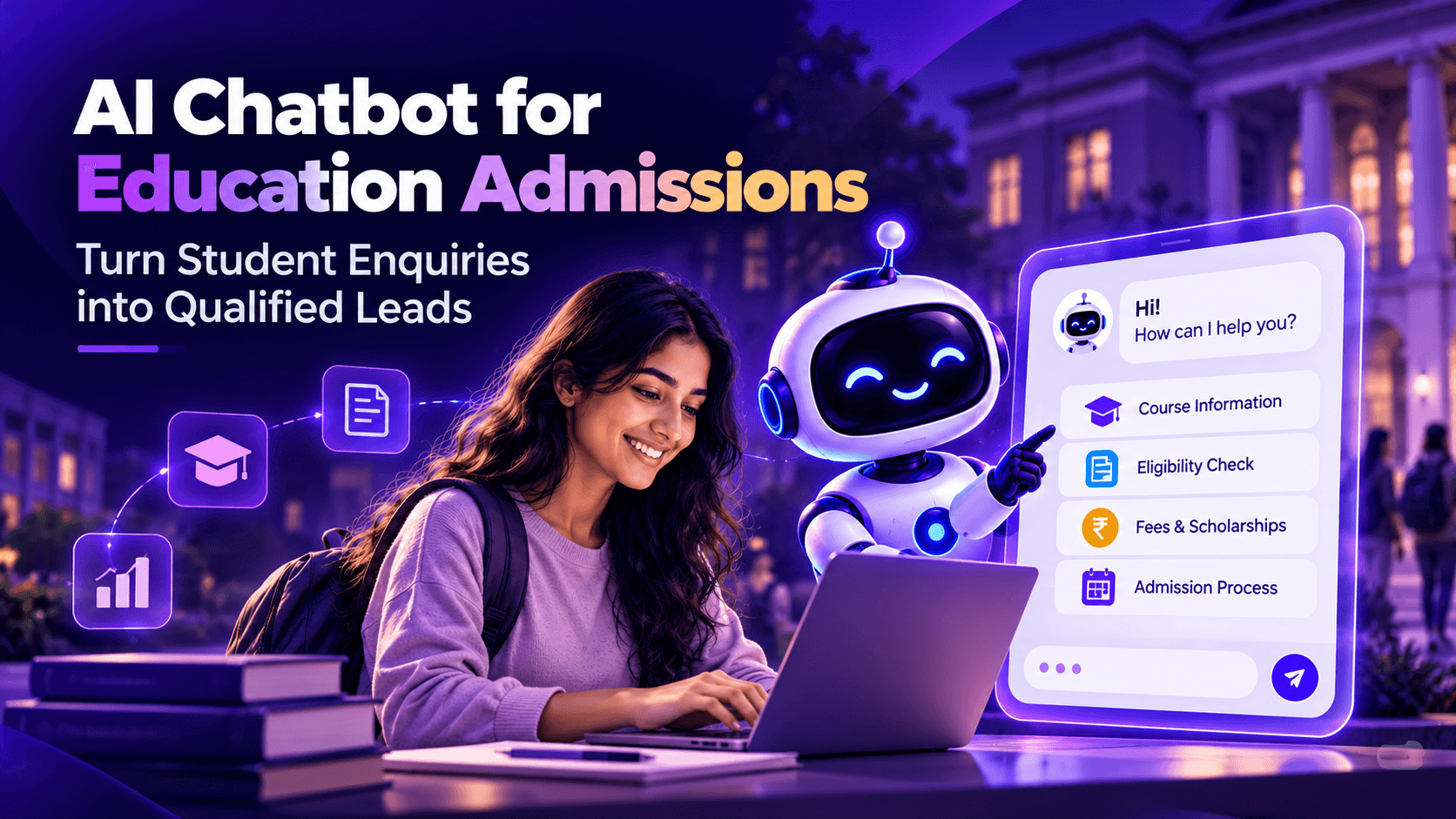
What is an AI chatbot for education admissions?
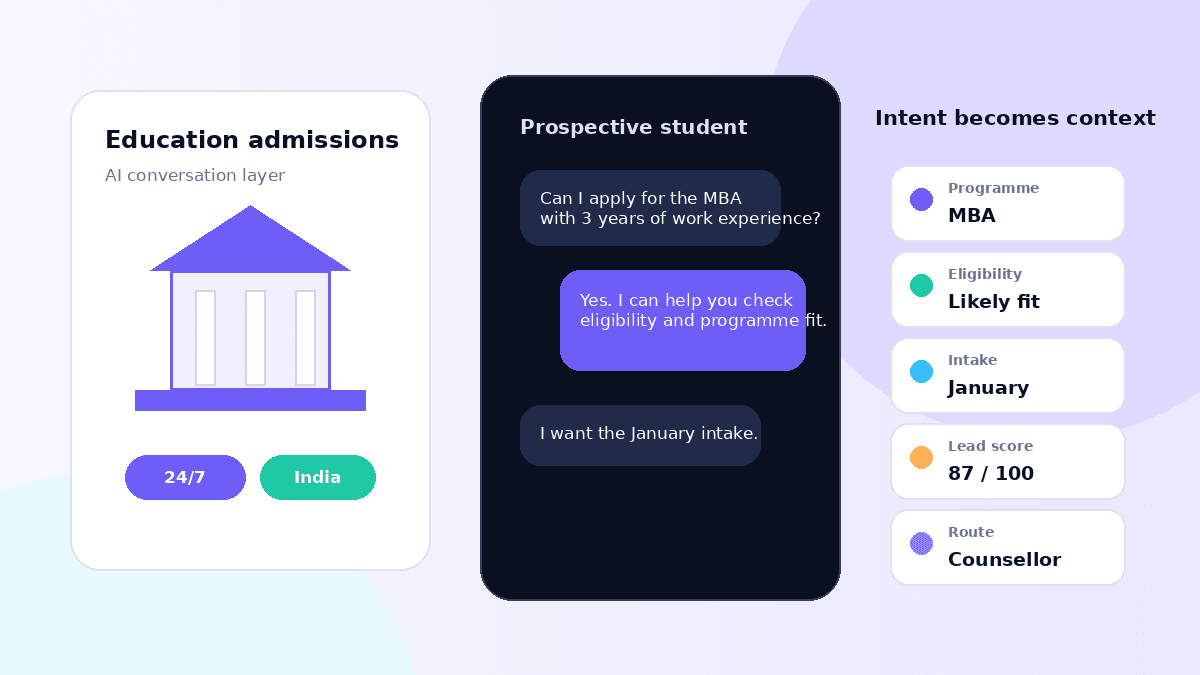
An AI chatbot for education admissions is a conversational system placed on a college, university, training institute or education company's website that can communicate with prospective students and assist them during the enquiry process.
Unlike a traditional rule based bot that asks visitors to choose from fixed menu options, an AI based chatbot can understand questions expressed naturally.
A student might ask: "Is an online MBA suitable if I am already working?" Another may type: "What is the fee for the marketing specialisation?" Another might ask the same question in Hindi or switch languages in the middle of the conversation.
A well configured education chatbot should understand the question, retrieve information from the institution's approved knowledge base and continue the conversation based on the student's needs.
The objective is not to replace the admissions counsellor. The objective is to make sure the counsellor receives a much better enquiry.
You can see how MagicFlow AI approaches this specifically for the education sector on the AI Chatbot for Education page.
The admissions funnel has changed
A conventional education funnel often looks like this: Advertisement → Landing page → Enquiry form → CRM → Counsellor call.
That sequence appears logical, but it places almost all of the work on the prospective student.
The student must understand the page, decide whether the programme is relevant, find the answer to eligibility questions, trust the institution enough to disclose a phone number, complete a form and then wait for somebody to call.
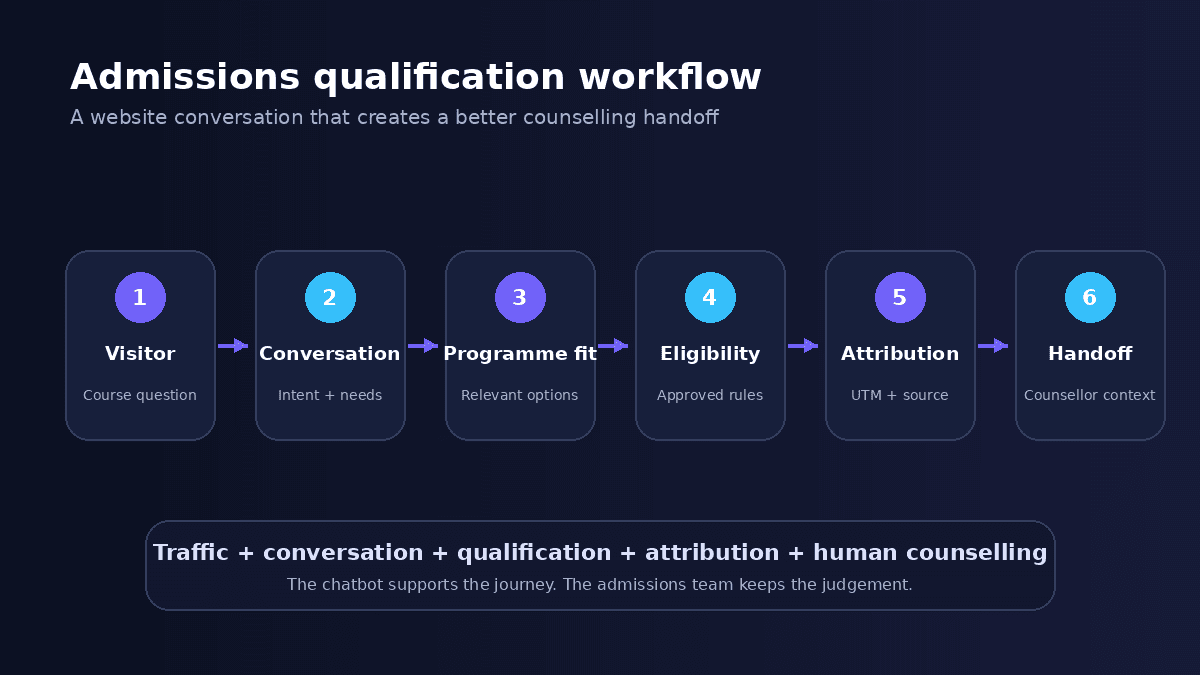
An AI chatbot introduces a conversational layer between the landing page and the CRM: Advertisement → Landing page → Conversation → Qualification → Contact capture → Lead score → Counsellor.
This matters because a conversation can adapt.
A BCom graduate looking for an MBA should not necessarily experience the same journey as an engineering student comparing postgraduate programmes. A working professional with eight years of experience should not receive exactly the same questions as a recent graduate.
The website may remain the same, but the conversation can change.
Why static admission forms lose valuable context
There is nothing inherently wrong with a contact form. The problem is how little context most forms capture.
A typical education enquiry might contain a name, email, mobile number, course and city. The counsellor receives the record and still has to determine almost everything else.
What qualification does the student have? Is the student eligible? Are they researching or ready to apply? Are they looking for online, distance or classroom learning? What is their preferred specialisation? Are they comparing fees? Are they planning to enrol this intake? Did they come from a Google campaign, Meta campaign or organic search?
A conversational qualification flow can capture much of this before the first counsellor call.
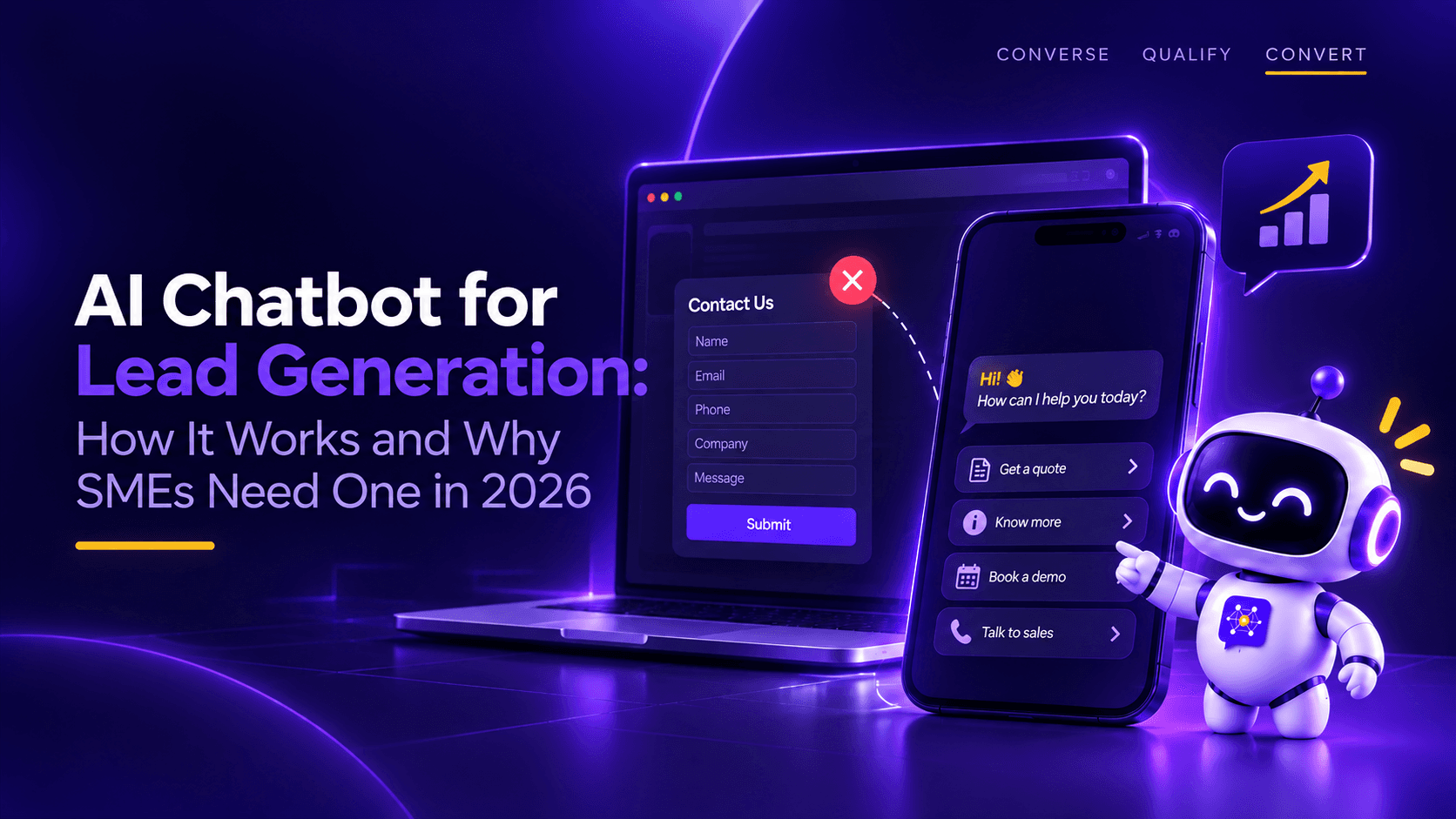
For a deeper explanation of conversational lead capture, see AI Chatbot for Lead Generation: How It Works and Why SMEs Need One in 2026.
What should an education chatbot actually do?
The value of an admissions chatbot does not come from answering "What are your office timings?" That is useful, but it is not transformative.
A strong implementation should connect several stages of the admissions journey.
1. Answer programme questions
Prospective students repeatedly ask about course duration, eligibility, specialisations, fees, scholarships, learning mode, examination structure, admission deadlines, required documents, accreditation, campus facilities, placement support, internship opportunities, financing and application steps.
An AI chatbot connected to an approved knowledge base can make this information conversational.
MagicFlow AI includes a knowledge base capability designed to use website pages, PDFs and other approved documents as grounding material. You can review the broader platform capabilities on the MagicFlow AI Features page.
2. Identify the programme the student is really looking for
Visitors do not always arrive knowing your internal programme names.
Someone might say, "I work in IT but want to move into product management." Another might say, "I want to study finance but cannot leave my job."
These are intent statements, not menu selections.
A conversational system can ask follow-up questions and guide the visitor towards relevant programme information without forcing the student to understand your website architecture first.
3. Perform preliminary qualification
The chatbot can gather information such as highest qualification, graduation stream, marks or grade, entrance examination status, work experience, preferred course, preferred location, learning mode, desired intake, and budget or financing requirement.
The actual eligibility decision should continue to follow the institution's approved rules. The AI's role is to collect the right information and apply only the rules it has been authorised to use.
4. Capture contact information at the right moment
This is where conversational lead capture differs from a conventional form.
Instead of opening the interaction with "Enter your name, phone number and email," the chatbot can first provide value.
A prospective student might ask whether a BSc graduate can apply for an MBA. The chatbot can answer from the approved admission criteria and then ask a relevant follow-up question, such as whether the visitor is currently working or studying.
Once the visitor has received useful information, requesting contact details feels like a continuation of the interaction rather than an administrative barrier.
This principle is explored further in Why Visitors Trust an AI Chatbot More Than a Contact Form.
Lead qualification matters more than collecting more phone numbers
Many admission teams already have plenty of leads. Their bigger problem is deciding where counsellors should focus first.
Consider three enquiries.
| Enquiry | What the admissions team knows |
|---|---|
| Student A | Looking for an MBA. Wants the next intake. Meets the basic eligibility requirements. Has shortlisted two programmes. Asked about payment and application steps. |
| Student B | Downloaded a brochure. Has not selected a programme. Plans to study next year. |
| Student C | Asked only whether the institution offers engineering. |
Prioritise, do not decide
Treating these leads equally creates unnecessary work.
A lead scoring model can give greater priority to signals such as clear programme interest, eligibility match, current intake, application intent, scholarship enquiry, fee enquiry, financing readiness, repeated website visits, high intent page activity and a completed qualification conversation.
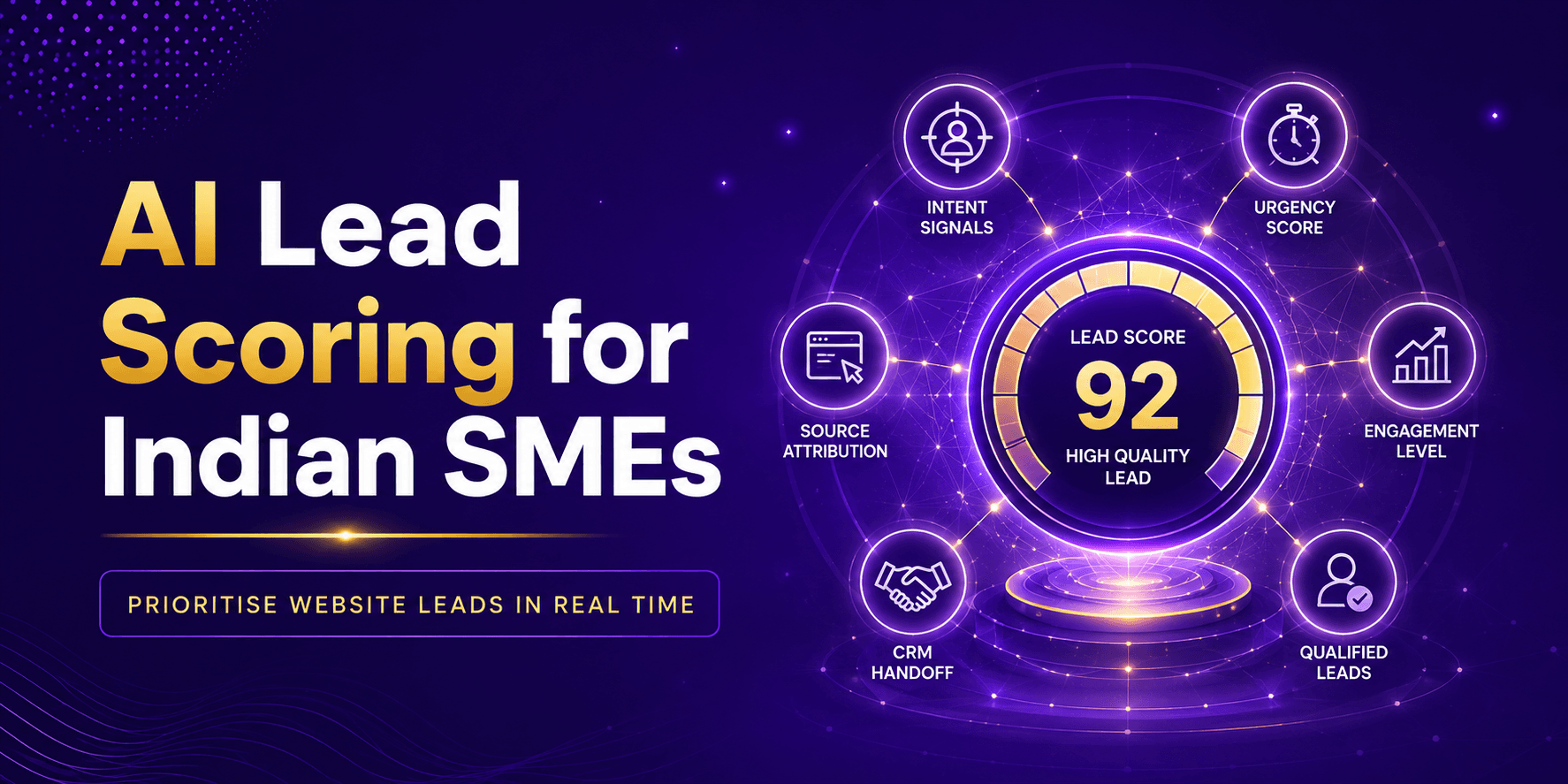
MagicFlow AI can combine conversation answers and behavioural context into lead scoring. The methodology is discussed in detail in AI Lead Scoring for Indian SMEs.
The result should not be "AI decides who gets admitted." It should be AI helps the admissions team decide which enquiries deserve faster human attention.
That distinction matters.
Connect the student enquiry to the campaign that produced it
Education advertisers often optimise around cost per lead.
Suppose Campaign A spends Rs 1,00,000 and generates 200 enquiries. Its cost per enquiry is Rs 500. Campaign B spends the same amount and generates 130 enquiries, so its cost per enquiry is higher.
Campaign A initially looks better.
But suppose qualification data shows that Campaign A produced 35 qualified enquiries while Campaign B produced 60.
The economics now look very different.
| Campaign A | Campaign B | |
|---|---|---|
| Spend | Rs 1,00,000 | Rs 1,00,000 |
| Enquiries | 200 | 130 |
| Cost per enquiry | Rs 500 | Rs 769 |
| Qualified enquiries | 35 | 60 |
| Cost per qualified enquiry | Rs 2,857 | Rs 1,667 |
Keep campaign data attached to the enquiry
This is why education marketers should connect campaign attribution with lead quality.
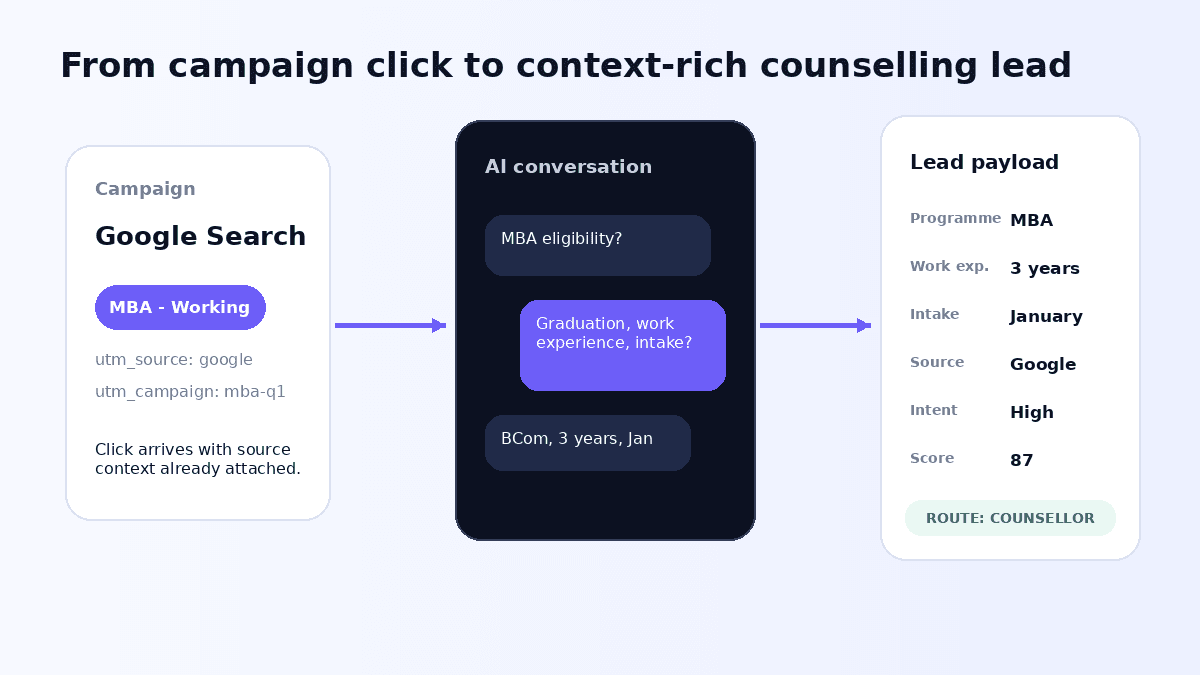
If a student arrives through a UTM tagged campaign, the source, medium, campaign and other relevant marketing data can remain connected to the resulting enquiry.
Instead of merely knowing that a student submitted a form, marketing can know that the student came from a particular Google campaign, asked about a specific specialisation, intends to enrol in the current intake and showed strong intent during qualification.
That is much more useful information.
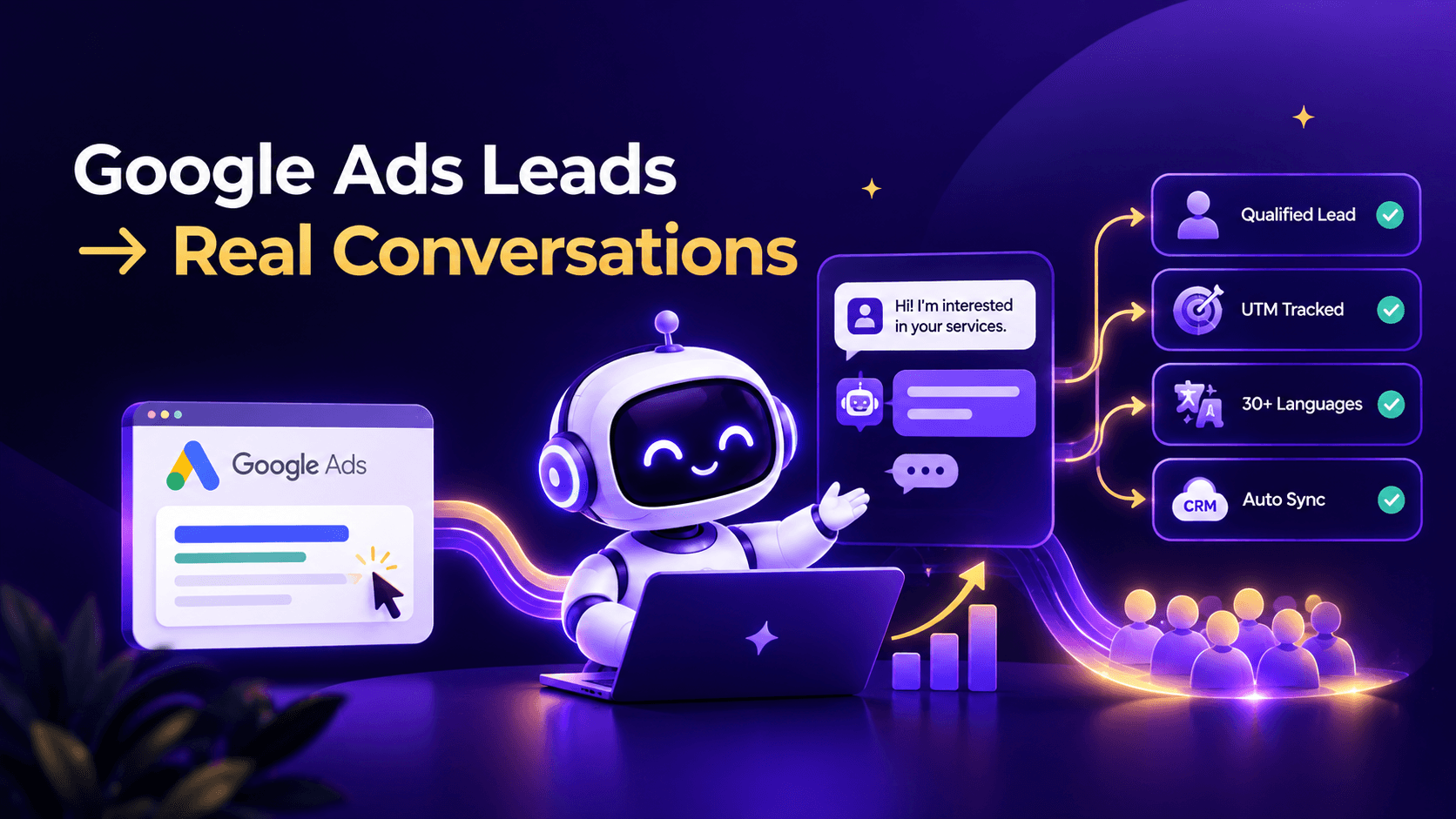
Read UTM Attribution for AI Chatbots for a detailed explanation of how campaign data can stay attached to qualified leads.
Why multilingual conversations matter for Indian education
India's education market cannot be treated as English only simply because the website is written in English.
A student may comfortably read an English course page while preferring to ask a complicated question in Hindi or Marathi. Another student may begin in English and switch languages halfway through the conversation.
The important point is not translation alone. It is conversational comfort.
Questions around eligibility, fees, recognition, careers and financial commitment are important decisions. Visitors often express themselves more naturally in the language in which they think.
A multilingual education chatbot can reduce this barrier while keeping the same underlying admission information.
If multilingual lead capture is important to your institution, read Hindi and Regional-Language Chatbots.
What happens after the chatbot captures the student?
Capturing information without improving the admissions workflow simply creates another inbox.
The handoff matters.
A useful CRM record might contain the student's programme, specialisation, qualification, work experience, desired intake, main question, traffic source, campaign, lead status and a short conversation summary.
The counsellor now starts the call differently.
Instead of asking, "You filled our form. Which course are you interested in?" the conversation can begin with context: "You were looking at our MBA Marketing programme and had a question about eligibility and payment options."
That is a better customer experience and a better use of the counsellor's time.
MagicFlow AI's Integrations page explains the platform's approach to lead handoff and workflow integration.
Eight high-value use cases for an admissions chatbot
1. Course discovery
Help students identify relevant programmes based on interests, education and career objectives.
2. Preliminary eligibility
Collect the information required to apply approved eligibility criteria.
3. Fee explanation
Answer common questions about tuition fees, instalments and payment schedules using approved information.
4. Scholarship guidance
Explain available scholarships and collect information relevant to eligibility.
5. Application guidance
Guide applicants through documents, deadlines and next steps.
6. Campus or counsellor routing
Direct the enquiry to the correct location, department, programme or counsellor.
7. After-hours admission support
Keep the website useful when the admissions office is unavailable.
8. Campaign qualification
Connect Google Ads, Meta Ads and other acquisition channels to actual student intent rather than measuring only form submissions.
Designing the right admissions conversation
A good chatbot should not behave like a twenty-question application form disguised as chat.
The conversation should be progressive.
Step 1: Understand intent
Start by understanding what the visitor is trying to achieve rather than immediately asking for personal details.
Step 2: Identify programme interest
Clarify whether the visitor is exploring undergraduate, postgraduate, professional, online or another type of programme.
Step 3: Answer the immediate question
Give the visitor something useful before asking for extensive information.
Step 4: Ask qualification questions naturally
Ask only what is relevant to the student's chosen programme and stage of consideration.
Step 5: Capture contact information
Request contact details once sufficient value and intent have been established.
Step 6: Determine urgency
Ask when the visitor intends to apply or enrol.
Step 7: Route appropriately
A highly qualified current-intake student should not enter the same follow-up queue as somebody researching programmes for next year.
Do not automate everything
Education decisions involve trust.
Students and parents may want nuanced conversations about career direction, programme fit, personal circumstances, financial constraints, learning difficulties, placement expectations, recognition and long-term career choices.
These deserve human judgement.
A good admissions AI system handles repetitive information and structured qualification so humans have more capacity for conversations where judgement, reassurance and experience matter.
The best model is therefore not AI versus counsellors. It is AI before and alongside counsellors.
Metrics education marketers should measure
Do not evaluate an admission chatbot based only on the number of conversations.
Track outcomes through the funnel.
| Area | Metrics |
|---|---|
| Engagement | Chat engagement rate, contact capture rate, qualification completion rate |
| Lead quality | Qualified enquiry rate, high intent leads by campaign, lead quality by traffic source, enquiries by programme, enquiries by language |
| Cost | Cost per qualified enquiry |
| Admissions outcomes | Counsellor response time, application rate, application-to-enrolment rate |
| Gaps to fix | Questions the chatbot could not answer, conversations requiring human escalation |
From widget to admissions system
These metrics turn the chatbot from a website widget into a measurable admissions system.
How to implement an AI chatbot for education
Phase 1: Map the enquiry journey
Document the questions your admissions team receives repeatedly. Review calls, WhatsApp conversations, forms, emails and counsellor notes.
Phase 2: Build the approved knowledge base
Include programme pages, prospectuses, eligibility rules, fee structures, scholarship rules, admission calendars, FAQs, accreditation information and application instructions.
Phase 3: Define qualification logic
Decide which information is required before an enquiry reaches a counsellor.
Phase 4: Configure campaign attribution
Make sure traffic source and UTM information remain connected to the conversation.
Phase 5: Create lead scoring
Define what makes an enquiry high, medium or low priority.
Phase 6: Connect the handoff
Route enquiries into the CRM or workflow your admissions team already uses.
Phase 7: Test real student questions
Do not test only perfect English. Test spelling mistakes, short questions, mixed language questions, fee questions, unusual course combinations and incomplete information.
Phase 8: Review conversations continuously
Search real conversation logs. Find unanswered questions. Improve the knowledge base. Adjust qualification questions. Refine scoring.
Conversational AI improves when the implementation team learns from actual prospective students.
How much does an education chatbot cost in India?
Pricing depends on factors such as conversation volume, knowledge base requirements, lead scoring, CRM integration, number of programmes, number of locations, multilingual requirements, reporting needs and custom workflows.
The better business question is usually not simply "What does a chatbot cost?" It is "What does it cost us to generate one qualified admission opportunity today, and can conversational qualification improve that number?"
MagicFlow AI publishes its current plans on the Pricing page.
AI chatbot for education versus a traditional website form
| Capability | Contact form | AI admissions chatbot |
|---|---|---|
| Answers questions | No | Yes |
| Adapts to programme interest | Limited | Yes |
| Captures conversational intent | No | Yes |
| Preliminary qualification | Basic fields | Conversational |
| Works after office hours | Captures form only | Interactive |
| Multilingual conversation | Usually no | Possible |
| Lead scoring | Requires separate system | Can be integrated |
| Campaign context | Possible with setup | Can remain attached to conversation |
| Knowledge base answers | No | Yes |
| Human handoff | After submission | Based on context and intent |
Forms still have a role
Applications, formal registrations and structured data collection often belong in forms.
The chatbot is most valuable before that stage, when a visitor is deciding whether to continue.
The real opportunity is not the chatbot
The interesting part of AI in education admissions is not the floating chat icon.
It is what happens when the institution connects traffic + conversation + knowledge + qualification + attribution + lead scoring + human counselling into one continuous journey.
That changes the website from a digital brochure into an active part of the admissions team.
A prospective student can arrive with a question. The system can answer it. The conversation can determine what the student actually needs. Marketing context can remain connected to the enquiry. High intent students can be identified earlier. Counsellors can begin with context instead of starting every conversation from zero.
That is the real case for an AI chatbot in education.
If your institution is evaluating this model, explore MagicFlow AI for Education, review the full MagicFlow AI feature set, or use the broader AI Chatbot for India guide to evaluate whether conversational lead qualification fits your admissions funnel.
Common questions from this article.

Chief Marketing and AI Officer (CMAIO), MagicWorks IT Solutions
Mohan Chute is Chief Marketing and AI Officer at MagicWorks IT Solutions, with 23+ years across go-to-market strategy, technology, and digital transformation. He built and scaled MagicFlow AI from concept to client deployment and pioneered the agency's AEO/GEO practice, helping brands earn visibility in AI-generated answers across ChatGPT, Perplexity, and Gemini.