The short answer
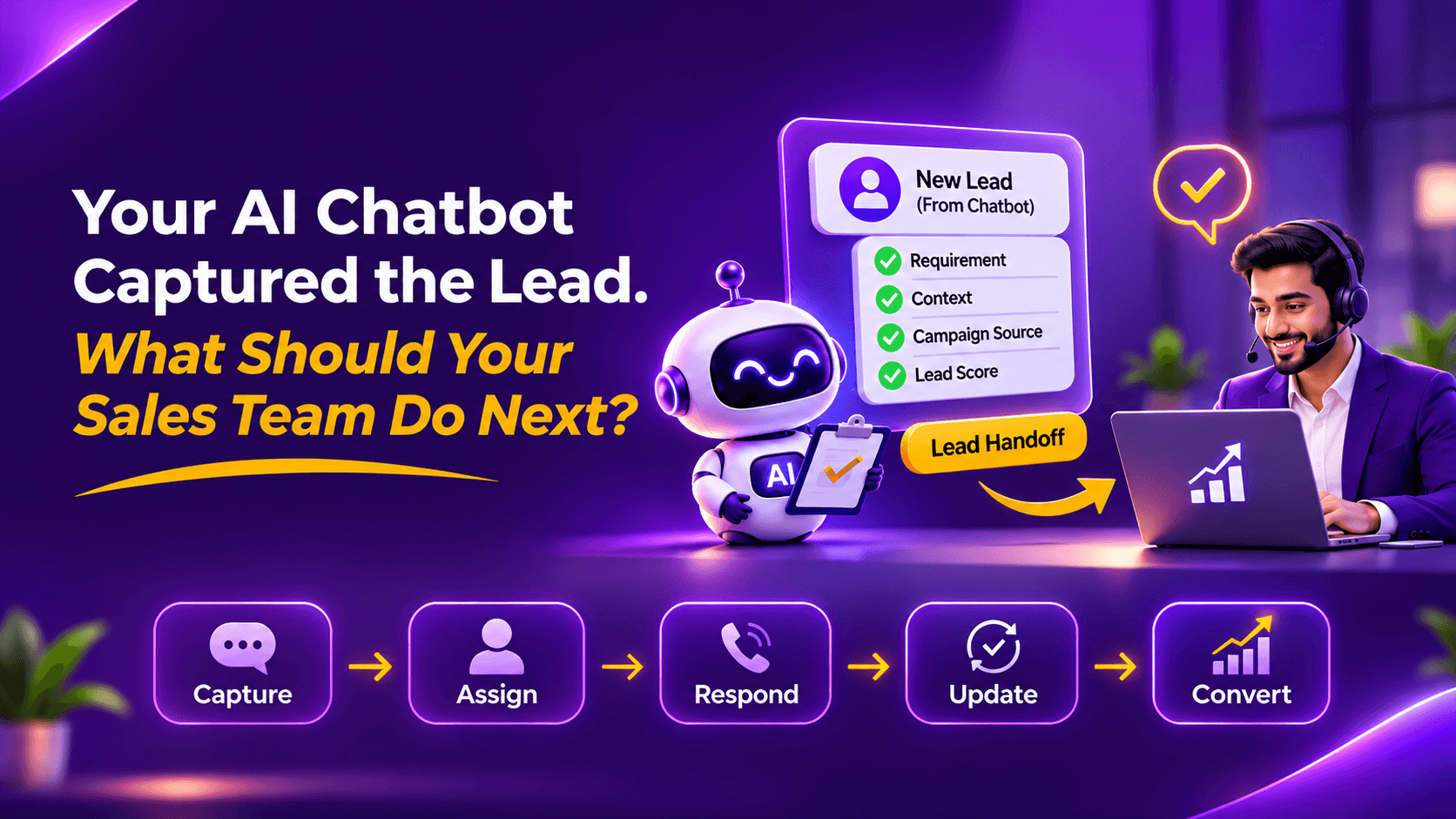
After an AI chatbot captures a lead, the sales team should review the visitor's requirement and conversation context, assign an owner, choose the appropriate response channel, follow up within a realistic agreed timeframe and record the outcome. High intent enquiries may deserve faster attention, while exploratory visitors may need a helpful resource and a later check in. The objective is not to call every captured number immediately. It is to continue the conversation in a way that makes sense to the person who started it.
This is where an apparently successful chatbot programme can quietly lose its value. A website visitor asks sensible questions, shares contact details and explains a genuine need. The assistant does its job. The record reaches an inbox. Then nothing happens. Or a salesperson calls and asks the visitor to repeat every detail.
The technology captured a lead. The business failed to continue the conversation.
A lead is a handoff, not a result
A useful way to think about website enquiries is as a relay. The chatbot handles the opening conversation. It may answer approved questions, learn what the visitor wants and capture relevant context. Sales then takes responsibility for the part that requires judgement, advice, negotiation or a human relationship.
The point where responsibility changes hands is often less visible than the chatbot itself. Companies invest time refining greetings and qualification questions, but leave the receiving team with no clear ownership, no response policy and no feedback loop. The result is a polished front end attached to an unreliable process.
MagicFlow AI's published features describe lead capture, source attribution, scoring and routing. Those capabilities can make a handoff more informative. They do not remove the need for human accountability, and the available routing channels depend on configuration and plan. The system must be designed as one connected journey, from the visitor's question to the outcome that follows.
What a salesperson should receive with each chatbot lead
Imagine that a prospect on a website says: "We are an education business receiving a lot of enquiries, but our counsellors spend too much time calling people who are not eligible. Can someone explain how this would work?"
A useful handoff is more than a name and phone number. It should allow the representative to start with the problem the visitor has already described.
| Lead field | Why it matters |
|---|---|
| Visitor and permitted contact method | Allows an appropriate response |
| Question or stated requirement | Prevents a generic opening call |
| Relevant product or service | Helps route to the right specialist |
| Page and campaign context, if available | Explains what brought the visitor in |
| Timing or urgency, if provided | Guides response priority |
| Conversation summary or transcript access | Preserves nuance and previous answers |
| Assigned owner and status | Makes the next action accountable |
| Consent and contact preferences | Helps respect the person's choice |
Step 1. Acknowledge the request before trying to sell
The first response should reassure the visitor that the conversation has been understood. It need not be long. A message might say: "Thank you for discussing your admissions enquiry process with us. I can see that your main concern is helping counsellors focus on eligible enquiries. Would a brief call tomorrow be convenient?"
Compare that with: "Hello, you filled a form on our website. What are you looking for?" The second message discards the context that the customer has already provided. It makes the business sound disorganised.
The acknowledgement should use only information the visitor actually shared. Do not manufacture familiarity, refer to details from unrelated sources or pretend that a human personally reviewed the conversation when that is not true. If a message is automated, it can be clear and natural without disguising its origin.
Step 2. Assign one owner, even if several teams are involved
A lead without an owner is a task waiting to be forgotten. In a small company, ownership may sit with one sales executive. In a larger organisation, an enquiry may be routed by product line, geography, language or account type. Either approach works when the rules are documented.
Create a primary owner, a backup and an escalation rule. A new lead should not spend hours in a shared inbox while colleagues assume someone else will call. If the primary owner is absent, another person needs a way to claim the task.
Where two teams are involved, clarify the sequence. Marketing may be responsible for campaign quality. Sales is responsible for timely contact and commercial progression. Customer support may handle existing customer issues. A website chatbot can encounter all three, so routing should be based on the request rather than forcing everything into sales.
Keep the ownership visible in whatever system the team uses. A CRM is useful, but even a structured lead register can support the basic discipline if statuses and responsible people are clear.
Step 3. Prioritise by need, not by noise
Not every chatbot enquiry should trigger an immediate sales call. A person asking for an urgent quotation is in a different situation from a student collecting information for a course next year. The response should reflect that difference.
Lead scoring can help arrange the queue, but it is not a substitute for judgement. MagicFlow AI already has a detailed guide to lead scoring. The operational question here is simpler: once a signal reaches sales, what action should it produce?
| Enquiry type | Sensible next action | Important caution |
|---|---|---|
| Explicit callback or demo request | Assign promptly and confirm a suitable contact time | Do not promise a call you cannot deliver |
| Clear need with near term timing | Route to the relevant specialist with context | Check actual fit before giving a quotation |
| Relevant but exploratory question | Send a useful answer or resource and offer a later discussion | Do not treat interest as consent to repeated calls |
| Support or complaint | Route to support with conversation history | Do not turn a service issue into a sales pitch |
| Unclear or incomplete request | Ask for missing context only when needed | Do not infer urgency from a score alone |
Step 4. Continue the visitor's language and preferred channel
A visitor who chose email may not appreciate an unexpected phone call. Someone who asked for a callback should not be sent a long marketing brochure instead. The next interaction should honour the contact method and next step offered during chat.
Language continuity matters too. A visitor may have been comfortable discussing a requirement in Hindi or Marathi. If the chatbot promises that the team can continue in that language, the handoff process should account for it. Do not market multilingual conversation as though it automatically guarantees multilingual human support.
The first message should contain the visitor's own problem in a short, recognisable form. A helpful response might be: "You mentioned that your team receives too many general enquiries and wants to focus on more suitable prospects. I can walk you through what information we would capture and how it reaches your counsellors." That sounds like someone has listened.
Step 5. Turn the handoff into a concrete next step
"Follow up soon" is not a task. A task needs an owner, a due time, an action and a status. Record whether the next step is a call, a written answer, a quotation, a scheduled demonstration or a request for additional information.
Where an appointment is agreed, confirm the day, time zone and agenda. If a proposal is promised, record what the proposal must cover and who will prepare it. If the visitor is not ready to speak, record a suitable time or reason to reconnect, subject to their preferences and permission.
A good CRM pipeline should tell the team what happened after the chatbot, not merely that a chat occurred. Consider a simple set of statuses: new, assigned, contacted, meeting planned, qualified opportunity, not suitable, and closed. Use labels that match your existing sales process rather than adding an elaborate system because a template suggested it.
Do not interpret "contacted" as proof of progress. An unanswered call and a productive discussion are different outcomes. Record the distinction so marketing and sales can learn what is actually happening.
Step 6. Follow up with value, not repetition
A follow up is easier to welcome when it advances the original conversation. The next message might answer the question that remained unresolved, share an approved product page or explain what the consultation will cover.
A short email could read: "You asked whether the website assistant can capture programme interest before a counsellor calls. It can be configured to ask approved qualification questions and pass the answers to your team. If helpful, we can review your existing enquiry flow and discuss the fields your counsellors need." This is relevant without promising results that have not been demonstrated.
If there is no response, decide on a restrained follow up sequence and stop when the visitor opts out. Repeated messages that ignore the customer's preferences can turn a useful chatbot experience into an unwanted sales campaign.
The objective is to create a coherent relationship between the first digital conversation and the first human one. That continuity is often more persuasive than an aggressive sales script.
Step 7. Close the feedback loop with marketing and the chatbot team
Sales can see problems that a website dashboard cannot. The chatbot may capture a high volume of contacts, but perhaps the visitors are outside the company's service area. Or it may ask one question that causes good prospects to abandon the conversation. Perhaps the team needs a different field to prepare an accurate quotation.
Create a short weekly review involving the people who run campaigns, maintain chatbot content and work the leads. Review a sensible sample of conversations and outcomes, with appropriate privacy controls. Ask three questions: which enquiries were useful, where did the journey break, and what is one change worth testing?
Feedback should result in a specific adjustment. If enquiries regularly arrive without a service category, improve that question. If people ask about an unavailable product, correct the knowledge source. If sales is missing calls, fix ownership or capacity before rewriting the chatbot's greeting.
Avoid changing multiple settings at once. Otherwise, you may see a different outcome without knowing what caused it.
What to measure after the first conversation
If your dashboard reports only the number of chatbot leads, it tells you something about capture but very little about commercial value. Start with a measurement chain that follows the same enquiry through its next stages.
| Measure | Working definition |
|---|---|
| Captured enquiries | Conversations that produced a valid next step and contact method |
| Sales accepted leads | Enquiries the receiving team considers relevant and actionable |
| Time to first meaningful response | Time from capture to a useful human reply, not merely a notification |
| Contact success | Whether the person was actually reached |
| Meetings or consultations held | Agreed conversations that really took place |
| Opportunities created | Enquiries that meet the business's opportunity definition |
| Closed outcomes | Sales or other agreed outcomes linked back to the original lead |
Keep definitions consistent
Choose definitions that fit your business and document them. If "sales accepted" changes meaning every month, the trend will not be reliable. If a lead can enter the system multiple times, decide how duplicates will be handled.
Source attribution can make this analysis more valuable. It may reveal that one campaign sends many conversations while another sends fewer but more suitable enquiries. However, attribution should be interpreted alongside lead quality and outcomes, not treated as an automatic judgement about individual visitors.
For a simple management review, look at both numerator and denominator. Suppose a business captures 100 enquiries and 30 are accepted by sales. Its sales acceptance rate is 30 percent under that definition. If an improvement raises captures to 140 but accepted leads stay at 30, the business has not necessarily improved its pipeline. These figures are hypothetical examples, not measured MagicFlow AI results.
A worked example: from website question to useful consultation
Imagine a manufacturing supplier. A visitor arrives through a campaign promoting a particular component. The visitor asks whether it is suitable for an application and what information would be needed for a quotation. The assistant provides approved product guidance, explains that final suitability must be confirmed by the technical team, and asks whether the visitor would like someone to review the requirement.
The visitor agrees and provides a permitted contact method, the intended application and a timeframe. The lead record now has enough context to be useful, but the company still needs to act.
The commercial team assigns the enquiry to a technical sales specialist. That person reviews the conversation, notices that one specification remains unclear and replies: "Thank you for outlining the application. Before we quote, could you confirm the operating temperature range? I can then have our technical team review the suitable options." The reply advances the conversation without pretending that the specification has already been verified.
After the visitor responds, the specialist confirms the next action and updates the lead status. Marketing later sees that the campaign generated a genuine technical enquiry. The chatbot team sees which technical questions were answered well and which required escalation.
This is the kind of connected process that creates value. The assistant does not have to close the sale. It has to make the first human conversation better.
Three useful first response templates
A visitor requested a demonstration
"Thanks for your interest. I can see you are exploring how this would work for your team. Would you prefer a short call or a demonstration? If you share a convenient time, we can arrange the next step."
A visitor asked a question that needs a specialist
"You asked about [specific requirement]. I do not want to give you an incomplete answer. I have passed your question to the relevant team so they can check the details. We will respond through the contact method you selected."
A visitor is researching but not ready to buy
"Thanks for explaining what you are planning. Here is a resource on [relevant topic] that may help you compare options. If you want to discuss your situation later, you can reply when it suits you."
The mistakes that lose value after lead capture
The first mistake is assuming that receiving the notification is the same as contacting the visitor. The second is calling without reading the conversation. The third is assigning every enquiry equal urgency. The fourth is recording a lead as converted because it reached a meeting calendar, without checking whether the meeting happened.
Another common mistake is blaming lead quality for what is actually a follow up problem. If suitable prospects are not reached, a new chatbot greeting will not solve staffing or ownership. Conversely, if sales repeatedly receives irrelevant enquiries, the qualification and campaign messaging may need attention. Diagnose the right part of the journey before changing the software.
Finally, do not treat silence as permission to persist indefinitely. Good sales follow up balances commercial diligence with a visitor's preferences. A clear opt out process and responsible contact policy protect the relationship you are trying to create.
A thirty day operational improvement plan
Days 1 to 7: make the handoff visible
Map where chatbot leads are delivered, assign owners, agree on statuses and test whether the sales team receives conversation context. Confirm the difference between an alert and a completed contact.
Days 8 to 14: improve the first response
Review a sample of real messages. Replace generic openings with ones that acknowledge the visitor's actual requirement. Set realistic internal response targets for different enquiry types.
Days 15 to 21: fix recurring gaps
Identify missing fields, unclear questions, routing errors and common information requests. Make a limited number of changes to the chatbot, knowledge sources or ownership rules.
Days 22 to 30: review outcomes
Compare captured leads, sales accepted leads, successful contacts and meetings held. Discuss differences with marketing and sales. Document one or two next experiments rather than changing everything at once.
The exact timeline can be adjusted to enquiry volume. A small business with ten leads a month should be careful about drawing big conclusions from a few conversations. A larger business may have enough volume to segment by campaign or service category. Either way, operational clarity should come before elaborate dashboards.
The real conversion moment comes after the notification
A visitor does not experience your website, chatbot and sales department as three separate systems. They experience one business. If the assistant appears helpful but the next person has no context, that single experience breaks down.
The right goal is not maximum chatbot activity. It is continuity: from the first useful answer, to a qualified enquiry, to a thoughtful human response, to a measurable outcome. MagicFlow AI can provide the conversational and routing foundation. The business must supply ownership, judgement and follow through. For a broader view of the capture side, see our guide to the AI chatbot for lead generation.
That is how a captured lead becomes the beginning of a better sales conversation, rather than one more name in a crowded inbox.
- MagicFlow AI, Features https://www.magicflowai.io/features
- MagicFlow AI, AI Lead Scoring in India https://www.magicflowai.io/blog/ai-lead-scoring-india
- MagicFlow AI, AI Chatbot for Lead Generation in 2026 https://www.magicflowai.io/blog/ai-chatbot-for-lead-generation-2026
Common questions from this article.

Chief Marketing and AI Officer (CMAIO), MagicWorks IT Solutions
Mohan Chute is Chief Marketing and AI Officer at MagicWorks IT Solutions, with 23+ years across go-to-market strategy, technology, and digital transformation. He built and scaled MagicFlow AI from concept to client deployment and pioneered the agency's AEO/GEO practice, helping brands earn visibility in AI-generated answers across ChatGPT, Perplexity, and Gemini.