The economics of attention, applied to a website
Simon's core claim, that an abundance of information consumes the attention of whoever must process it, and therefore creates a need to allocate that attention efficiently, describes almost exactly what happens when a visitor lands on a typical SME website.
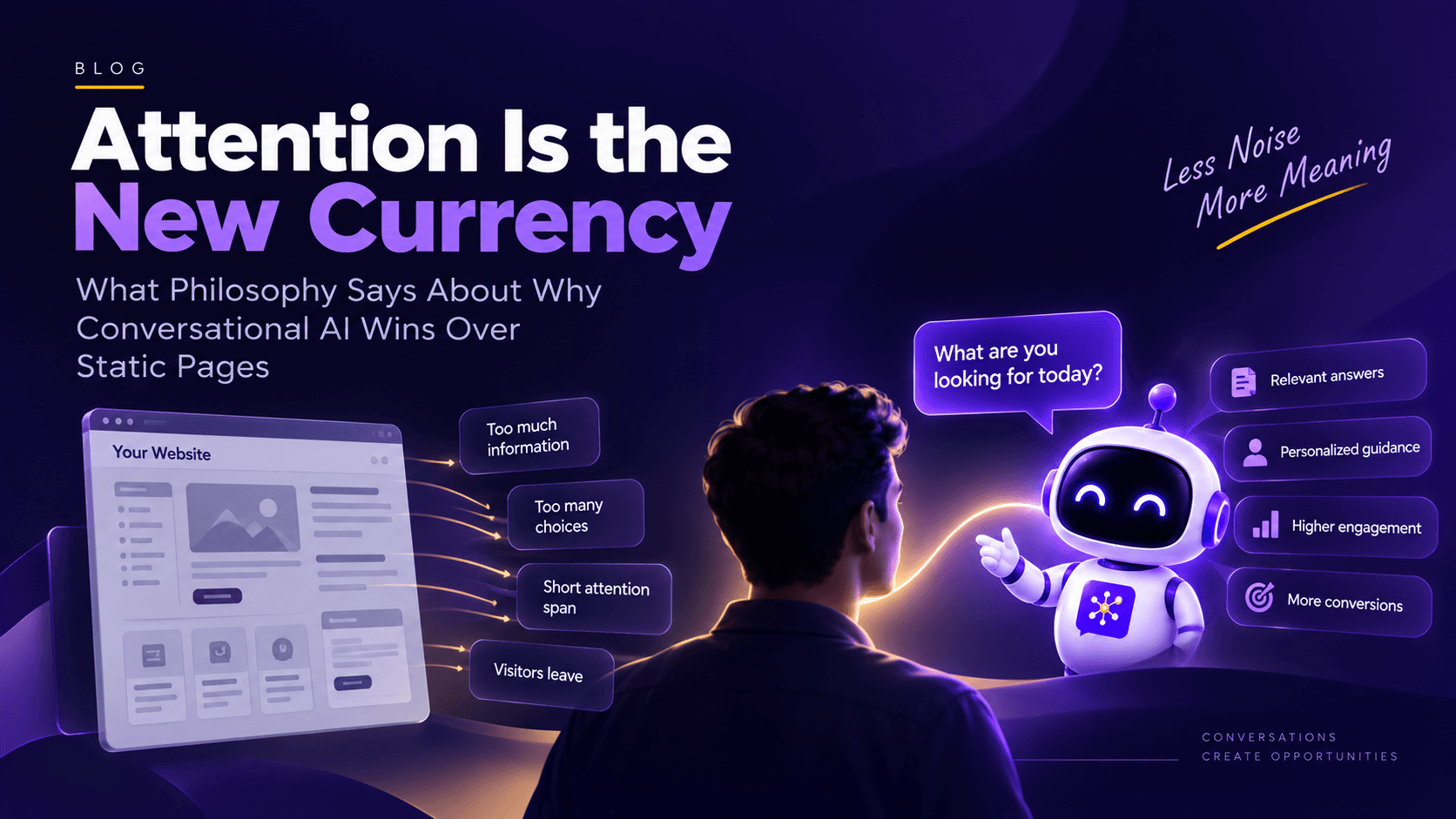
A homepage today often carries a hero banner, a navigation bar with a dozen links, a features grid, a testimonials carousel, a pricing table, and a contact form, all competing for the same visitor's attention within the same few seconds. This is information wealth in Simon's precise sense, more content, more choices, more paths, and the direct consequence is a poverty of attention: the visitor cannot process all of it, so they process almost none of it, and they leave. Average time on a web page across industries sits at around 54 seconds, and bounce rates for many page types run between 26 and 70 percent depending on the site.
A static page, by design, asks the visitor to do the work of finding what matters within all of that information. It is built to present everything at once and let the visitor allocate their own scarce attention across it. Philosophically, that is an extractive design, it takes attention rather than earning it, because it offers no mechanism to filter or prioritise on the visitor's behalf.
A static page does not fail because it says the wrong thing. It fails because it hands the visitor a filing cabinet and asks them to find the one page they came for, using a resource they do not have to spare.
Conversational AI as an attention allocation mechanism
An AI based chatbot works on the opposite principle. Instead of presenting the full wealth of information at once and asking the visitor to allocate their own attention across it, it asks a single question, listens to the answer, and returns exactly the slice of information relevant to that specific visitor's specific need.
This is not a stylistic choice. It is, in Simon's own framing, an information processing system, precisely the kind of solution Simon proposed in that same 1971 essay for managing an information rich environment: a system built specifically to condense the surrounding wealth of information down to what a given recipient's limited attention can actually use. A static page burdens the visitor with the job of filtering. A well built AI chatbot does the filtering for them, in real time, based on what they actually say they need.
The measurable outcome of this shift lines up with the philosophy exactly. AI based chatbots convert engaged visitors into leads at 10 to 25 percent, several times the 1 to 3 percent that static pages relying on a form typically achieve, not because chat is a novelty, but because it solves the actual scarcity, attention, rather than adding to the actual abundance, information, that was already overwhelming the visitor.
| Static page | AI based chatbot | |
|---|---|---|
| Who does the filtering | The visitor, using the scarce resource they arrived with. | The system, in real time, based on what the visitor says they need. |
| What is presented | Everything at once: banner, navigation, features, testimonials, pricing, form. | One question, then only the slice of information that answers it. |
| What it does to attention | Taxes it. Every extra field and banner is a charge against a shrinking budget. | Spends it. One exchange, aimed at the reason the visitor came. |
| Typical lead conversion | 1 to 3 percent for a page relying on a form. | 10 to 25 percent of engaged visitors. |
Why this only holds for a genuinely AI based system
There is a specific philosophical trap here worth naming directly. A script based or rule based chatbot does not solve the attention scarcity problem, it disguises it. Behind a friendly chat window, a rule based system is often still presenting the visitor with a fixed menu of pre written options, effectively the same wealth of pre-decided information a static page presents, just delivered one screen at a time instead of all at once. When the visitor's actual need falls outside that fixed menu, the system fails, and the promise of a filtered, attention respecting experience collapses. Research into poorly implemented automated chat found failure rates nearly 4 times higher than other AI applications specifically because of this mismatch between what the interface promises and what the underlying system can actually deliver.
A genuinely AI based chatbot, built on a language model capable of understanding open ended language and retrieving grounded answers from a business's real content rather than a fixed script, is what allows the philosophy to actually hold. It can respond to the specific, unpredictable way a real visitor phrases a real need, which means it is actually allocating attention on the visitor's behalf, rather than simply hiding a static menu behind a conversational costume.
Attention as the new currency, not a metaphor
Describing attention as a currency is not simply a rhetorical flourish borrowed from marketing writing. Simon's original argument was explicitly economic: attention behaves like any other scarce resource, it must be allocated efficiently, and whatever mechanism does that allocation most efficiently captures the greatest share of it. In a genuinely competitive attention economy, the business that spends the visitor's attention most efficiently, giving them exactly what they came for with the least unnecessary information in between, is the business that keeps that attention long enough to convert it into a relationship.
This reframes what a website redesign, or a chatbot rollout, is actually for. It is not decoration. It is a direct intervention in how efficiently a scarce resource, the visitor's attention, gets allocated the moment they arrive. Every unnecessary field, every irrelevant banner, every extra click required before a visitor gets an answer to their actual question is a small tax on an already scarce resource, and static pages, by their very structure, tend to over tax it.
The ethical dimension: earning attention vs extracting it
There is a distinction worth drawing out further, because it separates a genuinely useful conversational AI from a merely aggressive one. Much of the modern criticism of the attention economy, from writers examining how digital platforms are designed to capture and hold attention for its own sake, treats attention capture itself as ethically fraught. Infinite scroll, autoplay, and notification design are built to extend attention beyond what the user actually needs, extracting more of a scarce resource than the exchange genuinely warrants.
A business chatbot sits on different ground, but only if it is built with the same restraint Simon's framing implies. The goal of an AI based chatbot for lead generation is not to hold attention indefinitely, it is to resolve the visitor's need as efficiently as possible, capture the relevant details, and let the visitor go, ideally satisfied rather than depleted. A chatbot designed to prolong conversation artificially, padding responses or delaying an answer to increase engagement metrics, would be repeating the extractive pattern Simon's philosophy warned against, simply in a new format.
The measure of a well designed conversational system is not how long it holds a visitor's attention, but how little of that attention it needs to spend before delivering real value.
What this means for MagicFlow AI's design philosophy
MagicFlow AI is built around this exact principle of attention efficiency rather than information abundance. Instead of adding another banner, another form, or another page a visitor has to navigate, it meets the visitor with a single, direct question the moment they arrive, and lets the conversation itself determine which of a business's many features, plans, or answers are actually relevant to that one visitor, in that one moment.
Because the system is grounded in a retrieval based knowledge system built from the business's own website and documents, it can answer the specific, unpredictable question a visitor actually asks, rather than forcing that visitor to filter through a homepage's entire information wealth themselves. This is the philosophical difference between a static page and a genuinely AI based conversational layer: one adds to the information a visitor must process, the other spends the visitor's attention on their behalf, efficiently, and only once.
The takeaway
Herbert Simon's philosophy, written more than fifty years before the first AI chatbot existed, describes precisely why static pages are losing ground to conversational AI today. Information is abundant and getting cheaper to produce. Attention is scarce and getting scarcer.
A website that keeps adding more information to an already overloaded page is taxing a resource it cannot afford to spend carelessly, while a genuinely AI based chatbot spends that same scarce attention efficiently, on behalf of the one visitor standing in front of it. That is not a design trend. It is basic economics, applied to the one currency every website is actually competing for.
- Oxford Reference, Herbert A. Simon, Designing Organizations for an Information-Rich World https://www.oxfordreference.com/display/10.1093/acref/9780191843730.001.0001/q-oro-ed5-00019845
- Íñigo Medina, Herbert Simon: a wealth of information, a poverty of attention https://inigomedina.co/post/07-29-herbert-simon-una-riqueza-de-informacion-una-pobreza-de-atencion
- Contentsquare, The average time spent on websites: 3 tips, citing Dr Gloria Mark's attention span research https://contentsquare.com/blog/average-time-spent-on-websites-is-dropping/
- Umbrex, Average Time on Website Page Analysis https://umbrex.com/resources/ultimate-guide-to-company-analysis/ultimate-guide-to-marketing-analysis/average-time-on-website-page-analysis/
- HostingAdvice, Average Website Bounce Rate https://www.hostingadvice.com/how-to/average-website-bounce-rate/
- Wonderchat, The B2B Website Conversion Benchmark Report 2026 https://wonderchat.io/blog/b2b-website-conversion-report-2026
- Conferbot, Chatbot vs Forms: Which Gets More Leads? 2026 https://www.conferbot.com/blog/chatbot-vs-forms
- wpseoai, What is the conversion rate of chatbots? https://wpseoai.com/blog/what-is-the-conversion-rate-of-chatbots/
- Wonderchat, citing Qualtrics 2026 AI customer service failure rate research https://wonderchat.io/blog/b2b-website-conversion-report-2026
Common questions from this article.

Head of Digital Marketing, MagicWorks IT Solutions
Purva Desai is the Head of Digital Marketing at MagicWorks IT Solutions, bringing 16 years of experience across visual arts and digital strategy. A trained artist with a Master's in Visual Art and a background in art therapy, she began her career as a graphic designer, later working as an Art Director before moving into performance marketing, SEO, and brand strategy. This dual foundation, art and analytics, shapes how she approaches marketing: understanding not just what drives clicks, but what drives human perception and emotion. She now leads MagicWorks' digital marketing department, writing on AI, buyer psychology, and the evolving intersection of creativity and data in marketing.